

Embarkation day with Virgin Voyages is designed to feel more like the start of a boutique hotel stay than a traditional cruise. Even so, there are key timings, procedures and transport details that can make the difference between a smooth sail away and a stressful rush. This guide walks you through Virgin Voyages embarkation, boarding and transfer options so you know exactly what to expect from airport to cabin door.
Understanding Virgin Voyages Embarkation Basics
Virgin Voyages positions embarkation as a relaxed beginning to the holiday, but there is still a clear structure behind the experience. Every guest, called a Sailor, is given a Terminal Arrival Time during online check in. This is the time the line expects you to arrive at the port to complete security and check in formalities, and it is the single most important timing to plan your day around.
General boarding typically begins at around 2:15 pm in the homeports Virgin Voyages uses, though the exact process can vary slightly by sailing and port. Sailors with certain priority benefits, such as suite guests or those with specific add on packages, may be able to board earlier than the standard window. Even if you see people entering the terminal before your slot, staff can and do ask you to wait if you are significantly early, so it is worth working backwards from your assigned time when planning flights and transfers.
Virgin Voyages strongly recommends arriving in the departure city at least one day before embarkation, especially for international routes or during seasons with weather related flight disruption. If you must fly in on the same day, aim for a flight that lands by early afternoon at the latest. This gives you time to collect bags, travel to the port and handle any minor delays while still making your checked Terminal Arrival Time.
Unlike some traditional cruise lines that open boarding in the late morning, Virgin Voyages leans into later afternoon arrivals and a more staggered flow of Sailors through the terminal. That means there is usually no need to rush to the port first thing in the morning, and you can plan a relaxed check out from your hotel and a leisurely lunch before heading to the ship.
Online Check In, The App and Required Documents
The Virgin Voyages app is central to the embarkation experience. You will use it to complete online check in, select or confirm your Terminal Arrival Time, upload travel documents and, closer to sailing, complete a brief health questionnaire. Check in normally opens well ahead of time, and the line suggests finishing it at least two weeks before your voyage so any issues can be resolved long before you reach the port.
During the digital check in, you will be asked for passport details and, if applicable, visa information. Virgin Voyages generally expects passports to be valid for at least six months beyond the end of your voyage, in line with common international travel rules. Exact entry and visa requirements vary by nationality and itinerary, so it is important to verify these with official government guidance rather than relying solely on cruise materials or informal advice.
Within 24 hours of sailing, the app will prompt you to complete a short health check. This is typically a simple confirmation that you are fit to travel and not experiencing specific symptoms of concern. If for any reason you cannot access this portion of the app, terminal staff can usually review or complete the same questions in person during check in. It is still ideal to fill it out in advance when possible, as it can speed your movement through the terminal.
On embarkation day, you should arrive at the port with your passport, any required visas, your Virgin Voyages booking details and a payment method already linked in the app or ready to be added at check in. Most Sailors will receive a wearable wristband, known as The Band, which doubles as your room key and onboard charge method. Even though much of the process is digital, having printed copies of your booking confirmation and flight details can be helpful if there are connectivity issues at the port.
Ports, Terminals and Arrival Logistics
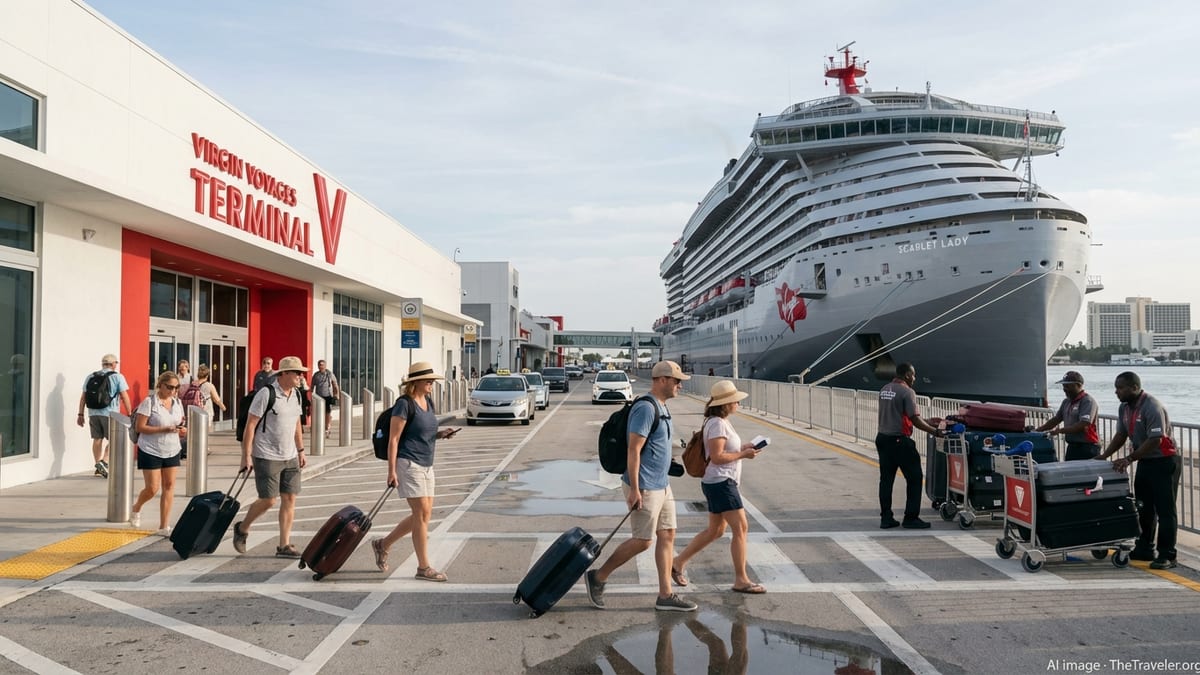
Virgin Voyages operates from a small number of primary homeports, each with its own dedicated or regularly used terminal. In Miami, for example, Virgin uses its purpose built Terminal V at PortMiami, located along North Cruise Boulevard close to the main cruise complex. In Barcelona, ships typically use the World Trade Center area on Moll de Barcelona, while in Piraeus for Athens departures the line works from one of the main passenger terminals depending on the sailing. In San Juan, Puerto Rico, ships commonly use Pier 4 in Old San Juan, a walkable distance from the historic district and many hotels.
The exact check in flow differs a little from port to port, but the structure is broadly similar. On arrival, porters will take checked luggage from the curbside or nearby drop zone, tag it and send it to the ship. You then proceed into the terminal with your hand luggage to go through security checks and embarkation formalities. Bags are later delivered to your cabin corridor, typically in the late afternoon or early evening, so anything you need for the first few hours on board should stay with you.
Because Virgin assigns Terminal Arrival Times, the line aims to avoid long standing queues outside the building, but at peak moments you may still see some lines form, especially just before general boarding opens. There is usually a separate queue or seating area for Sailors with priority boarding access such as RockStar Quarters guests or those with eligible loyalty and add on benefits. Clear signage and staff on the curb and in the terminal will direct you to the correct entrance for your status and assigned time.
Many Sailors choose to head directly from their hotel to the port after a late morning check out, arriving slightly before their official slot. In practice, Virgin Voyages staff can be flexible by a short margin, particularly if terminal crowds are light. Arriving extremely early with a significantly later assigned time, however, can still result in being asked to wait outside or in a holding area until your window opens, so it is usually better to spend that time enjoying the departure city instead.
Airport Transfers, Ride Shares and Independent Transport
Virgin Voyages periodically offers airport to port transfers that can be added to your booking, particularly in major homeports such as Miami and Barcelona. These are typically shared coach shuttles or similar services that operate within a defined arrival window from specific airports to the cruise terminal. Timings and pricing can change by season and itinerary, and availability sometimes closes in the weeks leading up to a sailing when capacity is reached.
If you choose to book a cruise line shuttle, the main advantage is simplicity. Your flight details are tied to your transfer, port staff know to expect you and, if there are operational delays affecting multiple Sailors, the line can often coordinate adjustments for the entire group. The tradeoff is less flexibility, as shuttle departure windows are fixed and you may have to wait at the airport for other guests to arrive before leaving for the port.
Many Sailors instead opt for taxis or ride share services between the airport, hotels and the terminal, especially in cities with dense networks such as Miami. This offers more control over your timing and can be cost effective for couples or small groups. If you choose ride shares, it is wise to build in extra buffer time around peak traffic hours, and to double check the exact port and terminal name before setting off, since large cruise ports often have multiple terminals spread over several piers.
For those staying in hotels near the port, some properties offer shuttle services to the terminal on embarkation day, either included in the room rate or at a small surcharge. These can be convenient yet may operate only at specific times, so confirm the schedule in advance and ensure it fits comfortably with your assigned Terminal Arrival Time. If a hotel shuttle leaves much earlier or later than your slot, it can still make sense to use a taxi or ride share to stay aligned with Virgin Voyages timing expectations.
Priority Boarding, Special Packages and Accessibility
Not every Sailor boards at the same time. Virgin Voyages offers priority boarding to certain cabin categories and to guests who hold specific promotional or loyalty benefits. RockStar Quarters and Mega RockStar Quarters, the line’s top suites, generally receive the earliest access to the terminal and the ship, often in a dedicated queue or lounge area. Other benefits programs and packages can also come with earlier arrival windows, though these can change over time, so it is always best to review the latest details in your booking documents.
Some add on packages have, at times, included priority boarding or earlier access to the ship. In those cases, the perk may not always display explicitly as an earlier Terminal Arrival Time in the app, which can be confusing. If your confirmation materials mention priority boarding and the app does not clearly reflect it, mention this at the terminal entrance, have the relevant section visible in your app or booking, and staff can usually route you into the appropriate queue.
Virgin Voyages also emphasizes accessibility support for Sailors who need it. If you require wheelchair assistance in the terminal, need extra time to move through security or have any other mobility, sensory or medical requirements, you are encouraged to complete a special services or accessibility form well before sailing. This allows the line to plan for support staff and equipment on embarkation day. On arrival at the port, there are usually clearly marked points where you can request assistance if it has not already been prearranged.
Regardless of status, one consistent rule is that you should still aim to arrive close to your advised time. Priority or not, turning up hours late without communicating with the line can reduce the benefits you receive and, in rare cases, put your boarding at risk if you cut close to the final check in deadline. If travel disruption is likely to make you late, Virgin Voyages publishes contact details for embarkation day assistance so you can notify them as soon as possible.
What To Expect Inside the Terminal
Once you enter the terminal after dropping checked luggage, the embarkation process runs through several distinct stages. First is security screening that is similar to airport style checks, though generally a little more relaxed in pace. Your hand luggage passes through an X ray scanner and you walk through a metal detector or similar device. Restricted items that are not permitted on board, such as certain electrical appliances or beverages above limited allowances, may be flagged at this stage and either held or refused.
After security, you proceed to the check in area where Virgin Voyages staff verify your identity, review your travel documents, confirm your method of payment and complete any remaining health or travel questions. At this point you typically receive your wearable Band if you do not already have it, along with any printed embarkation material. The process can be relatively quick if your online check in was fully completed, but times vary depending on crowd levels when you arrive.
When check in is finished, you move to a waiting lounge area until your boarding group is called. Priority groups, such as RockStar suites and other eligible Sailors, are usually invited to board first. General boarding follows in waves. The style of the waiting area differs by port, but most modern terminals offer comfortable seating and restrooms, with some providing views of the ship from large windows, which helps build the sense of anticipation as your embarkation time approaches.
Just before you step on board, you will pass through one final checkpoint, where crew verify your boarding pass and Band. Once you cross the gangway you are officially on ship time, and crew members are on hand to welcome you and point you toward cabins, dining venues or lounges. Cabin access times vary by ship and sailing, but even if your stateroom corridor is not yet open, restaurants and many public areas typically are, so you can relax with a drink or a bite to eat while waiting for your luggage to arrive.
Boarding Day Timing, Luggage and First Few Hours On Board
Virgin Voyages generally begins letting priority Sailors on board slightly ahead of the main 2:15 pm general boarding time, gradually scaling up the number of passengers entering the ship as the afternoon progresses. Final boarding often sits around late afternoon, though exact cutoffs depend on port regulations, sailing time and local immigration procedures. The key is that you should always treat the time printed on your boarding materials as the authoritative reference and allow generous buffers around it.
Your checked luggage usually arrives outside your cabin door anywhere from mid afternoon to early evening, depending on when you boarded and where your stateroom is located. If you plan to swim, visit the spa, change clothes for dinner or freshen up shortly after arriving, it is smart to pack a small carry on bag with essentials, including swimwear, medications, travel documents, a change of clothes and any valuables you do not want out of your sight.
As you settle in on board, the Virgin Voyages app becomes central again, now serving as your guide to restaurant availability, entertainment and shore excursion check ins. Many Sailors use the first afternoon to explore the ship at a relaxed pace, confirm or adjust dining reservations and enjoy a leisurely drink on deck as the ship prepares to sail. Mandatory safety drills are now often conducted in a more flexible format, where you watch or listen to safety information and then check in at a designated assembly point before departure, rather than gathering in a single mass muster.
If you encounter any issues during those first hours such as missing luggage, trouble with your Band or questions about your onboard account, the Guest Services or Sailor Services teams are available at the main lobby. Addressing small problems as soon as you notice them is generally easier than waiting until later in the evening, particularly on departure day when many of the key service teams are fully staffed and expecting a rush of common questions.
The Takeaway
Virgin Voyages treats embarkation day as the opening chapter of your voyage rather than a purely functional transfer from land to sea. With a digital first check in system, carefully managed Terminal Arrival Times and a relaxed afternoon boarding pattern, the line aims to remove much of the stress that can surround traditional cruise embarkation.
The simplest way to make the most of that approach is to work with the system rather than against it. Complete online check in early, confirm your passport and visa details well ahead of time, plan flights that land with a generous buffer, and choose airport or hotel transfers that align with your assigned arrival slot. If you qualify for priority boarding or need accessibility assistance, flag that early and be ready to mention it again at the terminal.
Once you understand the basic rhythms of Virgin Voyages embarkation, from the typical 2:15 pm general boarding start to the flow of luggage and the role of the app, you can focus less on logistics and more on the experience. Instead of spending the day anxiously guarding a suitcase in a crowded terminal, you will be free to savour a last coffee in the departure city, step onto the ship at the right time and begin your holiday in the relaxed, grown up style that Virgin Voyages is designed to deliver.
FAQ
Q1. What time does boarding usually start with Virgin Voyages?
General boarding for most Virgin Voyages sailings typically begins around 2:15 pm, with some priority groups boarding slightly earlier depending on the port and specific voyage.
Q2. How strict is Virgin Voyages about Terminal Arrival Times?
Terminal Arrival Times are used to stagger crowds and keep lines manageable. Staff can be flexible by a short margin, but arriving very early or significantly late can mean waiting or, in rare cases, tighter check in if you cut things close.
Q3. Should I fly into the departure city on the day of embarkation?
Virgin Voyages recommends arriving at least one day before sailing. If you must fly in on embarkation day, aim for a morning or very early afternoon arrival to allow for delays and transfer time to the port.
Q4. Do I need to complete the health check in the app before I can board?
The health check is typically available within 24 hours of sailing and is quick to complete. If the app does not allow you to finish it, terminal staff can usually handle any remaining questions in person during check in.
Q5. What documents do I need at the port?
You should bring your valid passport, any required visas for your itinerary, your Virgin Voyages booking details and a payment method linked in the app or ready to be added at check in.
Q6. Are airport transfers included with my Virgin Voyages booking?
Airport to port transfers are not automatically included. Virgin Voyages sometimes sells shuttle transfers as add ons, or you can use taxis, ride shares or hotel shuttles independently.
Q7. When will my luggage arrive at my cabin?
Checked luggage is collected curbside and delivered to your cabin corridor later in the day, typically between mid afternoon and early evening, depending on when it was dropped off and your cabin location.
Q8. How does priority boarding work on Virgin Voyages?
Priority boarding is generally offered to suite guests and some Sailors with specific benefits or packages. These guests are routed through dedicated check in lines or given earlier boarding groups ahead of general boarding.
Q9. What happens if my flight is delayed and I am running late?
If travel disruption makes it likely you will miss your advised arrival time, you should contact Virgin Voyages using the embarkation day assistance number in your documents so they know you are on your way and can advise next steps.
Q10. Can I go straight to my cabin as soon as I board?
Cabin access timing varies by sailing. Sometimes stateroom corridors open shortly after early boarding begins, while in other cases they open later. Public areas, lounges and many restaurants are usually available even if cabins are not yet ready.