

More news on this day
Passengers travelling between Visakhapatnam and Tirupati now have a more predictable option, as a previously special weekly service on the route has been regularised and added to the permanent timetable, offering consistent once-a-week connectivity between the coastal city and the Andhra Pradesh pilgrimage hub.
Get the latest news straight to your inbox!
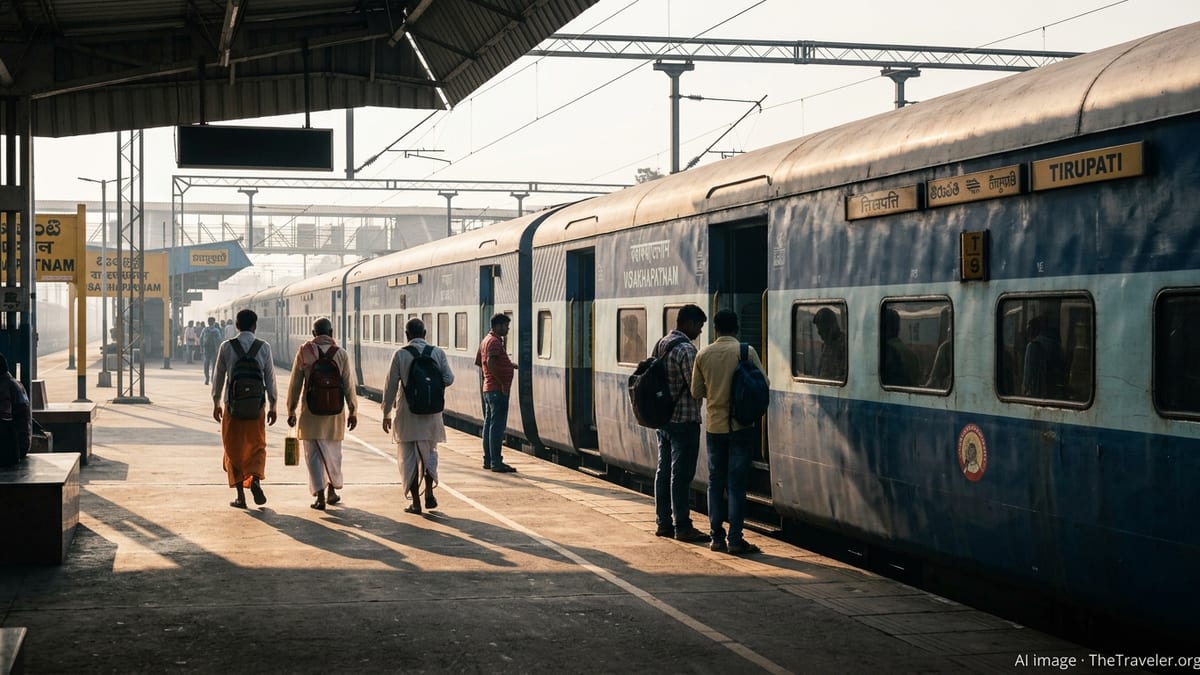
A Special Weekly Service Upgraded to the Regular Timetable
According to publicly available railway circulars and timetable updates, the Visakhapatnam–Tirupati weekly special, operated as train numbers 08583/08584, has been upgraded from a temporary "special" status into a regular service. This change means the train is now embedded in the standard timetable instead of being notified in short-term blocks, giving passengers clearer visibility and greater confidence when planning journeys weeks or months in advance.
Previously, the Visakhapatnam–Tirupati link was often scheduled as a Train on Demand or festival-oriented special, with periodic extensions and renewals. Such arrangements helped meet peak demand, particularly during religious seasons, but made long-range planning difficult. The regularisation marks a shift from ad hoc approvals to a fixed weekly slot, bringing the corridor in line with other established express services that already connect Visakhapatnam with major centres.
The move is part of a broader pattern in which Indian Railways has been converting frequently used special trains into regular express services once sustained demand is demonstrated. Rail forums and timetable repositories show that several seasonal or special services across different zones have recently been granted regular status after strong occupancy trends, indicating a system-wide effort to stabilise popular routes.
For Visakhapatnam and Tirupati, both key nodes in Andhra Pradesh’s transport network, the new status signals that the corridor has matured from an occasional special into an essential weekly link in the state’s regular passenger grid.
Route, Frequency and Likely Timings for the Weekly Link
Publicly available train information indicates that the service continues to operate as a weekly express between Visakhapatnam and Tirupati, maintaining its existing end-to-end route while transitioning into the regular timetable. As with most long-distance expresses from Visakhapatnam, the train is expected to follow the coastal trunk via important junctions in Andhra Pradesh before turning inland toward the Rayalaseema region and Tirupati.
Typical schedules on this corridor involve an overnight or long daytime run, capturing both pilgrims and general passengers who require through connectivity without multiple changes. While precise timings are set in the working timetable and subject to minor operational adjustments, the key difference after regularisation is not the clockface departure but the assurance that the train will occupy the same weekly slot from timetable to timetable, rather than being issued through short-term notifications.
Railway timetable aggregators show that weekly trains are usually slotted to avoid congestion around major junctions like Visakhapatnam, where platform capacity and locomotive changes can affect punctuality. By assigning the Visakhapatnam–Tirupati service a long-term, recurring path, schedulers can refine running times, turnaround windows and locomotive utilisation, which in turn can stabilise on-time performance.
Passengers are advised to refer to the latest official timetable or authorised booking platforms for exact departure and arrival times, as well as updated coach composition, which can change based on demand and seasonal travel patterns.
Boost for Pilgrimage, Education and Regional Connectivity
The regular weekly service is expected to be particularly significant for pilgrims travelling to the Tirumala-Tirupati temples, one of India’s busiest pilgrimage destinations. Tirupati sees heavy inflows from across Andhra Pradesh and neighbouring states, and Visakhapatnam, as a major coastal metropolis, generates consistent demand from devotees seeking a direct, reliable rail link to the temple town.
In addition to religious tourism, the route supports a steady stream of students and job seekers moving between Andhra Pradesh’s coastal belt and its interior educational and employment hubs. Regularisation of the weekly train reduces the need for circuitous routings and multiple connections via larger junctions, which can add both cost and uncertainty to travel plans.
Regional travel analysts note that adding fixed weekly services can help smooth passenger flows that were previously concentrated into irregular festival specials. A predictable once-a-week departure allows travellers to organise trips around assured availability rather than monitoring for the next round of special-train announcements.
The decision also strengthens intra-state connectivity at a time when Andhra Pradesh’s rail network is evolving, with new zones, upgraded trains and additional services being introduced to better link coastal districts, industrial centres and pilgrimage towns.
Operational Benefits: From Special Status to Stable Service
From the railway operations perspective, converting a special train into a regular weekly service can streamline planning for crew, rakes and maintenance. When a train is classified as a special, its continuance often depends on periodic approvals and ad hoc rake allocation, which can complicate long-term resource management. As a regular service, the Visakhapatnam–Tirupati train can be integrated into fixed rake links and crew rosters, improving utilisation and reducing last-minute changes.
Railway operations discussions and forum posts indicate that regular trains are typically given clearer pathing priority than one-off specials, which may have to wait for higher-priority services to pass. With a fixed weekly slot, the Visakhapatnam–Tirupati train can be sequenced more efficiently alongside other express services, potentially leading to more consistent running times and better adherence to schedule.
Regularisation also offers more clarity for intermediate stations along the route, which can now plan passenger handling, platform management and connecting local services around a known weekly arrival and departure pattern. This is particularly important at junctions where multiple long-distance trains converge and platform occupancy must be tightly managed.
Over time, stable weekly performance data from a regular service can help planners assess whether additional frequency is warranted, such as an extra weekly trip or an eventual upgrade to bi-weekly operations if demand justifies it.
What Passengers Should Know Before Booking
With the Visakhapatnam–Tirupati train entering the regular timetable, passengers gain the advantage of advance-booking windows that apply uniformly to regular express services across the network. This allows travellers to secure seats well ahead of key religious occasions, school terms or family events, rather than waiting for short-notice special-train announcements.
Published information indicates that the service is classified as an express train with reserved accommodation, and passengers can expect the usual mix of reserved classes that cater to different budget levels. Reservation status, waiting lists and dynamic demand patterns will now be governed by the standard rules that apply to comparable weekly express trains, providing a more predictable booking environment.
Travel planners recommend that passengers check for connecting options at both ends, as Visakhapatnam is a gateway for the wider north coastal Andhra region, while Tirupati connects onward to Tirumala and other towns through buses and local trains. The fixed weekly schedule makes it easier to coordinate such multimodal connections, particularly for groups and family travellers.
As the service completes more runs in its new regular avatar, patterns of occupancy, punctuality and class-wise demand are likely to inform future enhancements on the corridor, reinforcing the Visakhapatnam–Tirupati link as a dependable travel option in Andhra Pradesh’s evolving rail network.