

More news on this day
Volotea has secured a new four-year public service contract to operate and expand the Tarbes–Lourdes–Paris Orly route from June 2026, a move expected to significantly bolster tourism and pilgrimage traffic to the Marian shrine city of Lourdes.
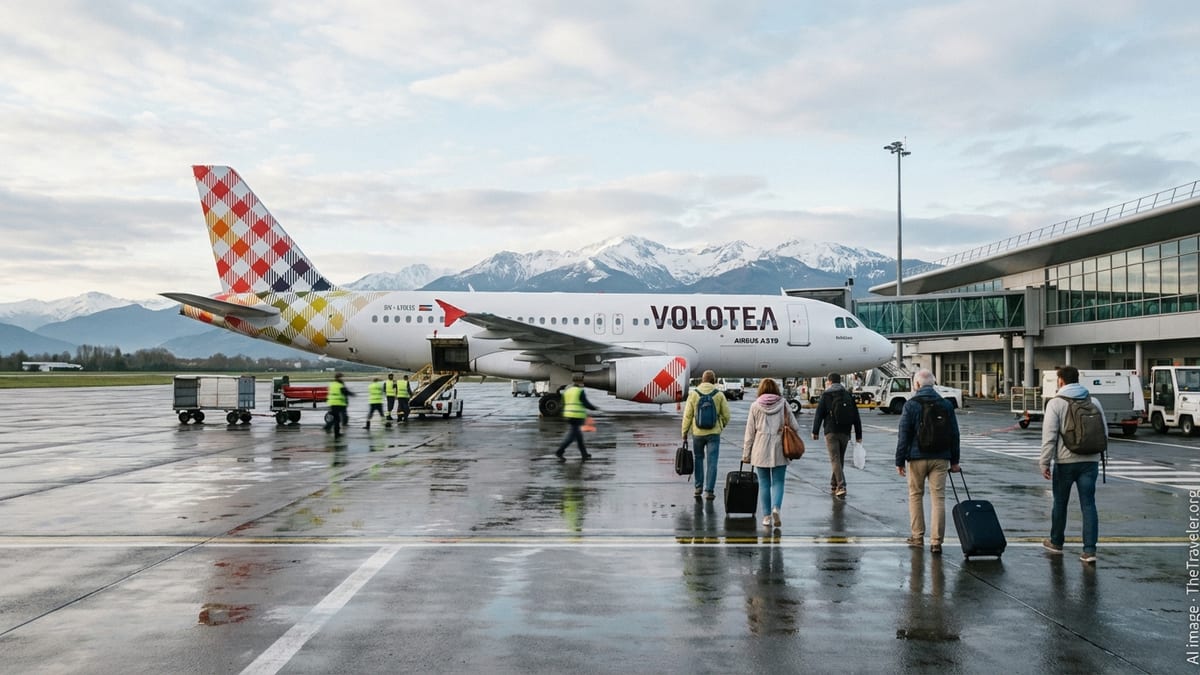
Four-Year Public Service Deal Extends Route to 2030
The Tarbes–Lourdes–Paris Orly air link will continue under a renewed public service obligation from June 1, 2026 to May 30, 2030, with Volotea again chosen as the operating carrier. Local authorities in the Hautes-Pyrénées region confirmed the agreement after lengthy negotiations that underscored the strategic importance of the route for both residents and visitors.
The new contract guarantees two daily round trips between Tarbes–Lourdes–Pyrénées Airport and Paris Orly, maintaining a level of service that has become essential for business travellers, medical transfers and international pilgrims heading to Lourdes. Operated by Airbus A319 aircraft, the schedule equates to around 230,000 seats annually on the route, with more than 910,000 seats planned over the four-year contract period.
The arrangement comes as Volotea cements its role as a key regional carrier in France, having first taken over the public service route in 2022. Since then, passenger numbers at Tarbes–Lourdes–Pyrénées Airport have nearly doubled to close to 600,000 per year, with the Lourdes base and dedicated aircraft seen as a catalyst for this growth.
Increased Capacity Targets Growing Pilgrimage Demand
With the renewed contract, Volotea is ramping up overall capacity from its Lourdes base, aiming to offer a record 331,000 seats in 2026, almost double the levels seen when it first launched operations in 2022. The airline currently operates 14 weekly flights on the Orly route, using 153-seat A319s, providing dense coverage throughout the week to match demand from religious groups and tour operators.
The reinforced schedule is particularly significant for Lourdes, one of the world’s foremost Catholic pilgrimage destinations, which welcomes millions of visitors annually to its sanctuaries and healing baths. Reliable air access from Paris Orly, a major national and long-haul gateway, is regarded by local officials as a cornerstone of the city’s international appeal, especially for travellers with limited mobility or tight itineraries.
Airport managers say group bookings and seasonal peaks linked to major feast days and pilgrimage events have supported strong load factors on the route. A more robust seat offering gives faith-based tour operators and diocesan groups greater flexibility when planning programs, while also smoothing capacity constraints that previously pushed some visitors onto longer rail or coach journeys.
Local Financing Underscores Economic Stakes
The renewed public service obligation comes with a higher price tag, set at 4.5 million euros per year, fully financed by regional stakeholders after the French state withdrew from the funding structure. The Region, the Département and the local agglomeration authority have agreed to share the cost, citing the air link’s outsized impact on jobs, tourism and local spending.
Officials argue that every euro invested in the Tarbes–Orly line generates multiple euros in economic returns, from hotel stays and restaurant visits in Lourdes to indirect activity for transport providers and service businesses. The Lourdes base itself employs several dozen staff, while the wider airport ecosystem supports hundreds of additional jobs tied directly or indirectly to air connectivity.
By choosing to shoulder the full financial burden, local authorities are effectively betting on air access as a long-term tool against geographic isolation. With rail journeys to Paris taking more than five hours, the Tarbes–Lourdes–Orly link is widely viewed as a lifeline for the area’s tourism economy and a key factor in retaining conferences, events and high-spending international visitors.
Gateway to Long-Haul Networks via Orly Partnerships
The strengthened Lourdes–Orly route is also expected to benefit from Volotea’s expanding partnerships at Paris Orly with long-haul operators such as Air Caraïbes and French bee. These commercial agreements allow passengers arriving from Lourdes to connect seamlessly at Orly to transatlantic and Caribbean destinations on a single itinerary, simplifying travel logistics for overseas pilgrims and tour groups.
Industry analysts say such interline-style cooperation amplifies the value of regional public service routes by tying them into broader international networks. For Lourdes, this means that groups travelling from North America or the Caribbean can reach the shrine city with one domestic hop after landing in Paris, rather than relying on complex overland transfers from Charles de Gaulle or other airports.
Tourism officials in the Pyrenees region are positioning the upgraded air link as part of a wider strategy to attract higher-yield, longer-stay visitors who combine religious tourism with cultural and nature-based experiences in the surrounding mountains. Improved connectivity via Orly is seen as a way to secure repeat visitation from large pilgrimage markets while extending Lourdes’ reach beyond its traditional European core.
Regional Connectivity Strengthens Despite Market Headwinds
Volotea’s commitment to expand capacity on the Tarbes–Lourdes–Paris Orly route comes at a time when other low-cost carriers are trimming seat supply in France in response to rising aviation taxes and regulatory pressures. This divergence highlights the role that targeted public service contracts can play in protecting essential regional links even as commercial networks shift elsewhere.
With the Tarbes–Lourdes line guaranteed through 2030, local leaders are now focusing on maximizing the tourism benefits of the enhanced schedule. Efforts include refining coordinated timetables with pilgrimage organizers, promoting multi-day stays that combine sanctuary visits with excursions into the wider Pyrenean region, and improving ground transport options between the airport, Lourdes and nearby mountain resorts.
As the 2026 summer season approaches, the combination of increased seats, secure long-term funding and new partnership-driven connections at Paris Orly positions Lourdes to capture a larger share of faith-based and leisure tourism. For the shrine city and its surrounding communities, the reinforced Volotea service is emerging not just as a transport link, but as a central pillar of their future visitor economy.