

More news on this day
The United Arab Emirates’ ambitious Tourism Strategy 2031, built on cultural capital projects and a fast‑rising digital infrastructure, is entering a turbulent phase as fresh geopolitical tensions stoke war-related travel anxiety and disrupt regional air corridors.
Get the latest news straight to your inbox!
Ambitious Growth Targets Meet a More Volatile Region
Launched in late 2022, the UAE Tourism Strategy 2031 set out to position the country among the top global destinations, targeting 40 million hotel guests annually and about 100 billion dirhams in additional tourism investment by the end of the decade. Publicly available data indicates that the country had already reached more than three quarters of its guest target by 2024, supported by record hotel occupancy and rising international arrivals.
Recent conflict in the wider region is now exposing how much those goals depend on seamless long-haul connectivity and the perception of the Gulf as a safe, neutral transit hub. Analytical forecasts published in March suggest that Middle East tourist arrivals could fall between 11 and 27 percent in 2026 compared with earlier growth projections, implying tens of millions fewer visitors and billions of dollars in lost spending across the region.
For the UAE, which has marketed stability and high service standards as key advantages, the sudden rerouting of flights and heightened security alerts has raised questions over whether current tourism targets may need recalibration. Industry observers note that while no official downgrade of the 2031 milestones has been announced, the planning context has shifted sharply compared with the largely optimistic assumptions that underpinned the strategy’s launch.
Tourism advisers point out that the country’s past performance in bouncing back from shocks, including the pandemic and previous security scares, argues against writing off the 2031 framework. Yet many also acknowledge that prolonged conflict, or further attacks affecting aviation infrastructure, could drag the sector off its intended trajectory even if demand eventually recovers.
Cultural Capital Pivot Becomes a Strategic Shock Absorber
A central plank of the UAE’s long-term tourism vision is its rapid build-out of museums, heritage districts and creative districts, particularly in Abu Dhabi and Dubai. The national strategy for cultural and creative industries aims to lift the sector’s share of GDP to around 5 percent by 2031, intertwining tourism with arts, design, film and live entertainment.
Projects such as Louvre Abu Dhabi, Saadiyat Island’s emerging cultural cluster, and Dubai’s public art and creative economy initiatives are designed to shift the narrative from pure sun-and-shopping to a more layered cultural offer. Policy papers from multilateral organizations and consultancy firms describe this as a “cultural capital” pivot that seeks to attract longer-staying, higher-spending visitors and international talent.
As war-related uncertainty dents some short-haul leisure flows, this cultural infrastructure is taking on a second role as a resilience tool. Destination analysts argue that major exhibitions, film productions and design festivals can sustain international visibility and business travel even when mass-market tourism softens. The UAE’s hosting of global cultural and creative events, combined with year-round programming in new arts venues, is therefore seen as a hedge against cyclical dips in regional demand.
However, there are limits to how far the cultural pivot alone can offset prolonged geopolitical tension. Large-scale cultural assets rely heavily on international visitor volumes, airline connectivity and corporate sponsorships, all of which are sensitive to security perceptions and insurance costs. If airspace disruptions and conflict-driven travel advisories persist, operators may face higher costs and thinner margins just as many projects are entering their most capital-intensive phase.
Digital Tourism Push Accelerates Amid Infrastructure Risks
Running parallel to its bricks-and-mortar developments, the UAE has doubled down on a digital tourism and smart-city agenda that leans on artificial intelligence, data analytics and advanced airport systems. National AI strategies and education reforms unveiled over the past two years highlight a longer-term aim to embed AI across sectors, including travel, culture and hospitality.
In tourism, that digital push is visible in biometric border controls, personalized marketing platforms and dynamic pricing tools used by airlines and hotels. The expansion of new airport capacity, including upgraded terminals in Abu Dhabi and Dubai, is underpinned by integrated digital systems intended to smooth passenger flows and support higher visitor volumes envisioned for 2031.
The latest round of regional hostilities has underscored the strengths and vulnerabilities in this model. On one hand, digital tools allow authorities and businesses to rebook passengers, reroute flights and communicate disruptions at speed, helping to manage reputational risk. On the other, recent reports of drone debris affecting airport areas and even damaging data center infrastructure point to a rising exposure of core digital assets to physical conflict.
Technology observers warn that the UAE’s tourism growth strategy increasingly depends on the uninterrupted operation of cloud and data infrastructure hosted in or near major cities. Any sustained damage to those assets, or to the networks that connect them, could slow the roll-out of smart tourism services and complicate efforts to present the country as a frictionless, high-tech gateway during a period of heightened regional insecurity.
War Panic, Market Sentiment and the Question of Pace
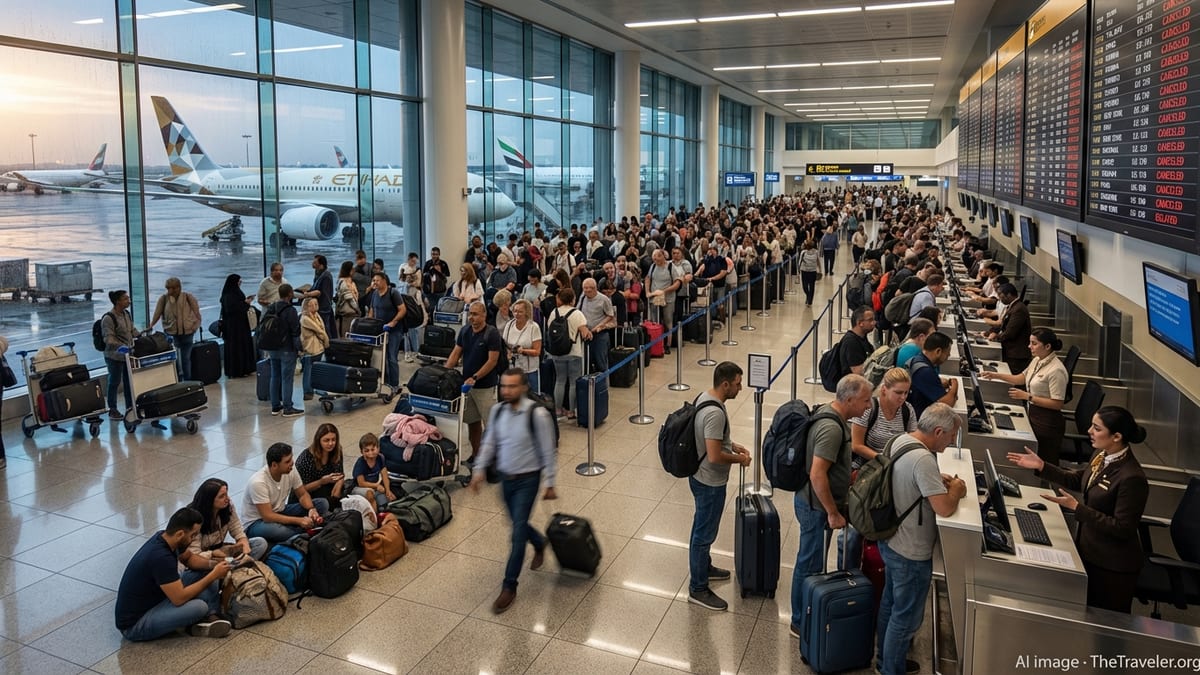
Across key source markets, media coverage of missile interceptions, sudden flight cancellations and emergency repatriations has contributed to what travel analysts describe as “war panic” among some leisure travelers. Booking data for parts of the Middle East has already shown sharp swings in demand following escalations, with tour operators in Europe and Asia rerouting clients away from perceived hotspots.
In this environment, the UAE faces a dual communications task: reassuring existing visitors and airlines about on-the-ground security, while convincing cautious new travelers that holidays and stopovers can proceed largely as planned. Commentary from regional tourism experts suggests that destinations with strong brands and diversified offerings, such as Dubai and Abu Dhabi, may retain more of their pipeline than smaller or less well-known competitors.
Even so, uncertainty over how long the conflict will last, and whether further attacks might target civilian infrastructure, is feeding into airline capacity planning and investor calculations. Some economists now frame the main risk to the UAE Tourism Strategy 2031 not as a collapse in demand, but as a slower-than-planned climb toward its upper-range targets if repeated shocks keep resetting traveler confidence.
For now, publicly available figures show that the Emirates remains on a broadly positive trajectory, with recent years delivering record or near-record visitor numbers despite overlapping crises. Whether that resilience is enough to stay fully on schedule to 2031 will depend on how quickly regional security concerns ease, how effectively cultural and digital investments translate into durable demand, and how far war-induced caution continues to shape global travel patterns.
Is the 2031 Vision Falling Behind, or Being Quietly Rewritten?
So far, there has been no formal revision to the UAE Tourism Strategy 2031 headline goals, but market observers detect signs of a more flexible, scenario-based approach emerging behind the scenes. Conference presentations, sector briefings and think-tank papers in late 2025 and early 2026 increasingly emphasize adaptability, diversified source markets and Gulf-wide cooperation, rather than fixed numerical targets alone.
Regional initiatives such as discussions on a common Gulf visitor visa and cruise alliances show how the UAE is seeking to embed its tourism plans within a broader ecosystem, potentially sharing both risks and rewards with neighboring states. This collaborative trend may help cushion any slowdown by making multi-country itineraries more attractive when conditions stabilize.
At the same time, analysts note that the strategy’s original success metrics were defined in a very different context, when the main variables were post-pandemic recovery and infrastructure delivery timelines. The emergence of a prolonged, high-intensity conflict affecting air routes, energy markets and traveler sentiment was not at the forefront of most scenarios.
Rather than viewing the 2031 strategy as “going far behind,” some tourism economists suggest it may gradually be reframed, with greater focus on resilience indicators such as yield per visitor, sectoral employment and cultural export revenues, alongside headline arrival counts. In that reading, the current moment is less about abandoning the vision and more about stretching the timeline and broadening what success looks like in an era where war, climate shocks and digital vulnerabilities are all reshaping global tourism.