

More news on this day
A cascading mix of war in the Middle East, government funding battles and volatile jet fuel prices has converged into what analysts describe as the most punishing stretch for global travel since the pandemic, stranding passengers, reshaping routes and testing the resilience of airlines and tourism economies worldwide.
Get the latest news straight to your inbox!
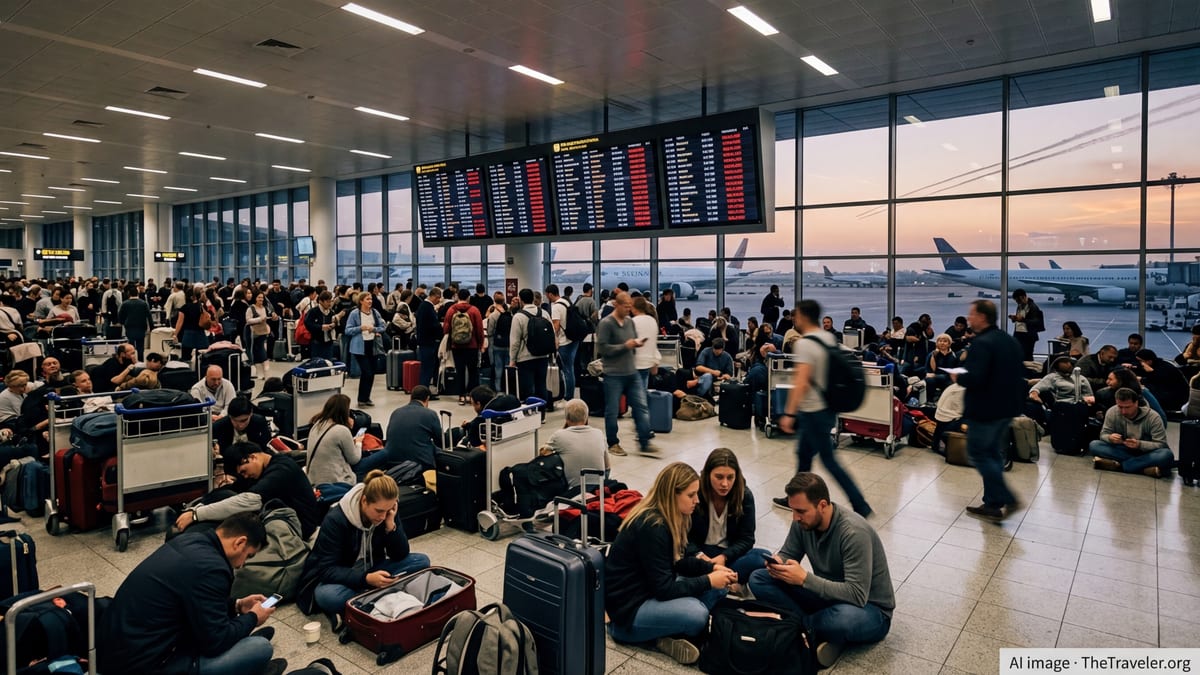
Middle East War Closes Skies and Strands Passengers Worldwide
Escalating conflict centered on Iran has rapidly reshaped global flight maps, as airspace closures spread across the Gulf and beyond. Reports indicate that airspace restrictions or outright closures over Iran, Iraq, Israel, Jordan, Qatar and several neighboring states have forced airlines to suspend thousands of flights and divert many more, severing key east–west corridors between Europe, Asia and Africa.
Major hubs in the Gulf, including airports in Dubai, Abu Dhabi and Doha, have faced prolonged closures or tight capacity limits in recent weeks. Publicly available flight-tracking and industry data show cancellations and diversions affecting well over 20,000 flights as carriers reroute around conflict zones or suspend operations entirely on certain city pairs. The result has been packed remaining services, soaring last-minute fares on alternative routes and a surge in demand for repatriation and special charter flights.
Travelers have been caught in an unpredictable patchwork of restrictions, with some passengers diverted to cities far from their original destination and others unable to secure replacement seats for days. Travel advisories urging citizens to leave parts of the region have added to the congestion, placing extra pressure on both commercial airlines and governments organizing evacuation flights.
Analysts tracking the aviation sector note that the Middle East has become a critical hinge in the global network, handling a disproportionate share of long-haul transfer traffic. When several of its primary hubs constrict simultaneously, ripple effects can appear as far away as Europe, North America and Southeast Asia in the form of missed connections, aircraft and crew displacement, and mounting backlogs at secondary airports.
Shutdown Threats and Staffing Gaps Expose System Fragility
At the same time, the domestic travel picture in the United States has been unsettled by renewed battles over federal funding. A protracted dispute over the budget for homeland security agencies has triggered warnings that some airport security checkpoints could face staffing shortfalls, with the Transportation Security Administration preparing for higher levels of absenteeism as employees work without timely pay.
Past shutdowns have provided a stark preview of what can happen when the aviation system is forced to operate under prolonged financial uncertainty. Historical records show that previous lapses in federal funding prompted emergency reductions in flight schedules at dozens of major airports and caused measurable revenue losses for large U.S. carriers. Industry groups now warn that another extended standoff could quickly lead to longer security lines, more missed connections and renewed pressure to trim schedules if safety-critical staffing levels weaken.
Even outside formal shutdown periods, the system remains vulnerable to localized staffing gaps and industrial action. Across Europe over the past year, repeated strikes by air traffic controllers and airport workers have led to waves of cancellations and delays, particularly during peak holiday seasons. While total cancellations have fallen from the worst levels seen immediately after the pandemic, data compiled by travel sites and aviation consultancies point to a sharp rise in delays, highlighting how thin margins remain in crew rosters and control centers.
Travel experts note that such disruptions quickly compound when overlaid with geopolitical shocks. When rerouted long-haul flights from the Middle East must squeeze into already congested European and North American airspace, any shortfall in controllers or security staff can turn routine bottlenecks into gridlock, further lengthening what is already, for many passengers, the roughest patch of flying in years.
Fuel Shocks Push Costs Higher as Oil Markets React to Conflict
The war-related upheaval has not been limited to flight patterns. Global energy markets have reacted sharply to the threat of wider regional instability, especially around key shipping lanes. Benchmark crude prices have moved higher on concerns about export disruptions and security risks to tankers, with refined products such as jet fuel rising even faster in some trading hubs.
Industry reports show that jet fuel typically accounts for roughly a quarter to a third of an airline’s operating costs, meaning even modest price swings can translate into significant hits to quarterly earnings. In recent weeks, carriers with heavy exposure to long-haul networks and fuel-intensive wide-body fleets have signaled that their fuel bills are climbing by hundreds of millions of dollars compared with earlier forecasts, driven both by higher prices and by extra fuel burn on longer rerouted flights.
Airlines have responded through a mix of fuel surcharges, targeted fare increases and continued capacity discipline on routes where demand remains strong. Public financial guidance from several major U.S. and European carriers indicates that, so far, robust leisure and business demand is helping to absorb the shock, but analysts caution that there is limited room for further increases before price-sensitive travelers begin to pull back.
For travelers, the immediate effect is a subtle but noticeable inflation in ticket prices, particularly on long-haul journeys that must detour around closed airspace or conflict zones. Combined with longer flying times and reduced frequencies on some routes, the fuel shock has reinforced the sense that this month’s travel conditions are being shaped as much by energy markets and shipping risks as by the traditional dynamics of seasonal demand.
Tourism Economies and Airlines Face a New Stress Test
The convergence of war, shutdown threats and fuel volatility is being felt far beyond airport terminals. Tourism boards in Gulf countries and other regional hubs report a sharp dip in visitor arrivals as travelers postpone or re-route holidays, business events and religious travel away from conflict-adjacent areas. Hotels, restaurants and tour operators that built their models around steady flows of transfer passengers and short-stay visitors are grappling with sudden cancellations and weaker forward bookings.
Global tourism flows are also being rebalanced as travelers choose alternative gateways. Some long-haul passengers bound for Asia are shifting to routes through southern Europe or South Asia, while others opt to split journeys with added stops in North America or East Asia instead of traditional Gulf hubs. This realignment creates winners and losers among destinations, with some secondary airports and cities experiencing an unexpected boost while others endure a sharp, if temporary, downturn.
For airlines, the moment represents a fresh stress test of the resilience they have rebuilt since the pandemic. Carriers heavily reliant on connecting traffic through Middle East hubs now face both operational and financial strain, while point-to-point airlines with more diversified networks may be better positioned to weather the turbulence. Credit analysts are watching closely for signs that prolonged war, elevated fuel prices and episodic shutdown risks could push the weakest players back toward restructuring.
Despite the turmoil, forward schedules and booking data suggest that underlying appetite for travel remains strong. Many passengers are choosing to endure longer routes, higher fares and added uncertainty rather than forego trips entirely. For the industry, that combination of resilient demand and relentless external shocks is defining what many insiders already regard as one of the most brutal months for global travel in years.