

More news on this day
Travelers at Newark Liberty International Airport faced hours-long lines, packed departure halls and mounting frustration on Saturday as at least 51 flights were cancelled and 172 delayed, disrupting journeys across the United States, Canada, Germany and other international destinations.
Get the latest news straight to your inbox!
Wintry Weather and Staffing Shortages Snarl Operations
The latest disruption at Newark comes as a potent mix of lingering wintry weather systems and chronic air traffic control staffing issues converged over one of the country’s busiest hubs. Gusty crosswinds and low cloud ceilings in the New York metropolitan area triggered a series of cascading delays, while reduced arrival and departure rates forced airlines to trim already tight schedules.
Airport officials said that while runways remained open, traffic into the congested Northeast corridor had to be slowed significantly, pushing back departure times throughout the morning and early afternoon. With aircraft and crews out of position, carriers increasingly opted to cancel flights outright rather than allow extended rolling delays that could stretch well into the night.
The Federal Aviation Administration has kept temporary caps on movements at Newark in recent months in an effort to reduce chronic gridlock, but on days like this, the reduced capacity leaves airlines with little room to recover when bad weather or operational hiccups hit. As one operations manager described it, “once we lose the morning, the rest of the day is a game of catch-up.”
Passengers reported receiving a flurry of texts and app alerts from carriers as schedules were repeatedly revised, with some travelers watching their departure times slip in 30- or 45-minute increments before their flights were finally cancelled.
Major Carriers Trim Schedules as Impact Spreads
United Airlines, which operates a large hub at Newark, accounted for a significant share of Saturday’s cancellations, pulling multiple departures to midwestern, southern and Canadian cities to relieve pressure on the system. Delta Air Lines and American Airlines also scrubbed a series of regional flights, while Air Canada cancelled and delayed transborder services linking Newark to Toronto, Montreal and other Canadian gateways.
The knock-on effects quickly reached across airline networks. Flights headed to Frankfurt, Munich and other German cities left behind clusters of stranded passengers after their Newark connections were disrupted, while domestic travelers bound for cities from Chicago and Atlanta to Denver and Los Angeles saw their itineraries unravel.
Airlines moved to rebook affected customers on later departures or alternative routings through other hubs such as Chicago O’Hare, Washington Dulles, Toronto Pearson and Montreal. However, with school holidays and late winter getaway traffic keeping loads high, available seats were limited, leaving some passengers with only next-day options or circuitous multi-stop journeys.
Several carriers issued travel waivers allowing customers ticketed to or from Newark to change their plans without fees, though fare differences still applied in many cases. At the airport, gate agents and customer service desks were inundated as long queues formed for rebooking assistance and hotel vouchers.
Scenes of Frustration and Fatigue in the Terminals
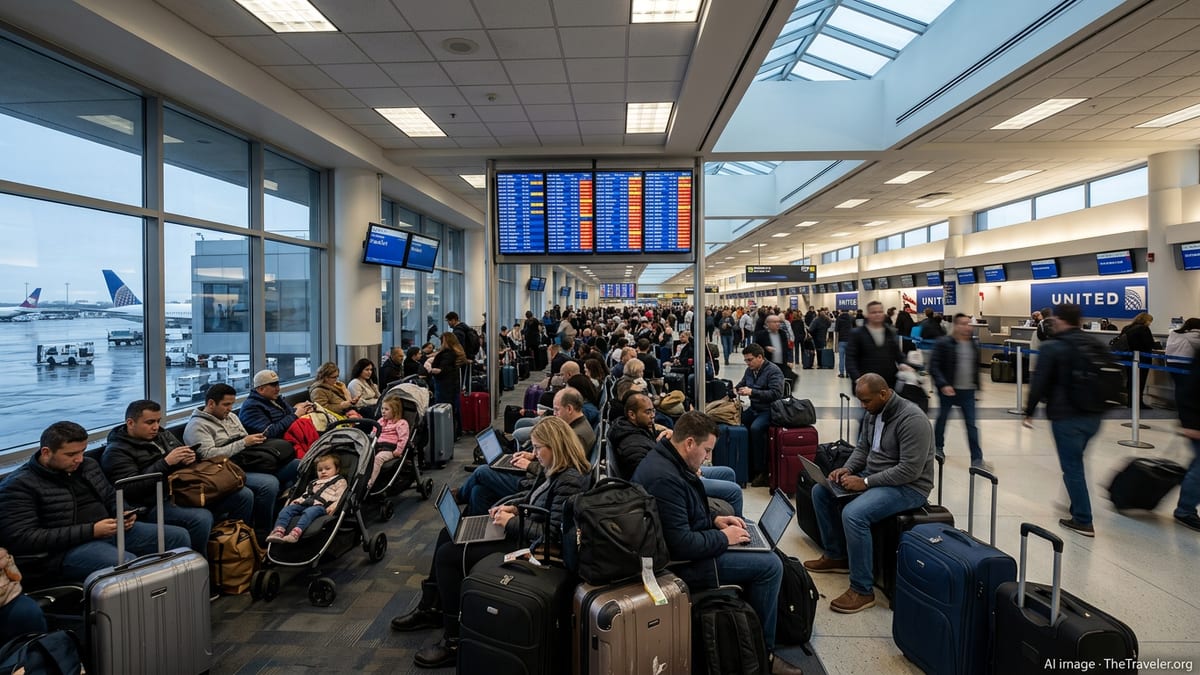
Inside Newark’s terminals, departure boards flickered with a growing line of red and yellow status updates as more flights shifted into delayed or cancelled categories. Families sprawled across the floor near charging stations, business travelers refreshed airline apps on their phones and international visitors clutched paper itineraries while trying to navigate new connections.
Security checkpoints and boarding areas grew increasingly crowded through the afternoon as delayed departures overlapped with on-time flights, filling gate hold rooms beyond capacity. Food concessions and coffee stands were met with persistent lines as travelers settled in for the likelihood of extended waits.
Volunteer airport ambassadors and airline staff circulated with updates and directions, but information often lagged behind what customers were seeing on their devices. Some travelers expressed confusion as flights appeared “on time” on overhead boards even as crews had not yet arrived and aircraft remained parked at distant gates or at other airports.
Hotels in the surrounding Newark and Elizabeth areas began to fill with rebooked travelers, and ride-hailing pickup zones outside the terminals saw a steady stream of passengers abandoning air plans in favor of trains, rental cars or buses to reach destinations in the US Northeast and eastern Canada.
Broader Strain on North American Aviation Network
The disruption at Newark underscored the continuing fragility of the North American aviation network during periods of intense weather and persistent staffing shortages. With several major hubs still managing reduced air traffic control capacity and airlines running tight schedules built around high aircraft utilization, a single day of poor conditions at a critical node can ripple across the continent.
Transborder routes between the United States and Canada were particularly affected, with passengers on both sides of the border reporting missed connections, overnight delays and instances where checked baggage failed to follow rerouted flights. German-bound travelers, often on tightly coordinated interline itineraries, faced the added uncertainty of missed long-haul departures and limited same-day alternatives.
Industry analysts noted that while carriers have made strides since the worst of the pandemic-era meltdowns, they remain vulnerable when severe weather coincides with already constrained infrastructure. Newark, in particular, has become a bellwether for broader system stress given its dense traffic, complex airspace and heavy reliance by both US and foreign carriers.
With airlines heading into the busy spring break and early summer travel period, Saturday’s scenes are likely to renew calls from regulators, unions and consumer advocates for more conservative scheduling, accelerated hiring in key operational roles and further investments in weather-resilient infrastructure at major hubs.
What Travelers Can Do When Disruptions Hit
For passengers caught up in Saturday’s turmoil, the immediate priority was finding a way to their final destination with as little additional cost and stress as possible. Travel advisors recommend that when cancellations spike, affected customers use a combination of airline apps, airport kiosks and phone support rather than relying on a single channel, as lines at service desks can grow quickly.
Experts also suggest checking flights from nearby airports in the broader New York and Philadelphia region, as carriers sometimes open up seats from alternative gateways when a single hub like Newark is heavily constrained. In some cases, airlines will allow same-day switches to or from John F. Kennedy International, LaGuardia or Philadelphia International at little or no additional charge during extended disruptions.
Travelers with international connections are urged to keep in close contact with both their transatlantic carrier and any domestic or transborder partner airline on the same itinerary, since rebooking options may differ depending on which segment is cancelled first. Keeping boarding passes, baggage tags and receipts organized can help streamline claims and compensation discussions later.
As operations slowly stabilize, many of those stranded at Newark on Saturday face the prospect of arriving at their destinations a full day or more behind schedule. For now, the crowded terminals and departure boards filled with delays offer a stark reminder of how quickly travel plans across the US, Canada, Germany and beyond can be upended when one of North America’s key gateway airports falters.