

More news on this day
Severe weather disruptions across China have grounded 60 flights and delayed a further 197 services at major hubs including Beijing and Shenzhen, leaving passengers facing long waits, missed connections, and uncertainty over rebooking options.
Get the latest news straight to your inbox!
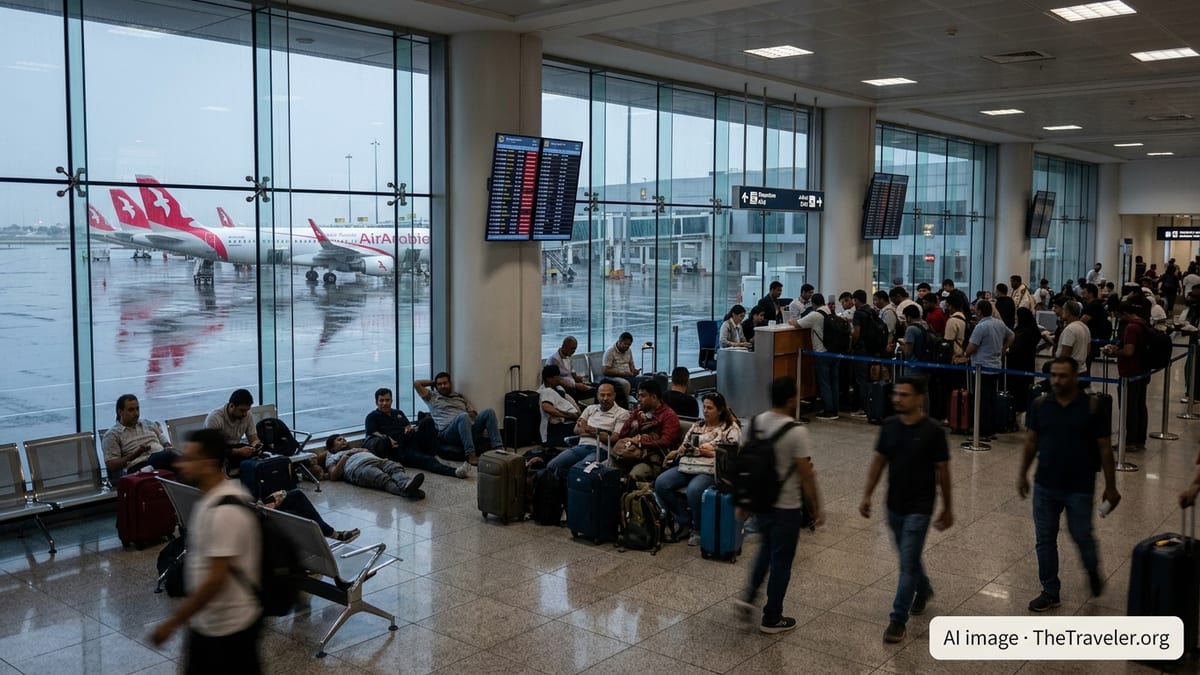
Storm Systems Snarl Operations at Key Chinese Airports
Publicly available flight monitoring data and industry reports indicate that a fast-moving band of convective storms over eastern and southern China triggered cascading delays on Tuesday, affecting schedules at Beijing Capital, Beijing Daxing, Shenzhen Baoan, Guangzhou, Hangzhou, Kunming and other busy hubs. Low cloud ceilings, heavy rainfall and lightning activity restricted runway capacity during peak departure and arrival banks, forcing airlines to cancel 60 flights outright while placing at least 197 others into holding patterns or extended ground delays.
Beijing Capital and Shenzhen Baoan, two of the country’s most delay-prone airports during summer weather volatility, experienced some of the sharpest operational impacts. Data compiled from aviation analytics platforms shows a pronounced spike in late-running services on trunk routes linking Beijing with coastal cities such as Shenzhen, Guangzhou and Hangzhou, as well as secondary hubs in central and western China.
Although similar weather-related disruptions are common during China’s rainy and typhoon seasons, the current wave of cancellations and delays stands out for its breadth across multiple airport systems at once. Travel industry analysis notes that once weather reduces throughput at even one major hub, knock-on effects often ripple nationwide because Chinese airspace is already highly congested and subject to tight routing constraints.
At several airports, departure boards showed large clusters of flights pushed back by more than two hours, particularly during the late afternoon and evening rush. Airlines responded with rolling schedule adjustments, aircraft swaps and crew reassignments, but the compressed window to recover operations left many passengers waiting in terminals late into the night.
Beijing and Shenzhen See High Delay Concentrations
In Beijing, where thunderstorms frequently build along the mountains west and north of the capital, arriving flights were reportedly placed into extended airborne holding or diverted to alternate airports when storm cells moved directly over final approach paths. Departure banks were periodically paused for lightning and wind-shear checks, leading to a backlog of aircraft waiting for pushback and takeoff slots.
Shenzhen Baoan, which sits on the Pearl River Delta and is particularly vulnerable to convective weather, also experienced a concentrated wave of disruptions. Aviation punctuality statistics regularly highlight Shenzhen as one of the more delay-affected major airports in China, and today’s conditions appear to have reinforced that pattern as thunderstorms rolled across the region and into neighboring Guangzhou and Hong Kong airspace sectors.
On core north south trunk routes between Beijing and Shenzhen, monitoring services showed a mix of outright cancellations and long delays, affecting both full service and low cost carriers. Some flights that did depart faced rerouting and longer flight times to skirt around storm cells, adding further strain to already tight rotation schedules for aircraft and crews.
Operational observers note that when both Beijing and Shenzhen are constrained at the same time, recovery becomes significantly more complex. Many aircraft are scheduled to shuttle repeatedly between these hubs during the day; when one leg is cancelled or heavily delayed, subsequent rotations can be thrown off by several hours, turning a local weather issue into a network wide challenge.
Airlines Prioritise Hub Connections and Evening Departures
With dozens of aircraft out of position and crews approaching duty time limits, airlines across the Chinese domestic market appeared to prioritise flights with the highest passenger loads and strategic importance. Industry reports suggest that late evening departures from Beijing and Shenzhen to other provincial capitals were given precedence in order to reconnect travelers with onward morning services and to reposition aircraft for the following day’s operations.
Point to point routes with lower demand and less critical connectivity were more likely to see outright cancellations rather than rolling delays. This approach is consistent with common disruption management strategies used by large carriers in congested airspace, where preserving the integrity of key hub banks and early morning departures can reduce the risk of multi day operational fallout.
Some regional flights into weather affected secondary airports were consolidated, with passengers moved onto fewer, fuller services once conditions permitted. Where aircraft and crews were available, airlines also mounted a limited number of additional late night sectors to clear backlogs on high demand city pairs such as Beijing Shenzhen and Beijing Guangzhou, although airport curfews and crew duty rules constrained the scope of these efforts.
Observers of China’s aviation sector note that such tactical decisions can be frustrating for travelers whose specific flights are cancelled, but they are generally aimed at restoring broader schedule stability as quickly as possible. The trade off is a short term concentration of inconvenience in exchange for a more orderly restart the next day.
What Affected Passengers Can Expect on Rebooking
For passengers caught in the latest wave of weather disruptions, rebooking outcomes vary depending on ticket type, carrier policy and the level of congestion on alternative flights. Publicly available conditions of carriage for major Chinese airlines typically classify severe weather as a force majeure event, which limits eligibility for cash compensation but does allow for free changes to a later flight on the same route when seats are available.
Travel industry guidance indicates that passengers on cancelled flights are usually rebooked first, either onto the next available service to the same destination or, in some cases, via a connection through another hub if that offers a faster arrival time. Those facing long overnight delays at Beijing or Shenzhen may be offered meal vouchers or basic accommodation support, although this is not uniformly guaranteed and is often constrained when disruption affects large numbers of travelers simultaneously.
Travelers holding separate tickets or discounted promotional fares can face more complex rebooking experiences, especially if connecting journeys involve different airlines or self arranged transfers. In these cases, rebooking onto alternative services might require fare differences or additional fees, and protection on missed onward segments is not always automatic.
Passengers who have booked through online travel agencies are generally advised by consumer advocates to check both the airline’s official announcements and the agency’s service channels, since responsibility for ticket reissuance can depend on who issued the original booking. Keeping boarding passes, delay notifications and expense receipts can also help if travelers later seek partial refunds or ex gratia vouchers.
Practical Steps for Travellers During Ongoing Disruptions
With unsettled weather patterns forecast to persist over portions of eastern and southern China, travel specialists recommend that passengers scheduled to fly to or from Beijing, Shenzhen and other major hubs build extra flexibility into their plans. Monitoring flight status in real time via airline apps and airport displays is considered essential, as departure times can shift multiple times before a final decision is made on whether a flight will operate.
Where possible, passengers are encouraged to opt in to airlines’ notification services, which can deliver text or app alerts about gate changes, rolling delays and cancellation decisions. Having this information early can make a significant difference in securing a seat on the next available service, as rebooking queues at airport counters often grow quickly once a wave of cancellations is announced.
Travel insurers note that some comprehensive policies offer limited coverage for additional hotel nights, meals and replacement transportation when delays exceed certain thresholds, even when weather is the underlying cause. However, coverage terms vary widely, and travelers are advised to review policy details before incurring major out-of-pocket expenses in expectation of reimbursement.
For now, the grounding of 60 flights and delays to nearly 200 more highlight how vulnerable China’s dense domestic network remains to sudden shifts in weather, particularly at high-volume hubs such as Beijing and Shenzhen. As airlines work through backlogs and reposition aircraft, passengers may continue to experience residual delays, underscoring the importance of contingency planning for anyone flying through the region this week.