

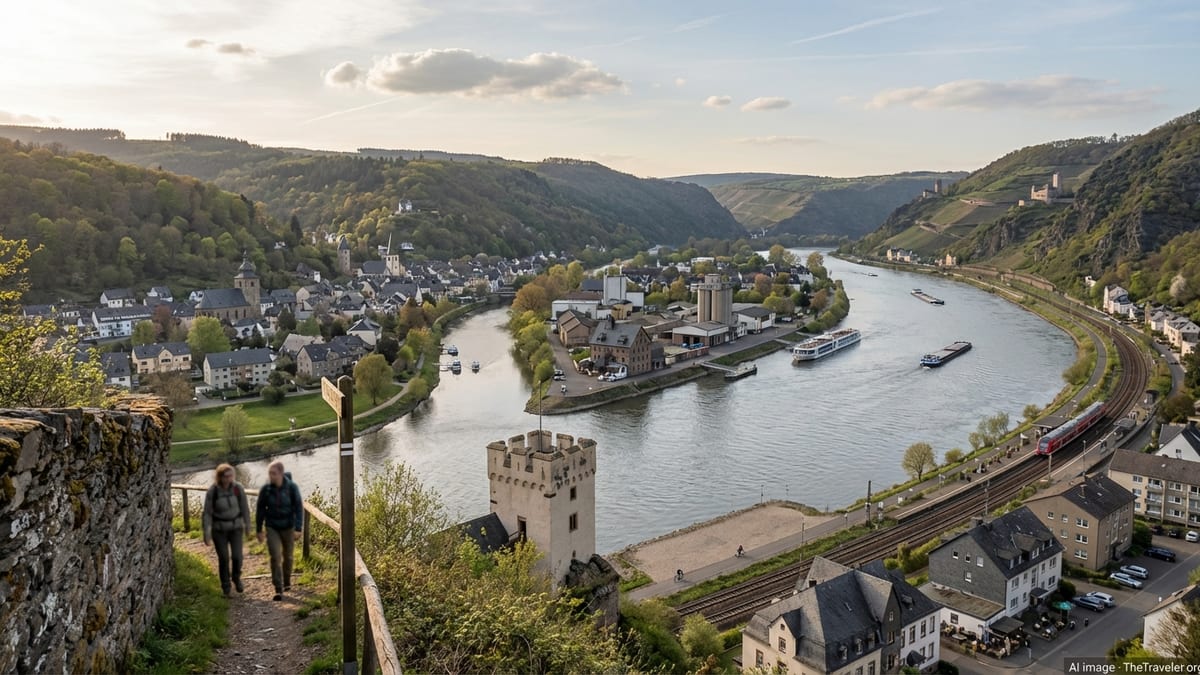
Lahnstein is one of those places whose position on the map explains almost everything about its character. Set where the Lahn River meets the Rhine, on the southern fringe of Koblenz and within the UNESCO listed Upper Middle Rhine Valley, it sits at a hinge point of geography, culture and trade.
If you want to understand the town’s appeal, its location shapes many things to do in Lahnstein. For travelers, this confluence setting shapes the landscapes you see, the castles that ring the hills, the wine in your glass and even the ease with which you can step from one river valley to another in a single afternoon.
The Meeting Point of River Worlds
Lahnstein lies just a few kilometers south of Koblenz, where the smaller Lahn flows into the broad Rhine after cutting through wooded highlands and quiet spa towns. The town itself occupies both banks of the Lahn and the right bank of the Rhine, making water omnipresent. Stand on the riverfront and you can watch barges creeping up the Rhine, local boats heading into the Lahn, and long distance cruise ships sliding past on itineraries that connect Cologne with Mainz and beyond.
This junction of waterways gives Lahnstein a dual identity. Up the Lahn, the scenery quickly narrows into a more intimate valley of meadows, sandstone cliffs and low key river tourism focused on canoeing, cycling and long distance walking trails. For many visitors, the setting strongly influences whether Lahnstein is worth visiting. Down the Rhine, the landscape broadens into one of Europe’s great transport corridors, with tall cliffs, vine lined slopes and regular freight traffic that underscores the river’s role as a working waterway. Lahnstein sits right at the moment where these two contrasting moods of river life meet.
Geographically, the town forms the northern gate of the steep sided Upper Middle Rhine Valley, a 65 kilometer stretch between Bingen and Koblenz recognized as a World Heritage cultural landscape. South of Lahnstein, the Rhine becomes narrower and more dramatic, hemmed in by slate hills and guarded by castles. North toward Koblenz, the valley opens out into the wider Neuwied Basin. For visitors, waking up in Lahnstein means you can choose each morning between the quieter Lahn valley, the classic Rhine Gorge scenery to the south or the big river junction bustle around Koblenz to the north without ever changing your base.
A Cornerstone of the Upper Middle Rhine World Heritage Landscape
What makes Lahnstein’s location particularly special is that it helps define one end of the most famous section of the Rhine. The Upper Middle Rhine Valley’s official description refers to the “Lahnstein Gate,” the point where the river leaves the tight gorge and widens. In other words, Lahnstein is not just inside the World Heritage site; it marks a transition point within it. The panoramic view from the hills above town captures that shift from narrow, cliff lined river to more open valley.
This position gives Lahnstein access to an unusually dense concentration of castles, historic towns and vineyard slopes within a modest radius. To the south along the Rhine, names like Boppard, St. Goar and the Lorelei rock line up one after another, all reachable by boat or regional train from Lahnstein. To the north you are minutes from Koblenz, with the great fortress of Ehrenbreitstein and the monumental river junction at the Deutsches Eck where the Moselle merges with the Rhine. From Lahnstein you can easily experience both the cultivated romance of the Middle Rhine and the slightly wilder Moselle without long transfers.
At the same time, Lahnstein is large enough to feel like a lived in town rather than a pure tourist stage set. Its riverside quays, residential neighborhoods and working harbor form part of the larger Upper Middle Rhine cultural landscape. Barges loading building stone, grain stored in old industrial mills and the rail line that threads along the bank all reflect the continuing economic role that the Rhine corridor plays. For travelers interested in more than just postcard views, this mix of everyday life and world famous scenery is a major part of the appeal.
Castles on the Heights and Trails in Every Direction
Lahnstein’s hilltop vantage points are as important as its riverside promenades. Immediately above town rises Lahneck Castle, one of the great Rhine fortresses and a focal point in almost any photograph of the local skyline. It stands at a strategic angle between the Lahn and the Rhine, its walls and towers oriented to control both valleys. From its ramparts you can look south along the tightening Rhine Valley, north toward Koblenz and inland along the Lahn, appreciating in a single sweep why this hillside commanded power for centuries.
Several of the region’s long distance hiking routes stitch directly across Lahnstein’s slopes. The Rheinhöhenweg trail follows the high ridges on both sides of the Rhine, connecting Bonn with the wine towns further south and passing by Lahneck along the way. Another route, the Rheinburgenweg or Rhine Castles Trail, threads together fortifications such as Marksburg, Lahneck, Stolzenfels and Ehrenbreitstein. Standing in Lahnstein you are essentially at a crossroads of these elevated paths, able to choose stage hikes that drop into neighboring river towns or simply follow balcony like stretches above the water.
The Lahn valley has its own network of trails that intersect in or near Lahnstein. The Lahnhöhenwege, or Lahn Heights Trails, run along both sides of the Lahn from Wetzlar to Oberlahnstein, blending river views with forested plateaus and small wine growing pockets. Pilgrims’ routes such as the Lahn Camino also converge here, linking churches and chapels with historic routes across the hills. For walkers and cyclists, Lahnstein’s location means you do not have to choose between a Rhine itinerary and a Lahn itinerary. You can easily design a trip that uses the town as a hub and alternates between the two.
Where the Big River Meets the Wine Valleys
Although Lahnstein itself is more industrial and residential along the immediate riverside, it sits within easy reach of several distinct wine landscapes shaped by the Rhine and its tributaries. Upstream along the Middle Rhine, terraced vineyards cling to steep slate slopes and produce traditional Rieslings that have been famous since the era of Romantic painters and poets. Small wine villages line both banks, and tasting rooms are rarely more than a short boat ride or train hop from Lahnstein.
To the west, the Moselle Valley begins just a short distance away at Koblenz, where the Moselle flows into the Rhine. This river winds through a softer landscape of looping bends, medieval towers and vine covered hills that feel different from the more cliff dominated Rhine. From Lahnstein it is straightforward to reach Moselle towns such as Winningen, one of the oldest wine villages in the region, on a local cruise or via regional trains, and to return to sleep among Rhine views the same evening.
Even the smaller Lahn Valley has a modest wine tradition in places like Obernhof and Weinähr, where vineyards occupy sunny slopes above the river. These Lahn wines are officially marketed under the Middle Rhine designation, tying them back into the broader Rhine wine culture while retaining a more offbeat, small scale character. Travelers based in Lahnstein can combine tastings from all three river valleys across a few days, contrasting styles and growing conditions while hardly ever leaving sight of water.
A Historic Transport Node in the Rhine Corridor
Lahnstein’s location is not just scenic; it is highly practical. Historically, the confluence of the Lahn and the Rhine made this an ideal place to control trade routes, levy tolls and move goods between river and land transport. The Romans already understood the strategic value of the area, constructing a fort near the Lahn mouth in late antiquity to secure movement along the frontier rivers. Through the Middle Ages and early modern period, competing lords used fortresses such as Lahneck and nearby Marksburg to oversee shipping and the approach to Koblenz.
Today, that same geography translates into convenience for travelers. Lahnstein sits on the right bank railway line that closely follows the Rhine, linking it by direct regional trains to both Koblenz and the chain of Middle Rhine towns down to Rüdesheim. A ring of federal highways converges on the town from the Taunus hills and the Hunsrück plateau, meaning you can drive in easily from Frankfurt Airport or Cologne and then switch to slower, more scenic forms of transport once you arrive.
The town also maintains working harbor facilities on the Rhine, consisting of a river harbor and a basin harbor used to ship building stone, agricultural goods and fuels. Grain silos, cranes and a large historic mill building converted to logistics use all speak to the continuing importance of river freight. While this industrial side may not be conventionally picturesque, it vividly illustrates how the Rhine remains a living artery for modern Germany. Watching barges being loaded from a riverside café in Lahnstein, you are seeing a continuity of river commerce that stretches back two millennia.
Gateway to Koblenz, the Moselle and the Deutsches Eck
Part of what makes Lahnstein’s location special is its proximity to Koblenz without being swallowed by its urban sprawl. Within a few minutes by train or a short drive you can stand at the Deutsches Eck, the symbolic wedge of land where the Moselle joins the Rhine. Here, under the equestrian statue of Emperor William I, the two rivers mingle in full view of the massive Ehrenbreitstein Fortress on the opposite bank and the historic old town of Koblenz just behind you.
This three river relationship offers a unique sightseeing pattern: you can leave Lahnstein in the morning, enjoy a boat cruise along either the Moselle or the Rhine from Koblenz, tour a castle or a wine village, ride the cable car up to Ehrenbreitstein for sweeping views, and still return to a quieter riverside hotel in Lahnstein by evening. Several small cruise operators run boats along the Rhine that connect Koblenz with intermediate stops like Niederlahnstein, Stolzenfels and Braubach, giving you the option to mix and match water and rail segments as you explore.
On the Moselle, excursion boats connect Koblenz with downstream villages and towns, with some services passing through a lock so passengers can experience the engineering that manages water levels on this more tightly controlled tributary. From Lahnstein, shifting between the muscular main flow of the Rhine, the sinuous Moselle and the more modest Lahn becomes an engaging part of the travel experience. Each river tells a different story of geology, settlement and wine, yet all three are within a modest arc around the town.
Between Hills, Forests and Nature Parks
Turn your back to the river for a moment in Lahnstein and the land rises quickly into wooded hills. The town sits at the edge of the Nassau Nature Park, a vast protected area of forested plateaus, deep cut valleys and small streams that stretches east of the Rhine. This position between large river and upland forest gives Lahnstein a remarkably varied hinterland, particularly appealing to travelers who want to mix cultural sightseeing with time outdoors.
Within a short distance you can move from busy quays and castle courtyards into beech and oak woods, where long distance trails intersect with quiet local paths used mainly by residents. The contrast is especially striking on hot summer days, when the shaded ravines and upland meadows above town provide a cool counterpoint to the sunlit riverbanks. Because Lahnstein is not purely a resort town, many of these green spaces are integrated into everyday life: children’s playgrounds are set close to the woods, viewpoints are connected by local buses and small restaurants cater to hikers as much as to visiting tour groups.
The town’s location also places it within easy reach of the Taunus and Westerwald ranges, each with its own network of trails, viewpoints and traditional villages. For a traveler using Lahnstein as a base, it is entirely feasible to spend one day following the line of the Rhine, another climbing to a Taunus summit and a third cycling along the Lahn, all without long transfers or major logistical planning. Few places in the Upper Middle Rhine region offer such geographic variety so close at hand.
The Takeaway
Lahnstein’s special quality is that it stands at several crossroads at once. It is the meeting point of the Lahn and Rhine, close to where the Moselle arrives; the northern gate of the celebrated Upper Middle Rhine Valley; a hinge between industrial river corridor and forested hills; and a junction of long distance hiking, cycling and pilgrimage routes. Its riverside quays, castle crowned slopes and working harbor all grow directly from this geography.
For travelers, this means Lahnstein functions as a natural base camp for exploring the greater Rhine and Moselle region. In a single stay you can sample wine from three different river valleys, tour castles that once controlled the main artery of Western Europe, walk along panoramic ridge trails and still have time for a sunset stroll beside the water. The town’s location does not just influence what you see from its viewpoints; it shapes the entire rhythm of a visit. To understand the landscape of the Middle Rhine and its tributaries, there are few better places to stand than this confluence town.
FAQ
Q1. Is Lahnstein actually at the confluence of the Rhine and Moselle?
Lahnstein is at the confluence of the Lahn and the Rhine. The Moselle joins the Rhine a few kilometers north in Koblenz, which is easily reached from Lahnstein by train, car or boat.
Q2. Why is Lahnstein considered part of the Upper Middle Rhine Valley World Heritage Site?
The official World Heritage area for the Upper Middle Rhine Valley runs between Bingen and Koblenz, and Lahnstein lies within this stretch near its northern end. It helps mark the transition from the narrow gorge to the wider Neuwied Basin, with castle crowned hills and historical infrastructure that form part of the protected cultural landscape.
Q3. What makes Lahnstein’s position different from staying directly in Koblenz?
Koblenz sits at the Rhine Moselle junction and has a more urban feel, while Lahnstein is slightly smaller and quieter, located just south along the Rhine where the Lahn arrives. From Lahnstein you have easier immediate access to the steep gorge section of the Middle Rhine and to trails and castles such as Lahneck and Marksburg, yet Koblenz remains only minutes away.
Q4. Can I easily visit both the Rhine and Moselle valleys from Lahnstein without a car?
Yes. Regional trains connect Lahnstein with Koblenz and the Rhine towns to the south, and from Koblenz you can reach Moselle towns by train or boat. In addition, seasonal river cruises often stop in or near Lahnstein, giving you flexible options to combine boat and rail travel.
Q5. Which castles are closest to Lahnstein?
Lahneck Castle stands directly above Lahnstein at the junction of the Lahn and Rhine. Nearby along the Rhine you can quickly reach Marksburg above Braubach, Stolzenfels Castle just north of the town, and the vast Ehrenbreitstein Fortress opposite Koblenz, all within a short train or boat ride.
Q6. Is Lahnstein a good base for hiking?
It is an excellent base. Long distance routes like the Rheinhöhenweg and the Rhine Castles Trail pass close by on the heights above the Rhine, while the Lahnhöhenwege and the Lahn Camino follow the Lahn valley. You can set out on day hikes directly from town or use short train rides to access different trail stages.
Q7. What kind of landscapes can I expect around Lahnstein?
You will find a mix of broad river vistas, steep slate hills with castles and vineyards, narrower side valleys along the Lahn, and heavily wooded plateaus in the Nassau Nature Park. Within a short distance you can move from busy riverside promenades to quiet forest paths and open hilltop viewpoints.
Q8. How does Lahnstein’s working harbor affect its atmosphere?
The harbor underlines that the Rhine is still a major freight route, with barges loading stone, grain and fuels. For many visitors this adds interest, giving a sense of continuity with the town’s historical role in river trade and contrasting with the purely touristic settings in some nearby villages.
Q9. Are there wine tasting opportunities near Lahnstein?
Yes. While Lahnstein itself is not a classic wine village, it is surrounded by wine regions. Along the Middle Rhine you will find terraced vineyards and tasting rooms in many small towns, the Moselle’s renowned wine villages are close via Koblenz, and even the Lahn valley has small producers whose wines fall under the Middle Rhine designation.
Q10. How many days should I plan to appreciate Lahnstein’s location fully?
Three to five days allow you to experience the variety that Lahnstein’s location offers. With that amount of time you can explore the local castle and trails, take at least one full day cruise on the Rhine, make an excursion to the Moselle, and still have time to wander the town and enjoy its riverside setting.