


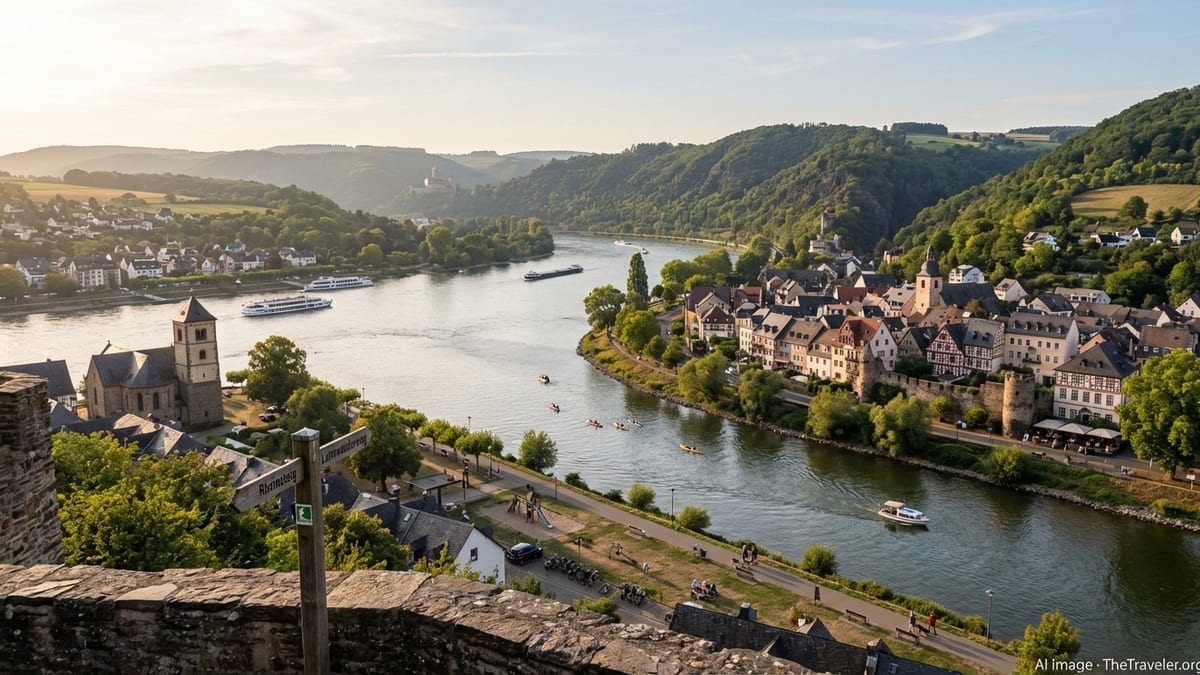
Perched where the Lahn River meets the Rhine, Lahnstein offers first-time visitors a compact mix of medieval castles, dramatic riverscapes, forested gorges and relaxed riverside life right in the heart of the Upper Middle Rhine Valley UNESCO World Heritage landscape. Whether you arrive for a day trip from Koblenz or linger for several nights, this underrated town rewards slow exploration, scenic hiking and castle-hopping without the crowds of larger Rhine destinations.
Getting Oriented in Lahnstein and the Rhine–Lahn Confluence
Knowing where attractions are located directly affects where you should stay in Lahnstein. Before rushing to the castles and hiking trails, it helps to understand Lahnstein’s layout and how the two rivers shape your visit. The town is divided into Oberlahnstein and Niederlahnstein, wrapped around the final bends of the Lahn just before it joins the Rhine. Trains, ferries and walking paths fan out along both valleys, making it easy to plan day trips or one-way hikes back into town.
Strolling the Rhine and Lahn Riverfront Promenades
For a first impression of Lahnstein, start with a gentle walk along the riverfront. On clear days the views stretch along the Rhine to Koblenz and down the Lahn toward the forested hills and cliffs that will feature in many of your outings. Benches, playgrounds and small café terraces make this an easy place to linger after a travel day.
The Lahn-side promenade is more intimate, with pleasure boats and kayaks gliding past and tree-lined banks that glow at sunset. The Rhine-side feels grander, framed by rail lines, passing cruise ships and distant castle silhouettes. Both are excellent at dusk, when the valley lights flicker on and river traffic slows.
Exploring Oberlahnstein’s Old Town Streets
Oberlahnstein, rising slightly above the river, preserves echoes of a fortified medieval town. Remnants of the historic walls and towers still punctuate the skyline, and short lanes link half-timbered houses to baroque churches and small squares. It is compact enough to explore without a map; simply drift and follow the stonework and church spires.
This is also the area where you will find many of Lahnstein’s restaurants, bakeries and traditional wine taverns. For first-time visitors, planning at least one slow evening here gives you a feel for everyday life in the valley, especially outside the peak cruise season when the streets become pleasantly quiet.
Castles and Fortresses around Lahnstein
Seeing the sights firsthand helps reset expectations about whether Lahnstein is worth visiting overall. The Rhine and Lahn valleys around Lahnstein are among Germany’s richest castle landscapes. Within a short radius you can visit several major fortresses and romantic residences, most dramatically set on cliffs or promontories overlooking the river. For a first trip, focus on Lahneck Castle right in town, then add one or two nearby highlights depending on your time and interest in history and architecture.
Touring Lahneck Castle above Oberlahnstein
Lahneck Castle crowns a rocky spur above the confluence of the Lahn and Rhine and is Lahnstein’s signature landmark. Originally built around 1290 to guard the trade routes and river traffic, it later fell into ruin before a 19th-century restoration revived its towers and curtain walls. Today it offers guided tours that blend medieval history with Rhine Romanticism.
From Oberlahnstein, a short but fairly steep walk leads up through forest to the castle gate, with expanding views over the town as you climb. Inside, expect stone staircases, narrow passageways and rooms furnished to evoke different eras of castle life. The ramparts provide one of the best panoramas of the Lahn valley and the Rhine corridor, especially atmospheric in the late afternoon.
Check seasonal opening times before you go, as hours can vary outside the main spring and summer months, and some days are reserved for groups or events. When open to individual visitors, tours are typically guided at set times and presented in German, sometimes with written information sheets in English.
Visiting Stolzenfels Castle across the Rhine
Just across the Rhine from Lahnstein rises Stolzenfels Castle, one of the great statements of Prussian Romanticism along the river. The original medieval fortress was rebuilt in the 19th century as a summer residence for the Prussian king, with elaborate gardens and a terraced landscape park designed to highlight sweeping river views and castle vistas up and down the valley.
Reaching Stolzenfels from Lahnstein is straightforward by local train or bus toward Koblenz and then by short onward connections, followed by a walk up a paved path through the forested park. Inside, guided or self-guided visits lead through reception halls, viewing terraces and restored living quarters, many furnished in Biedermeier style. The exterior gardens and park are at least as rewarding, especially if you are interested in historic landscape design.
Plan at least half a day to combine the journey, castle tour and a slow walk through the park. Many first-time visitors pair Stolzenfels with Lahneck Castle to compare medieval fortification with 19th-century romantic reinterpretation of the Rhine landscape.
Day Trips to Marksburg and Other Rhine Castles
From Lahnstein you are within easy reach of several of the most important castles in the Upper Middle Rhine Valley. Travelers deciding between towns often compare Lahnstein vs Koblenz at this stage. The standout is Marksburg, the only hilltop castle between Bingen and Koblenz that was never destroyed and remains largely in its medieval state. Perched above Braubach, it can be combined with a hike along the Rheinsteig long-distance trail or reached by short connections via train and bus.
Inside Marksburg, guided tours typically lead through the keep, living quarters, storerooms and armory, giving a vivid sense of fortified life on the Rhine during the Middle Ages. The terraced viewpoints around the castle deliver classic river panoramas, with vineyards, cliffs and small towns laid out far below.
Other nearby castles, such as the Ehrenbreitstein Fortress overlooking Koblenz, can be reached with slightly longer excursions. Together, these sites give first-time visitors a strong grounding in the region’s layered military and political history, from the Holy Roman Empire through Prussian unification.
Hiking the Rheinsteig and Lahnwanderweg Trails
Lahnstein is one of the best bases in the valley for hikers, sitting at the junction of two major long-distance routes: the Rheinsteig along the right bank of the Rhine and the Lahnwanderweg along the Lahn valley. Both trails are well marked, easily accessible from town and split into day-friendly stages. Even if you are not an avid trekker, short segments deliver big scenery with minimal logistics.
Sampling the Rheinsteig above the Rhine Valley
The Rheinsteig is a premier hiking route tracing the right bank of the Rhine between Bonn and Wiesbaden. Around Lahnstein it follows narrow forest paths, rocky outcrops and vineyard terraces, often high above the water for extended stretches of panoramic views. Sections between Koblenz, Niederlahnstein and Braubach are particularly popular because they are short, scenic and well served by trains at each end.
A classic first-timer option is the stage from Niederlahnstein to Braubach. The route starts near the river, climbs to cliffside viewpoints over Lahnstein and then undulates through mixed woodland and open plateaus. Surefootedness is useful in some rocky passages, but the overall difficulty is moderate for anyone with normal fitness. At the end, you can visit Marksburg before descending to Braubach’s station for an easy ride back.
Wear sturdy shoes and carry plenty of water, especially in summer when shade can be intermittent on exposed sections. While the trail is open year-round, winter and early spring can bring mud and slippery roots, so check local conditions if you plan to hike in colder months.
Following the Lahnwanderweg into the Lahn Valley
The Lahnwanderweg complements the Rheinsteig by tracing the Lahn River from its upper reaches down to Lahnstein. Near town, it runs across higher ground above the valley, with wide views over meandering river loops, forested slopes and scattered villages. This trail tends to be quieter than the Rheinsteig and offers a sense of seclusion despite its proximity to rail and road links.
From Lahnstein, you can tackle short out-and-back segments or plan one-way walks to nearby villages such as Fachbach or Bad Ems, returning by train. The Lahnwanderweg stages around Lahnstein often highlight the same dramatic landscapes as the more famous Rhine valley, but with gentler inclines and fewer crowds, which can be appealing for families or casual walkers.
Because the path traverses plateaus and forest tracks, carrying a simple map or offline trail app is advisable, even though waymarking is generally clear. Picnic spots and rest shelters appear at intervals, making it easy to plan an extended half-day hike with scenic lunch breaks.
Exploring the Ruppertsklamm Gorge
One of the most distinctive outdoor experiences near Lahnstein is the Ruppertsklamm, a 1.2-kilometer gorge carved by a small tributary of the Lahn. Designated as a nature reserve since the 1930s, it slices steeply through bedrock and climbs roughly 235 meters from the lower entrance to a ridge with a shelter hut and crossing trails.
The path through the gorge is narrow and rugged, with rocky steps cut into the cliff and wire ropes in place along the steepest sections to aid balance. While the route is short, it feels adventurous and is best suited to visitors who are comfortable with uneven ground, occasional scrambling and getting their boots wet after heavy rain.
Both the Rheinsteig and the Lahnwanderweg incorporate the Ruppertsklamm into certain stages, but you can also visit it as a loop from Lahnstein, combining riverside walking with the ascent through the gorge and a gentler return route over forest tracks. Start early on warm weekends or holidays to avoid congestion in the narrowest sections.
Historic Churches, Fortifications and Urban Heritage
Beyond the high-profile castles, Lahnstein has a quieter layer of historic sites that reward unhurried exploration. Romanesque churches, baroque chapels and civic fortifications tell the story of a town that once sat on a key crossroads of trade and power in the Middle Rhine region.
Visiting the Johanniskirche in Niederlahnstein
On the riverbank in Niederlahnstein stands the Johanniskirche, dedicated to John the Baptist and considered the oldest gallery church in the Middle Rhine region. Its foundations date to the early 12th century, and despite devastating fires in later centuries, the church has been repeatedly restored and remains a striking example of Romanesque architecture along the river.
From the outside, its massive stone walls and simple outlines contrast sharply with the ornate romantic castles further downstream. Inside, you may find a calmer atmosphere, with modest decoration and a focus on architectural form rather than elaborate ornament. The church’s position so close to the water underlines how closely medieval life here was tied to river traffic and trade.
When services or events are not in progress, visitors can usually enter during posted opening times, which may vary seasonally. Even if the interior is closed, a riverside walk to view the church façade and adjoining monastery buildings is worthwhile.
Tracing the Old Walls of Oberlahnstein
Oberlahnstein preserves sections of its medieval fortifications, remnants of an era when the town was an important strongpoint controlling river crossings and regional routes. Short portions of wall, towers and gate structures remain integrated into later buildings and modern streets, rewarding those who look carefully as they wander.
While this is not a single, ticketed attraction, it is an engaging theme for an hour’s stroll. Follow the rough outline of the former walls around the old town, pausing at surviving towers and looking for coats of arms or date stones on gate remnants. Interpretive panels in German and sometimes English help explain key points.
Combining this walk with a visit to Schloss Martinsburg, the former residence of the archbishops and electors of Mainz in Oberlahnstein, helps complete the picture of the town’s medieval and early modern significance along the Rhine.
River Cruises, Paddling and Scenic Transport
Some highlights are best enjoyed from the water, which is why Lahnstein river cruises often shape the visit. Lahnstein’s position at the junction of two rivers makes it an excellent base for exploring the valley from the water. From leisurely sightseeing cruises to self-guided paddling on the Lahn, first-time visitors can experience the landscape from a different perspective and cover substantial distances without a car.
Joining a Rhine River Cruise from Lahnstein
Several cruise operators run scheduled services along the Rhine that either stop in Lahnstein or in nearby Koblenz, reachable in a few minutes by train or bus. These boats typically follow the most dramatic central stretch of the Upper Middle Rhine Valley, passing vineyards, cliffs, small towns and a near-continuous chain of castles.
For first-time visitors, a half-day cruise is often enough to gain a strong impression of the landscape, especially when combined with onshore time in one of the postcard towns such as Boppard or St. Goar. Commentary varies by company, but most provide basic information about major sights and legends, including the famous Lorelei rock further downstream.
In peak summer, booking ahead is wise, particularly on weekends and holidays. Shoulder seasons such as late spring and early autumn can be ideal, with fewer crowds and good light on the vineyards and ruins.
Paddling and Boating on the Lahn
The Lahn River is calmer and more intimate than the busy Rhine and has become a favored route for canoeing, kayaking and small boat excursions. Several rental outfits along the valley supply equipment and arrange one-way trips, allowing you to paddle between towns and return by train.
A day on the Lahn offers a different perspective on the landscape. Instead of towering cliffs and large cruise ships, you glide past meadows, wooded banks and smaller villages, with occasional views up to castles and chapels on the ridgelines. For families or those new to paddling, it provides a gentle, accessible outdoor activity close to Lahnstein.
Water levels and conditions can vary by season, so check with local operators about suitable sections and safety recommendations, especially if traveling with children or planning to combine paddling with hiking or cycling.
Scenic Rail Journeys along the Rhine and Lahn
Even if you never set foot on a boat, simply riding the trains that hug the riverbanks can be a memorable experience. Lahnstein itself has multiple stations on the East Rhine Railway and the Lahn Valley Railway, with regular regional services connecting to Koblenz, Rüdesheim, Limburg and beyond.
Choose a window seat on the river side and watch the sequence of castles, vineyards and towns slide past. On the Lahn line, the atmosphere is quieter, with frequent bridges, tunnels and wooded slopes. On the Rhine line, expect more traffic on both river and rails but also the classic postcard scenes that have defined Rhine tourism for generations.
Rail journeys are especially appealing on days of mixed weather or when you need a lighter activity between strenuous hikes. Regional day tickets often cover unlimited travel within a large area, making spontaneous hops on and off feasible for visitors based in Lahnstein.
Food, Wine and Local Traditions
The Middle Rhine and Lahn valleys are long-established wine regions, and Lahnstein sits close to vineyards that produce characterful Rieslings and other varieties. Add hearty regional cooking and riverside terraces, and you have the ingredients for relaxed, satisfying evenings after active days outdoors.
Tasting Rhine and Lahn Valley Wines
While Lahnstein itself is more a river crossroads than a vineyard town, it is surrounded by slopes where grapes thrive on sun-exposed terraces and slate soils. Local restaurants and wine taverns typically feature producers from the Middle Rhine and neighbouring regions, with Riesling leading the way alongside some Pinot varieties.
For first-time visitors, sampling a flight of regional wines in a traditional tavern or modern wine bar is a rewarding introduction. Staff are usually happy to explain differences between sites along the valley, levels of sweetness and recommended food pairings. If you have more time, consider a short excursion to nearby wine-focused towns, returning to the quieter base of Lahnstein in the evening.
Enjoying Traditional Rhineland Cuisine
Menus in and around Lahnstein showcase robust dishes that suit the cooler climate and hiking culture of the region. Expect schnitzels, roasts, sausages and potato preparations, often accompanied by seasonal vegetables, salads and sauces rich with local herbs and wine reductions. River fish can appear on some menus, as can regional specialties such as stews and dumplings.
Lunch is generally the main hot meal, but evening service is well established in most restaurants, with some places closing one or two days per week. In smaller towns along the trails, opening hours can be limited outside weekends, so it is worth checking ahead or planning to eat in Lahnstein or Koblenz if you are returning late from a hike.
Sampling Bakeries and Cafés after the Hike
The valley’s bakeries are a staple for hikers and cyclists, offering an affordable mix of breads, pastries, sandwiches and simple coffees to fuel long days outdoors. In Lahnstein, starting your morning at a bakery rather than waiting for cafés to open can save time and help you get on the trail earlier.
Look out for seasonal cakes and fruit tarts, which pair well with mid-afternoon coffee breaks on terraces or in small Konditorei cafés. On weekends, bakeries can become busy with locals stocking up, but turnover is usually quick and offers a glimpse of daily routines in the town.
The Takeaway
For first-time visitors, Lahnstein brings together many of the Middle Rhine Valley’s best qualities on a manageable, human scale. You can climb to a medieval castle in the morning, hike a famous long-distance trail in the afternoon and end the day with a glass of local wine on a quiet riverfront terrace, all without the crowds of the most famous Rhine towns.
Its location at the meeting of the Lahn and Rhine places you in the middle of a web of scenic routes, from the gorge of the Ruppertsklamm to plateaus with views of Marksburg and Stolzenfels. Strong rail and river connections invite easy day trips, while the town’s modest size encourages slow exploration and spontaneous detours along alleyways and embankments.
Whether you come primarily for hiking, castle-hopping, river cruising or simply to absorb the rhythm of life along two of Germany’s most storied waterways, Lahnstein offers a rewarding base for a first encounter with this UNESCO-listed landscape, and plenty of reasons to return.
FAQ
Q1: How many days should a first-time visitor plan to stay in Lahnstein?
For a balanced first visit that includes at least one major hike, a couple of castle visits and time on the river, two to three full days in Lahnstein works well. With four or five days you can explore more stages of the Rheinsteig and Lahnwanderweg or add extra day trips to towns and castles further along the Rhine.
Q2: Is Lahnstein a good base without a car?
Yes, Lahnstein is well suited to visitors traveling by train and bus. Multiple stations connect it to Koblenz, Braubach, Bad Ems and other valley towns, and many hiking routes start directly from town or from nearby stations. River cruises and boat services are also accessible by public transport, making a car optional rather than essential.
Q3: When is the best time of year to visit Lahnstein?
Late spring through early autumn, from about May to early October, is ideal for hiking, river cruising and castle visits. Vineyards are green, most attractions run full schedules and outdoor terraces are open. July and August can be warm and busier along the Rhine, while shoulder months like May, June and September often combine pleasant weather with fewer crowds.
Q4: Are the hiking trails around Lahnstein suitable for beginners?
Many sections of the Rheinsteig and Lahnwanderweg near Lahnstein are rated moderate, with some steep climbs and rocky sections, particularly in the Ruppertsklamm gorge. Confident walkers with basic fitness usually manage these routes without difficulty. Absolute beginners or families with small children may prefer shorter, less exposed segments or valley paths and should avoid the steepest sections in wet or icy conditions.
Q5: Do I need special equipment for the Ruppertsklamm gorge?
You do not need technical climbing gear, but sturdy hiking shoes with good grip are important, as the path is steep, uneven and can be slippery after rain. A small backpack with water, a snack and a light jacket is recommended. Walking poles can help on the descent but are not essential. The gorge is not suitable for strollers, and caution is advised with younger children.
Q6: Are English-language tours available at the castles?
Availability varies by site and season. Some castles, such as Marksburg and Stolzenfels, occasionally offer tours in English or provide written information sheets and audio guides. Others may conduct tours in German only. If an English tour is important to you, it is wise to check current options and schedules in advance and be prepared to follow along visually when only German tours are offered.
Q7: How crowded does Lahnstein get in peak season?
Compared with well-known Rhine towns, Lahnstein generally remains relatively calm even in summer. Weekends and holidays can bring more hikers to the Rheinsteig and Ruppertsklamm, and river cruises will be busier, but the town itself tends to feel relaxed. Larger crowds are more noticeable in nearby Koblenz and at headline castles, especially during festivals or special events.
Q8: What should I budget for daily expenses in Lahnstein?
Costs vary by travel style, but a midrange visitor might budget for a hotel or guesthouse, restaurant meals once or twice a day, bakery snacks and modest transport and attraction fees. Self-catering with supermarket purchases and using regional day tickets for trains can keep expenses down. Wine tastings and boat trips add to daily costs but are manageable with advance planning.
Q9: Is Lahnstein suitable for families with children?
Yes, Lahnstein works well for families, particularly those with school-age children who enjoy the outdoors. Castles, short hikes, river cruises and paddling trips provide variety. Some routes, such as the Ruppertsklamm, require close supervision and are better suited to older children, but gentler trails and riverside promenades offer safe alternatives for younger ones.
Q10: Can Lahnstein be visited as a day trip from larger cities?
Lahnstein is an easy day trip from Koblenz, and with careful planning it is also feasible from cities like Frankfurt or Cologne using regional trains. A day allows time for one castle visit and a short hike or riverside walk. However, staying overnight in Lahnstein or nearby gives you quieter mornings and evenings, plus more flexibility for weather-dependent activities.