

More news on this day
As global fleets modernize and pandemic-era capacity cuts ripple through aviation, hundreds of aircraft are now reaching the end of their flying careers each year, triggering a complex afterlife that stretches from desert storage lots to specialized recycling plants and even boutique hotels.
Get the latest news straight to your inbox!
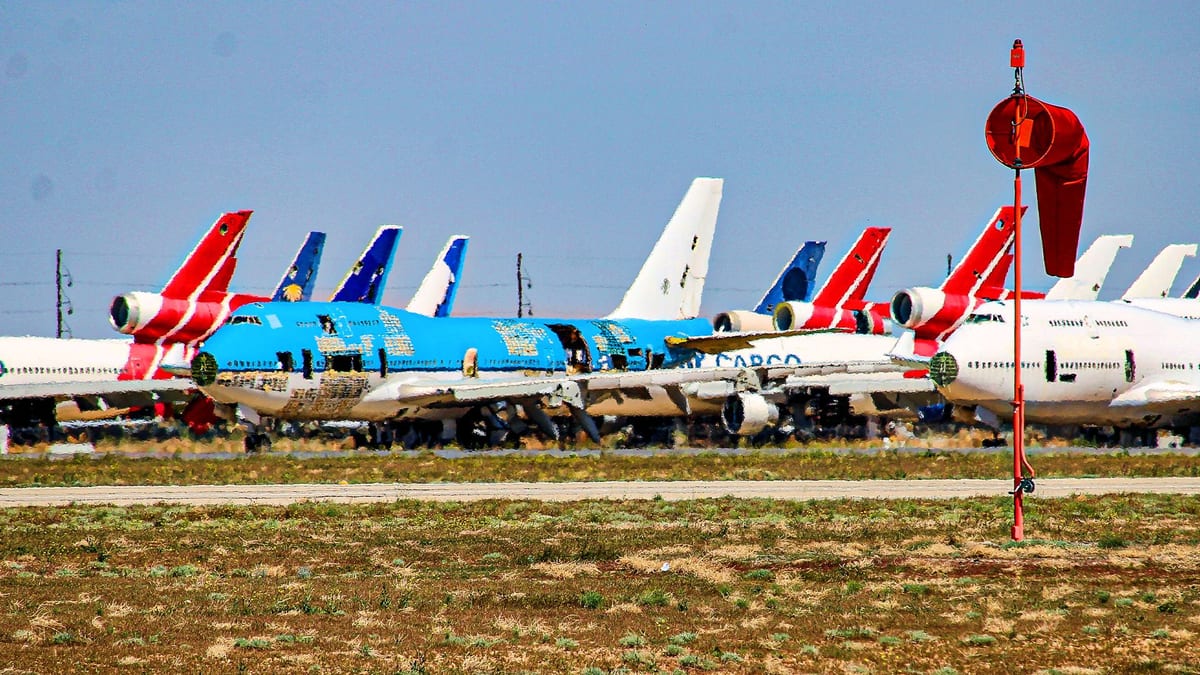
Image by Simple Flying
From Flight Line To Long-Term Storage
Retirement for a commercial jet rarely begins with an immediate trip to the scrap heap. Industry reports indicate that many aircraft first move into temporary or long-term storage as airlines adjust to market cycles, fuel prices and changing route networks. Operators park older or less efficient models while newer, more economical jets enter service, keeping their options open if demand rebounds.
Dry, high-elevation desert airfields in the southwestern United States have become the most visible symbols of this transition phase. Facilities such as Pinal Airpark in Arizona and sites in California’s Mojave region are frequently cited in published coverage as major hubs for parking and preserving out-of-service jets. The arid climate slows corrosion and the hard-packed soil reduces the need for extensive paving, making these locations practical holding grounds for aircraft that may yet fly again.
Once parked, jets are placed into varying levels of preservation. Publicly available information shows that technicians typically drain fluids, seal openings, protect engines and cover windows to shield interiors and systems from the elements. Some aircraft are kept in an “active storage” condition, meaning they can be reactivated with comparatively modest work, while others enter deep storage, expecting either conversion, part-out or eventual dismantling.
This limbo period can last from months to many years. Recent coverage of pandemic-related fleet changes highlighted how aircraft that seemed destined for retirement were occasionally pulled back into service as travel demand recovered or as cargo markets tightened, underscoring how flexible the retirement pipeline can be.
Second Lives As Freighters And Special-Mission Aircraft
For airframes that remain structurally sound and economically viable, conversion into cargo aircraft has become one of the most prominent second-life pathways. Aviation industry analyses point to steady demand from express carriers and e-commerce operators seeking to expand or refresh freighter fleets without paying the premium for brand-new cargo aircraft. Converting older passenger jets can extend their operational life by a decade or more.
Widebody models in particular have seen extensive use in cargo conversion programs. Previous generations of Boeing 767s and Airbus A330s, for example, have been modified by specialized engineering firms that cut new cargo doors, reinforce floors and strip out cabin furnishings. While some aircraft types, such as certain aging Boeing 747-400 variants, are now viewed as less economical to convert, others continue to find strong demand in freight service as long as fuel burn and maintenance costs remain competitive.
Retired airframes have also been adapted for niche roles beyond standard freight operations. Publicly available case studies describe former passenger jets converted into aerial firefighting tankers, maritime patrol platforms or airborne testbeds for new technologies. In these roles, the aircraft’s large internal volume and range make it a useful platform even when it no longer suits mainstream passenger service.
However, not every retired jet qualifies for such upgrades. Structural fatigue limits, outdated avionics and the rising cost of spare parts can make conversion prohibitively expensive. When this balance tips, aircraft are more likely to be parted out or scrapped, feeding the growing secondary market for used serviceable material.
The Business Of Parting Out And Recycling
Once an airline or leasing company determines that an aircraft will not return to commercial service, it often becomes more valuable in pieces than as a whole. Analysts tracking the sector estimate that hundreds of aircraft each year are disassembled at dedicated facilities, with engines, landing gear, avionics and high-value interior components removed, inspected and certified for reuse.
Industry bodies and environmental agencies have reported that engines alone can represent a majority of the recoverable value of a retired jet, particularly as operators seek cost-effective replacement parts to keep remaining fleets flying. These used serviceable materials are resold to airlines and maintenance providers, cutting both costs and the environmental footprint associated with manufacturing new components.
After components are harvested, the remaining structure advances to material recycling. Technical papers on the subject note that modern processes can reclaim up to roughly 85 to 90 percent of an aircraft’s weight, primarily in the form of aluminum, titanium and other metals. Scrap metal from retired jets is melted down and fed back into industrial supply chains, sometimes even returning to the aviation sector in the form of new aircraft parts.
The rise of composite materials, particularly carbon fiber, has added complexity. Research cited by manufacturers and academic institutions highlights that specialized methods are required to safely process composites and to recover fibers without releasing electrically conductive dust. Efforts are under way within the aviation and materials industries to scale up composite recycling techniques so that next-generation aircraft can be dismantled with minimal waste.
Military Boneyards And Strategic Reserves
Retirement looks different for military aircraft, which are subject to defense planning cycles, arms control treaties and long-term readiness concerns. Publicly accessible information from defense departments describes vast storage complexes where thousands of retired fighters, bombers, transports and helicopters are preserved in various states of readiness.
These military boneyards function both as spare-parts depots and as strategic reserves. Reports on the largest facilities indicate that airframes are carefully cataloged, sealed and periodically inspected so that components can be removed and returned to active fleets as needed. Engines, control surfaces and other critical parts harvested from stored aircraft can significantly reduce support costs for aging fleets that remain in front-line service.
In some cases, stored military aircraft have been reactivated after years in the desert, upgraded with new engines or avionics and returned to operational roles. In others, international agreements have required that certain categories of aircraft be verifiably destroyed, leading to controlled dismantling programs overseen by defense and verification bodies. Metal recovered from these scrapped aircraft, as in the civil sector, typically reenters industrial recycling streams.
The scale of military storage sites has also turned them into points of public fascination. Satellite imagery and media coverage regularly highlight long rows of aging bombers and transports lined up on desert plains, underlining both the cost of modern air power and the logistical challenge of managing its retirement.
From Museum Pieces To Hotels And Homes
Not all retired aircraft end their days behind perimeter fences. A small but high-profile share of airframes find new lives as attractions, accommodation or architectural features. Travel and lifestyle outlets have documented former airliners converted into aviation museums, educational exhibits, themed restaurants and even full-scale hotels where guests sleep in cabins that once crossed oceans.
These creative reuses often involve extensive interior remodeling while preserving the distinctive exterior silhouette of the aircraft. Some projects position retired jets on hilltops or near airports as eye-catching landmarks, tapping into the nostalgia many travelers feel for specific models such as early jumbo jets. Others repurpose fuselage sections as event spaces, offices or private residences, turning what would have been scrap metal into long-term installations.
Artists and designers have also begun to explore smaller-scale upcycling of aircraft materials. Seat components, windows, overhead bins and wing sections have been transformed into furniture, sculptures and décor pieces, capitalizing on the aesthetic appeal and engineering heritage of aviation-grade materials.
Although these high-visibility projects represent only a fraction of global retirements, they serve as reminders that an aircraft’s story does not necessarily end when its logbook closes. From utilitarian second careers in cargo service to inventive roles on the ground, the afterlife of retired aircraft is increasingly varied, commercialized and visible to travelers worldwide.