

I arrived in Winnipeg with a suitcase full of assumptions. I had heard the jokes about the cold, the crime stories, the occasional praise for its arts scene, and the refrain that it was “cheap but boring.”
I had already spent time in more obvious Canadian destinations like Vancouver, Toronto, Montreal, Calgary, and Quebec City, so I thought I knew roughly where Winnipeg would sit on that spectrum.
What I actually experienced was a city that felt strangely intimate and rough edged, with moments of genuine beauty, flashes of cultural depth, and a fair share of disappointment. It was not love at first sight, but it did leave a lasting impression that was more complicated and human than I expected.
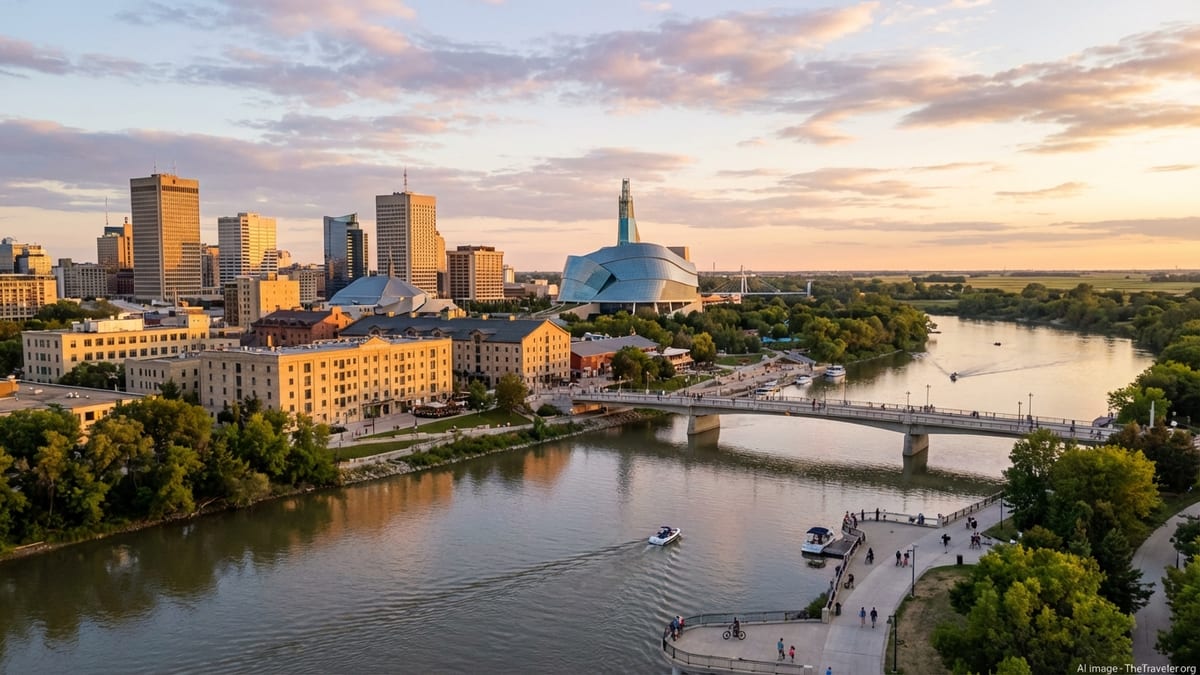
First Impressions: A City That Feels Smaller Than Its Statistics
On paper, Winnipeg is a major Canadian city with a metro population that surprised me when I looked it up. On the ground, it felt more like a very large town than a bustling metropolis. Flying in over the flat prairie, I could see endless grids of low rise neighbourhoods and big box shopping corridors, but no dramatic skyline or mountains framing the horizon the way Calgary and Vancouver have. Landing here did not give me the sense of arrival I felt in Toronto or even Halifax. It felt practical, almost matter of fact.
Driving in from the airport, that impression deepened. Streets spread wide, traffic moved easily, and nothing felt particularly dense or hectic. Compared to the congestion of Montreal or Vancouver, Winnipeg’s pace was almost disorientingly relaxed. Part of me liked that my shoulders dropped almost immediately. Another part of me wondered if I had flown so far just to be surrounded by chain restaurants and strip malls that could have been almost anywhere in North America.
It took me a day or two to adjust my expectations. Winnipeg is not trying to put on a show the way tourist heavy cities do. There is no mountain backdrop, no ocean, no Old Port with manicured cobblestones. What it does have reveals itself slowly: river confluences, old warehouses turned cultural spaces, neighbourhood coffee shops full of regulars, and the sense that this is a place people live in year round rather than perform for visitors.
Compared to other Canadian cities I have visited, Winnipeg’s first impression is underwhelming. If you need instant postcard charm, you do not get it here. But once I accepted that, I started noticing a quieter authenticity that I rarely feel in more polished destinations.
Weather, Mood and the Reality of “Winterpeg”
I did not come in the depths of January, and I am grateful. Even in shoulder season, I could feel why “Winterpeg” is a nickname locals use with a mixture of pride and exasperation. The sky often pressed low and grey over the city, and even a mild wind felt sharper than the same temperature in Vancouver or Toronto. Locals talked casually about minus thirty days the way people on the coasts talk about rain. That toughness is part of the city’s identity, but as a visitor, it can be a mental hurdle.
Weather affects mood, and I felt that in the streets. On colder, windier days, Winnipeg felt withdrawn. Fewer people lingered outdoors, the sidewalks emptied early, and I found myself retreating back to my hotel earlier than I would in, say, Montreal, where nightlife and street energy pull you out late into the evening even in winter. Winnipeg felt more utilitarian in bad weather: get where you need to go, then get home.
That said, I could see how the climate shapes a strong indoor culture. Cafes felt like living rooms, and when I visited an event at The Forks, the public market and common areas were full of families and groups of friends hiding from the wind and sharing long conversations. Compared to coastal cities that lean heavily on patios and parks, Winnipeg funnels social life indoors for much of the year, and that creates a surprisingly warm, communal atmosphere once you are in the right spaces.
If weather is a major factor in where you choose to travel, Winnipeg is a city to visit intentionally. In deep winter, you have to embrace the cold and plan around it, leaning into indoor culture and winter activities. In summer, from roughly June to August, the atmosphere softens and the city feels far more open and approachable, closer to how Calgary or Ottawa feel in their own peak seasons.
Downtown, The Forks and the Exchange: Beauty, Gaps and Uneasy Edges
Most guidebooks point you first toward downtown, The Forks, and the Exchange District, and that was how I structured my days. The Forks in particular was the first place I visited that felt truly distinctive. Standing at the confluence of the Red and Assiniboine rivers, you can sense the site’s long history as a meeting place. The converted brick buildings, public art, and riverfront walkways gave me a much clearer visual identity than I had found driving in from the airport.
Inside The Forks Market, I found the kind of experience I expect in bigger Canadian cities: local food stalls, craft beer, artisan goods. It reminded me a bit of Granville Island in Vancouver or St. Lawrence Market in Toronto, but smaller and more relaxed. I liked how everyday it felt. There were tourists, but also office workers grabbing lunch and families sharing tables. What disappointed me slightly was the limited variety compared to those larger markets. After a couple of visits, I felt I had seen most of it, whereas I can explore markets in Montreal or Vancouver for days without feeling I have exhausted them.
A short walk away, the Exchange District surprised me most. The collection of early 20th century warehouses and historic commercial buildings is one of the most atmospheric areas I have seen in any Canadian city. In good light, those brick facades and narrow streets could almost pass for a small corner of Chicago. Independent galleries, coffee shops, and small theatres tucked into these old buildings give the area a creative, slightly scruffy charm. This was where I felt Winnipeg’s soul most clearly.
But the gaps are hard to ignore. Compared with downtown Calgary or central Ottawa, Winnipeg’s downtown still feels underpopulated and uneven. Some blocks buzz with activity, while others are quiet to the point of feeling deserted. Certain streets made me a little uneasy after dark, not because anything happened to me, but because the mix of vacant storefronts, visible poverty, and lack of other pedestrians left me acutely aware that I was a visitor. I have walked through rougher feeling pockets of Vancouver and Toronto, but they are usually embedded in larger zones of street life. Winnipeg’s quieter core makes the edges feel starker.
Culture, Festivals and Indigenous Presence: Deeper Than I Expected
One of the biggest ways Winnipeg differentiated itself from other Canadian cities I have visited was in how openly it engaged with Indigenous history and contemporary Indigenous culture. At The Forks and around the city, signage, installations and programming consistently acknowledged the Indigenous peoples of the region. It felt less like an afterthought and more like a central narrative. Compared with cities where Indigenous presence is visible but often pushed to designated cultural centres, Winnipeg’s integration felt more honest and present.
That same depth carried through the city’s festivals and arts scene. In summer, Winnipeg’s calendar fills quickly. Even in a short stay, it was obvious this is a festival city. The Fringe Theatre Festival, Folklorama, the International Jazz Festival and the Red River Exhibition are just some of the events that light up the city in June, July and August. Rather than giant, slick spectacles like Toronto’s major film festival, these events felt more grassroots and community built. I found myself chatting with volunteers and artists who clearly lived here year round and poured energy into making these events happen.
There is also a multicultural vibrancy that far exceeded the city’s modest image. Folklorama, a huge multicultural festival that stretches across dozens of cultural pavilions, is a good example of this spirit. Even though I could not catch the full event, hearing locals describe it made me realize Winnipeg’s diversity is more woven into neighbourhood life than its stereotypes suggest. In that sense, the city reminds me more of Montreal than of smaller Prairie cities, even if the scale is very different.
Where I did feel a gap was in casual, everyday street culture. In Montreal or Vancouver, it is easy to stumble into buskers, pop up events, or crowded plazas in almost any season. In Winnipeg, those moments mostly coincided with planned events, and outside of those, public spaces could feel a bit underused. The city clearly has cultural depth, but you have to know when and where to look for it. If you come in the wrong week or stick only to a small slice of downtown, you might miss much of what locals love about the place.
Transit, Getting Around and the “Car City” Trade off
Getting around Winnipeg forced me to confront one of the biggest trade offs of visiting a more car centric Prairie city. Compared to Toronto’s subways, Montreal’s metro, or even the growing light rail systems in Calgary and Edmonton, Winnipeg relies heavily on buses and wide roads. The bus network covers a large area, but in practice, I found it slower and less intuitive than the transit systems in other Canadian cities I have used.
Service has been going through a major redesign, and I visited at a time when routes and stops were still in flux. Talking to riders and reading local coverage, it was clear many people were frustrated. Some routes had fewer stops than before, and late night service was thinner than you would expect from a city this size. Safety concerns on buses have been serious enough that the city has added community safety officers and raised fares to levels comparable with much larger cities, all of which contribute to a sense that transit is under pressure rather than thriving.
As a visitor, the result was that I defaulted to using rideshare or renting a car much more than I typically do. In Vancouver or Montreal, I barely think about driving because public transit is fast, frequent and intuitive. In Winnipeg, I found myself checking bus schedules carefully and planning around longer travel times. When I did ride, buses were essential workhorses but not especially comfortable or confidence inspiring after dark.
The upside is that driving in Winnipeg is relatively straightforward. Streets are generally wide, and rush hour traffic is noticeable but not at the scale of Toronto gridlock. If you are comfortable driving, you can move between neighbourhoods with minimal stress. The downside is that this car orientation shapes the city’s feel. Many interesting spots are separated by stretches of fairly anonymous arterial roads and parking lots. As a pedestrian, I never felt the seamless urban fabric I get walking across central Montreal, Quebec City or even downtown Calgary.
Costs, Food and the Trade Off Between Affordability and Choice
Where Winnipeg clearly stood out in a positive way was cost. Relative to Toronto, Vancouver or Victoria, my money went significantly further here. Accommodation, meals and basic daily expenses were meaningfully lower than what I have come to expect in major Canadian cities. After paying eye watering hotel rates in downtown Vancouver, being able to find a decent, centrally located place in Winnipeg at a far more reasonable price felt like a relief.
Groceries and casual dining also felt modestly cheaper. It is not a budget destination in an absolute sense, but compared to the runaway prices on the coasts, Winnipeg gave me a sense of value. If you are traveling in Canada on a tighter budget or simply prefer not to spend a fortune on basics, this city offers a more sustainable way to experience urban Canada. The trade off is that you may sacrifice some of the variety that comes with bigger, richer restaurant scenes.
The food scene itself was better than its reputation but did not blow me away. I had some memorable meals, from creative takes on prairie ingredients to hearty Ukrainian and Filipino dishes that reflect the city’s diverse communities. There are excellent bakeries and coffee shops, and a few restaurants that could compete in any major Canadian city. But compared to the sheer density of great options in Montreal or Toronto, Winnipeg’s scene feels more scattered. You have to seek out standouts rather than assume you cannot go wrong by just walking down the block.
Still, I appreciated that when I did find places I liked, the bill did not induce sticker shock. In that sense, Winnipeg’s affordability allowed me to take more chances, try more local spots and linger longer without constantly calculating costs. For travelers who enjoy exploring everyday neighbourhood food rather than chasing Michelin stars, this balance of decent variety and lower prices is appealing.
Neighbourhood Character and Comparison With Other Canadian Cities
To really understand how Winnipeg feels compared to other Canadian cities, I tried to spend time in different neighbourhoods rather than just orbiting downtown. It quickly became clear that this is where the city’s most interesting contrasts live. Residential streets lined with older houses and big trees reminded me of quieter parts of Edmonton or Regina, while certain commercial strips evoked pieces of Toronto’s more modest inner suburbs.
Neighbourhoods with strong immigrant communities gave Winnipeg much of its flavour. Walking past small grocery stores, ethnic restaurants and community centres, I felt echoes of the multicultural corridors of Toronto and Vancouver, just on a smaller scale. The absence of mountains or a dramatic waterfront means the focus shifts to human scale details: porch decorations, murals, corner stores, and the way people actually use the streets and parks.
Compared with the tourist polished neighbourhoods of Quebec City or the hyper curated streets of central Vancouver, Winnipeg’s areas felt less staged and more lived in, for better and worse. There were fewer Instagram ready facades and more ordinary life. At times, that came with visible struggles: aging infrastructure, vacant lots, and social challenges that Canada is still grappling with nationally. If you want your travels to airbrush those realities out, Winnipeg will not cooperate. But if you are interested in cities as they actually are, that honesty can be refreshing.
What I missed, compared with my experiences in Montreal or even Halifax, was a consistently walkable, cohesive central district where multiple neighbourhoods blend into each other without long gaps. Winnipeg has pockets of walkability and charm rather than a continuous swath, and your experience depends heavily on how you connect those pockets. Planning your days thoughtfully matters here more than in cities where you can simply wander and count on stumbling into something interesting every few minutes.
The Takeaway: Who Winnipeg Is For and How I Would Do It Differently Next Time
By the time I left Winnipeg, my feelings about the city were layered. It did not seduce me the way Vancouver’s ocean and mountains do or overwhelm me with energy like Toronto. It also did not immediately charm me with a concentrated historic core the way Quebec City does. Instead, Winnipeg won me over in smaller, more personal increments: a conversation with a café owner in the Exchange District, an unexpectedly moving piece of Indigenous public art at The Forks, a warm evening at a local festival where everyone seemed to know everyone.
If you are looking for an easy, iconic Canadian vacation with big scenery and tourist ready infrastructure, I would not put Winnipeg at the top of your list. Western newcomers will likely find Calgary or Vancouver more instantly satisfying, and those drawn to culture and food might gravitate first to Montreal or Toronto. Winnipeg asks more of you as a visitor. It requires you to look past first impressions, accept some rough edges, plan around a less convenient transit system, and meet the city on its own terms.
That said, there are clear groups for whom Winnipeg is absolutely worth the trip. Budget conscious travelers who still want a real city experience will appreciate the lower costs. Festival lovers who plan around specific events will find a rich, community driven calendar in summer. Travelers interested in Indigenous history and contemporary culture will find a presence here that feels more integrated and visible than in many larger Canadian cities. And anyone curious about the Prairies beyond stereotypes will find in Winnipeg a complex, imperfect, but undeniably real urban story.
If I were to do it again, I would come in high summer, anchor myself near The Forks or the Exchange District, rent a car for flexibility, and plan my visit around a major festival or two. I would also give myself permission not to see “everything,” but to spend more time in a few neighbourhoods, getting to know small routines and local spots. Winnipeg will probably never compete with the postcard glamour of other Canadian cities, but for travelers willing to trade instant charm for authenticity, it offers something more subtle and lasting.
FAQ
Q1. Is Winnipeg safe to visit compared to other Canadian cities?
Safety in Winnipeg feels more uneven than in many other Canadian cities I have visited. There are very safe, family friendly areas and busy cultural hubs, but downtown and some surrounding neighbourhoods can feel quiet and uneasy after dark, especially if you are walking alone. I did not have any incidents, but I was more cautious than I am in cities with busier cores, and I planned my evenings around well lit routes and rideshares rather than long walks late at night.
Q2. When is the best time of year to visit Winnipeg?
In my experience, the best time to visit is from late June through August, when festivals are in full swing and the weather is warm enough to enjoy the rivers, patios and parks. Winter can be beautiful in its own stark way, but the cold is intense, and much of the city’s life moves indoors, which can be tough if you are not used to harsh prairie winters. Shoulder seasons can work, but you risk grey, chilly days that do not show the city at its best.
Q3. Do I need a car in Winnipeg as a visitor?
You can technically get around without a car, using buses and rideshares, but I found having a car made my visit much smoother. The bus network is extensive on paper, yet service can be slower, less frequent and more confusing than transit in cities like Toronto or Montreal. If you want to explore multiple neighbourhoods comfortably, especially in the evening, renting a car or budgeting for rideshares is a practical choice.
Q4. How does Winnipeg’s cost of travel compare with other Canadian cities?
Overall, I found Winnipeg noticeably more affordable than cities such as Vancouver, Toronto or Victoria. Hotels, casual restaurants and everyday expenses were all lower, which meant I could do more without constantly worrying about prices. It is not a rock bottom budget destination, but given how expensive many Canadian cities have become, Winnipeg offers relatively good value for what you get.
Q5. Is there enough to do in Winnipeg for a long weekend?
Yes, there is plenty to fill a long weekend if you plan thoughtfully. Between The Forks, the Exchange District, local museums, a couple of neighbourhoods, and at least one festival or performance if you time it right, I never felt short of options. Where Winnipeg differs from larger cities is that you have to connect specific dots rather than rely on endless spontaneous discovery. With a loose itinerary, three to four days can feel full and satisfying.
Q6. How does Winnipeg’s food scene compare to other Canadian cities?
Winnipeg’s food scene is smaller and less hyped than those in Toronto, Vancouver or Montreal, but it pleasantly surprised me. I found strong local bakeries, inventive restaurants and a good range of cuisines that reflect the city’s diverse communities. The difference is density: instead of entire districts crammed with standout spots, you are discovering individual gems scattered across the city, which requires a bit more research and local tips.
Q7. Is Winnipeg a good destination for first time visitors to Canada?
If it is your very first trip to Canada and you want the classic, postcard version of the country, I would probably start with somewhere like Vancouver, Toronto or Montreal. Winnipeg works better as a second or third Canadian city, once you have seen the obvious highlights and are curious about how people live in a less tourist oriented, more everyday Canadian setting. It is rewarding, but it does not carry the instant “wow” factor many first timers expect.
Q8. What makes Winnipeg different from other Prairie cities like Calgary or Edmonton?
For me, Winnipeg felt more intimate and historically layered than Calgary or Edmonton. Without the distraction of mountains or rapid downtown development, the focus falls more on older architecture, local arts and a strong sense of community. Its Indigenous and multicultural stories are woven into the city narrative in a way I noticed more sharply here. At the same time, it feels less economically flush and a bit rougher around the edges than Calgary in particular.
Q9. Are there good cultural and Indigenous experiences for visitors?
Yes, and this is one of Winnipeg’s real strengths. From the way The Forks presents its long history as a meeting place to the city’s museums, galleries and public art, I found a consistent and thoughtful engagement with Indigenous histories and contemporary voices. Paired with festivals and community events, this gives Winnipeg a cultural depth that quietly rivals larger cities, even if it is not as heavily marketed to tourists.
Q10. Would I visit Winnipeg again, and what would I change next time?
I would visit again, but I would be more strategic. I would time my trip for peak summer, plan around at least one major festival, stay within walking distance of The Forks or the Exchange District, and rent a car for flexibility. I would spend less time trying to “cover” the city and more time returning to a few favourite neighbourhood spots. With those adjustments, I think Winnipeg would feel less frustrating and more rewarding, highlighting the aspects that make it quietly special.