

Picking the right place to stay near Niagara Falls can transform a quick sightseeing stop into a memorable trip. From hotel towers facing the Horseshoe Falls to quieter neighborhoods with easy shuttle connections, each area on both the Canadian and U.S. sides offers a different experience. Understanding these districts before you book helps you balance views, budget, convenience and atmosphere.
Understanding the Layout of Niagara Falls
Niagara Falls spans the border between Ontario in Canada and New York State in the United States, and where you stay will shape what you see first and how you get around. The Canadian side is known for its sweeping, postcard-style panoramas of all three waterfalls, along with high-rise hotels clustered above the gorge. The U.S. side offers a closer, more park-like feel, with trails, islands and viewpoints that bring you right beside the water. Both sides have neighborhoods that work well as a base, depending on your priorities.
Most visitors focus on staying within a short walk or quick shuttle ride of the main viewpoints. On the Canadian side, that usually means the Fallsview district, Clifton Hill and nearby hotel corridors linked by the WEGO visitor bus system. On the U.S. side, it often means downtown Niagara Falls near Niagara Falls State Park, where hotels sit a few blocks from the park entrances. If you plan to see both sides, factor in border crossing times at the Rainbow or Whirlpool bridges.
Because the area is compact, distances can look deceptively small on a map. A hotel that appears close may sit at the top of a steep hill or require a bus connection to reach the viewing platforms. Before you book, check not only how far the property is from the falls, but also how you will move between your hotel, viewpoints, attractions and parking. Public transportation, inclines and walking routes all play a role in how convenient a location will feel once you arrive.
Season also matters. In summer and on holiday weekends, streets around the falls can be crowded and parking fills quickly. During these periods, being able to walk or use frequent shuttle buses can be more valuable than saving a few dollars by staying farther away. In quieter seasons, you may find discounted rooms with views that would be far more expensive in July or August, giving you a chance to prioritize scenery without stretching your budget.
Fallsview District, Niagara Falls, Ontario: Best for Iconic Panoramic Views
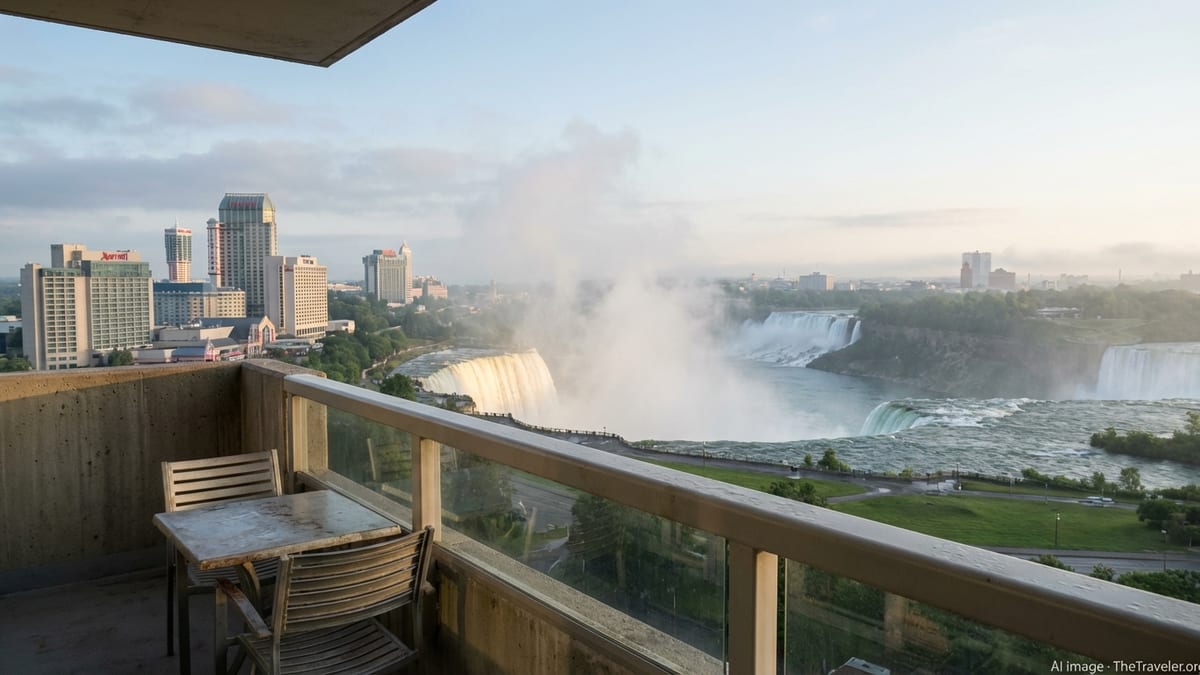
For many travelers, the classic image of Niagara Falls is taken from a high-rise hotel window in the Fallsview district on the Canadian side. This neighborhood, centered on Fallsview Boulevard and stretching toward the Niagara Parkway, sits slightly upriver from the Horseshoe Falls and offers some of the widest, most dramatic vistas of the waterfalls and gorge. Many hotels here were deliberately built to face the falls, with room categories clearly labeled as fallsview or city view.
Staying in Fallsview offers the most straightforward way to enjoy the scenery without effort. In many properties, you can watch the morning mist rise over the Horseshoe Falls, see the nightly illumination and, in season, catch fireworks displays from your room. Upper floors and corner rooms will usually command higher prices, especially during summer weekends, but travelers who value views above all else often consider the premium worthwhile.
In practical terms, Fallsview is an entertainment hub as well as a hotel district. The large casino complex, theaters, restaurants and the Skylon Tower all sit nearby, giving you plenty to do within a short walk of your room. The area is built on a plateau above the river, so expect some uphill and downhill walking between your hotel, the promenade along the Niagara Parkway and attractions closer to the brink of the falls. The Falls Incline Railway connects the upper district to the Table Rock area, providing a convenient shortcut for those who prefer to limit steep climbs.
For getting around the broader destination, Fallsview is well-served by the WEGO visitor bus system, which links hotels with key sites and other tourist districts. This makes it easy to park your car once and rely on transit for the rest of your stay. If you want a base that puts you at the center of the action, with restaurants and nightlife steps away and the most photographed views just outside, Fallsview is the natural first choice.
Clifton Hill and Surroundings: Best for Families and Nonstop Attractions
North of Fallsview, the Clifton Hill district in Niagara Falls, Ontario is the area most families picture when they think of a classic tourist strip. Lined with arcades, themed attractions, funhouses, mini-golf and casual restaurants, it feels more like a compact amusement quarter than a traditional neighborhood. Hotels here tend to be mid-rise rather than towering, and many cater directly to families with pools and bundled attraction passes.
In terms of access, Clifton Hill offers a strong combination of walkability and connectivity. The hill slopes down toward the Niagara Parkway and the river, putting you within a short walk of viewpoints, boat tours and the entrance points to many tours and experiences along the gorge. At the top and bottom of the hill, WEGO bus stops connect you to other parts of the city, including Fallsview, Lundy’s Lane and the attractions further along the parkway.
While Clifton Hill does not typically deliver the same panoramic in-room views as Fallsview’s high-rises, it compensates with proximity to kid-focused attractions. The Niagara SkyWheel offers elevated, enclosed cabins with broad views over the falls and city, and the Fallsview Indoor Waterpark near the district’s edge can be a major draw during cooler months. For families who plan to spend as much time in arcades and rides as at the main viewing platforms, staying here can eliminate frequent transfers and keep everything within easy reach.
One factor to consider is ambiance. Clifton Hill is lively well into the evening, especially in summer, and the bright lights and music create a carnival atmosphere. Travelers seeking quiet, scenic relaxation may prefer to stay a little outside the core of this strip and visit it for a few concentrated hours instead. Those who enjoy an energetic setting, however, often find this district delivers exactly the immersive vacation feel they want.
Lundy’s Lane and Outlying Canadian Areas: Best for Budget and Parking
Just inland from the main tourist core, Lundy’s Lane and adjacent corridors in Niagara Falls, Ontario offer a more spread-out landscape of hotels, motels and campgrounds. This area appeals most to travelers watching their budget, those arriving by car who value easy parking, and visitors staying for several nights who prefer larger rooms or suites over direct views. Distances to the falls are longer, but still manageable with planning.
Lundy’s Lane hotels typically sit along a broad commercial strip with chain restaurants, retail stores and services that can be useful during a longer stay. Because land and building costs here are generally lower than directly above the gorge, you may find better rates, complimentary parking or added amenities such as kitchenettes and indoor pools. Road layouts are simpler than in the dense cliffside districts, which can make arriving and departing by car less stressful, particularly in peak season.
In terms of access to the falls, much of Lundy’s Lane connects into the visitor transportation network. The WEGO system has historically served this corridor, linking it to central transfer points closer to the river. If you plan to rely on the bus, it is worth checking that your chosen hotel sits near an active stop and confirming operating dates and frequencies that match your travel period. Many visitors opt for a hybrid approach, driving to a parking area near the parkway on their first day, then using transit or walking from there.
Staying outside the immediate tourist core also changes the feel of your trip. Even though you remain within the city, the pace is noticeably calmer, and you are more likely to encounter local businesses alongside souvenir shops. For some travelers, this balance of local atmosphere, accessible prices and straightforward road access outweighs the lack of a direct falls view. If you are comfortable trading scenery for space and savings, Lundy’s Lane and similar corridors are worth serious consideration.
Niagara Parkway and Nearby Canadian Park Areas: Best for Scenic Strolls and Green Space
Running along the rim of the gorge on the Canadian side, the Niagara Parkway offers one of the most scenic drives and promenades in the region. While there are fewer large hotels directly on this route compared with Fallsview and Clifton Hill, staying near the parkway places you steps from landscaped gardens, walking paths and continuous views of the river and falls. This setting suits travelers who prioritize outdoor time and a more relaxed ambiance over dense entertainment districts.
Many visitors know the Table Rock area, where viewpoints sit close to the brink of the Horseshoe Falls and indoor observation spaces provide shelter from the mist. From there, the parkway extends north past the American Falls and Bridal Veil Falls, connecting to overlooks, attractions and the start of the path toward Niagara-on-the-Lake. Accommodations near this corridor, even when set back on side streets, often give you the option to walk to these viewing points early in the morning or at quieter times in the evening.
Access from parkway-adjacent areas is typically straightforward for pedestrians and those using the visitor transportation system. WEGO buses run along the parkway, stopping at major attractions and connecting back to hotel clusters and transfer hubs. This makes it feasible to stay slightly outside the densest commercial zones while still moving easily between viewpoints, boat landings and indoor attractions. For cyclists, the parkway also offers a scenic route, and buses are equipped to carry bikes on front-mounted racks, which can extend how far you explore in a day.
Travelers who choose this style of location often describe their stay as feeling more like a traditional park visit, with time spent on benches, in gardens and along riverside paths. Dining and shopping options may require slightly more walking or a short transit ride compared with the restaurant-dense districts, but the payoff is a calmer environment. If your ideal trip to Niagara Falls centers on photography, leisurely walks and quiet moments watching the water, an address near the parkway can be an excellent fit.
Downtown Niagara Falls, New York: Best for Access to Niagara Falls State Park
On the U.S. side, the most convenient places to stay for visiting the falls cluster around downtown Niagara Falls, New York, within walking distance of Niagara Falls State Park. Unlike the Canadian side’s high-rise skyline, this area has a lower profile, with a mix of medium-height hotels, smaller independent properties and some new developments near the main park entrances. Rather than wide-angle views from hotel windows, the focus here is on very short walks to riverside paths, islands and observation points inside the park.
Niagara Falls State Park, created in the nineteenth century, is the centerpiece of the U.S. side experience. Trails, bridges and lookout points on Goat Island and other small islands bring you within a short distance of the American Falls and Bridal Veil Falls, and offer alternate perspectives on the Horseshoe Falls downstream. Staying in downtown hotels a few blocks away allows you to enter the park early or return in the evening with minimal travel time, which can be especially valuable if you want to photograph sunrise, sunset or night illuminations.
Downtown Niagara Falls, New York, has been undergoing gradual redevelopment, and visitor services are improving as new businesses open. You will find restaurants, cafes and convenience stores within walking distance of most hotels, along with attractions such as an urban casino and cultural venues. Street layouts are relatively simple, and much of the area around the state park is flat, making walking manageable for many visitors. Parking is generally more available than immediately across the river, although fees and regulations vary by lot and season.
From an access perspective, staying on the U.S. side is practical if you are arriving from within the country by car or domestic flight and want to minimize border crossings. However, if you hope to see the panoramas for which Niagara Falls is most famous, you will likely want to schedule at least a half-day visit to the Canadian side. Passport requirements, potential wait times at the Rainbow Bridge and parking near Canadian viewpoints are all factors to consider when deciding whether to base yourself in downtown Niagara Falls, New York, for your entire stay.
Quieter U.S. Neighborhoods and Regional Bases: Best for Side Trips and Lower Key Stays
Beyond the core streets around Niagara Falls State Park, several residential and mixed-use neighborhoods in Niagara Falls, New York and nearby towns can work as a base for travelers seeking a quieter environment. Areas slightly removed from the park often offer more residential surroundings, traditional streetscapes and, in some cases, easier on-street parking. While you will generally trade immediate proximity to the falls for this calm, driving distances remain short by most standards.
Choosing a hotel or rental in these areas may suit visitors who plan to combine the falls with broader regional exploration. Day trips to Buffalo, the Erie Canal corridor or nearby wine regions on both sides of the border are straightforward by car, and using a quieter base can make it easier to come and go without navigating the densest tourist traffic each time. For families or groups staying several nights, access to supermarkets and local services, as well as a more residential feel, can be appealing.
However, it is important to be realistic about access. Walking from these outer neighborhoods to the falls is usually impractical, so you will be relying on a car or, in some cases, local transit services. Street parking around Niagara Falls State Park and the downtown core can fill quickly in peak season, and you may need to budget for paid lots on days you visit the main viewpoints. If your primary goal is to see the falls multiple times a day, staying closer is generally more convenient.
For travelers who prefer to separate their sightseeing time from their downtime, though, these quieter districts can provide a welcome contrast. Even after short drives, returning in the evening to a more low-key street or hotel away from the constant sound of traffic and crowds can help a busy travel day feel more balanced. As with any location choice around Niagara, the decision comes down to how often you want to be at the falls themselves versus exploring the wider region.
How to Choose the Right Area for Your Trip
Deciding where to stay near Niagara Falls starts with clarifying your priorities. If your top goal is to wake up and fall asleep to uninterrupted views of the waterfalls, the Fallsview district on the Canadian side is the most straightforward choice. If you are traveling with children who will spend as much time in arcades, waterparks and rides as at the viewpoints, a hotel near Clifton Hill may make the most sense. Those with tighter budgets, larger vehicles or longer stays might gravitate toward Lundy’s Lane or similar outlying corridors where daily parking and room rates can be more forgiving.
Travelers who see the falls as one highlight in a broader itinerary might prefer locations that simplify driving in and out of the region. On the U.S. side, that could mean staying a short drive from Niagara Falls State Park in a quieter neighborhood or nearby town, while planning one or two focused days at the viewpoints. On the Canadian side, it might involve selecting accommodations near major routes leading toward Niagara-on-the-Lake, wine country or the greater Toronto area, then using the visitor transportation system or short drives to reach the main promenade.
Mobility and accessibility are also key considerations. Some areas, especially the cliffside districts on the Canadian side, involve hills, inclines and busy intersections that can be challenging for travelers with limited mobility. In such cases, proximity to the parkway itself, to the Falls Incline Railway or to WEGO bus stops with frequent service can make a significant difference in comfort. Verifying elevator access, drop-off zones and the distance from hotel lobbies to nearest transit stops before booking can help avoid surprises on arrival.
Finally, remember that Niagara Falls changes character with the seasons. Summer brings extended hours, busier streets and frequent events, while winter can be quieter, with frozen mist and occasional closures of certain seasonal attractions. Shoulder seasons often offer a middle ground: lower rates, fewer crowds and still-reliable transportation services. Whichever time of year you choose, align your accommodation choice with how you plan to experience the falls, whether that is from a high-rise window, a riverside bench or the deck of a boat tour.
FAQ
Q1. Which area offers the very best views of Niagara Falls from hotels?
The Fallsview district on the Canadian side generally offers the broadest, most panoramic views, especially from high-rise hotels facing the Horseshoe Falls.
Q2. Is it better to stay on the Canadian or U.S. side of Niagara Falls?
The Canadian side is stronger for wide-angle views and dense attractions, while the U.S. side is better for a park-like feel and easy access to trails and islands.
Q3. Can I walk to Niagara Falls from hotels in Clifton Hill?
Yes. From most Clifton Hill properties you can walk down to the Niagara Parkway and main viewpoints in roughly 10 to 15 minutes, depending on your exact location.
Q4. Do I need a car if I stay in Fallsview or Clifton Hill?
Not necessarily. Both districts are highly walkable and connected by the WEGO visitor bus system, which links major hotels with viewpoints and attractions.
Q5. Are Lundy’s Lane hotels too far from the falls?
Lundy’s Lane is farther from the brink, but still a short drive or bus ride away. Many visitors stay there for better prices and parking, then use transit or drive in.
Q6. What is the most convenient place to stay on the U.S. side?
Hotels in downtown Niagara Falls, New York, within walking distance of Niagara Falls State Park, are the most convenient for visiting U.S. viewpoints.
Q7. How easy is it to cross between the U.S. and Canadian sides if I stay in one country?
Crossing via the Rainbow Bridge is straightforward with proper travel documents, but you should allow extra time for border queues, especially in peak season.
Q8. Are there quiet places to stay near Niagara Falls away from crowds?
Yes. Outlying areas such as Lundy’s Lane on the Canadian side and residential districts or nearby towns on the U.S. side generally offer a calmer atmosphere.
Q9. Is public transportation reliable around Niagara Falls?
On the Canadian side, the WEGO bus network offers frequent service in peak season and year-round coverage on core routes, making it practical to rely less on a car.
Q10. When is the best time of year to book a fallsview room?
High summer and holiday weekends see the strongest demand. For better value, consider spring or autumn midweek stays, when rates are often lower and crowds thinner.