

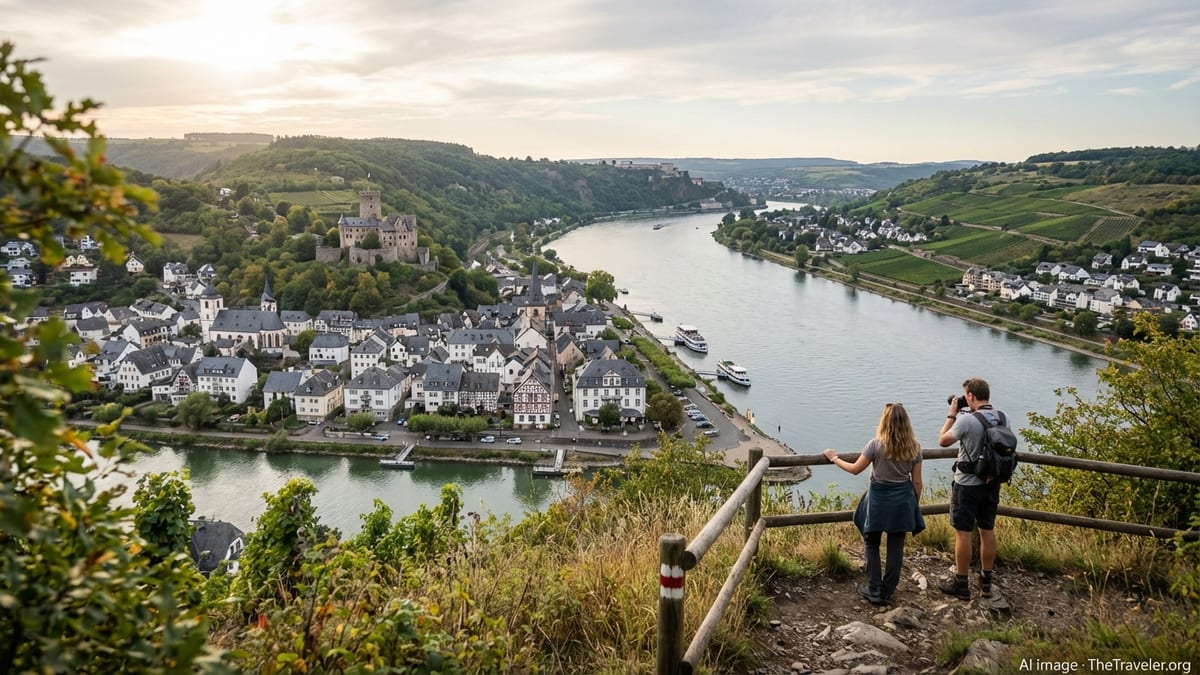
Lahnstein is one of those places that quietly rewards travelers who linger. Set at the confluence of the Rhine and Lahn rivers just south of Koblenz, it has its own charms in half-timbered lanes and hilltop castles. But what really makes Lahnstein a smart base is how easy it is to slip away for day trips: by train, regional bus, boat or even on foot along famed hiking trails.
From storybook river towns to spa resorts and volcanic lakes, the region around Lahnstein offers more worthwhile excursions than you are likely to squeeze into a single visit. If your time is limited, covering the main things to do in Lahnstein first helps decide which day trips are realistic. The trick is choosing the ones that genuinely justify a full day of your time.
Koblenz: Urban Energy at the Meeting of Two Rivers
Just a short hop by regional train from Lahnstein, Koblenz is the obvious first day trip and one that does more than fill a spare afternoon. Trains run frequently between Lahnstein and Koblenz Hauptbahnhof, with journey times usually under 15 minutes, and you can also approach by boat along the Rhine in season. That ease of access makes Koblenz a natural hub for urban flavor after quieter days in the valley. The city sits where the Moselle meets the Rhine, and much of its appeal lies in that setting: long river promenades, leafy parks and viewpoints that give sweeping perspectives on the landscape you are exploring.
For most visitors, the highlight is the Ehrenbreitstein Fortress, which crowns the cliffs on the right bank of the Rhine opposite the old town. A modern cable car glides across the river to the fortress plateau, a ride that is worth it for the views alone. Once on top, you find not only stark fortifications but also exhibition spaces, courtyards and grassy ramparts where you can pause with a coffee and watch cruise ships sliding through the UNESCO-listed Upper Middle Rhine Valley. Back down in the Altstadt, cobbled squares, baroque churches and the German Corner monument at the river junction make for easy wandering, and there is a good selection of restaurants and wine bars for a leisurely lunch.
Koblenz is also a practical springboard. Local tourist offices coordinate cruises on both the Rhine and Moselle, and boat operators run a full roster of sightseeing and castle-focused trips between roughly April and October each year. Trip planning often depends on realistic expectations, which is why travelers check if Lahnstein is worth visiting for more than a short stay.
In recent years, ships have typically operated between Cologne and Mainz, with Koblenz in the middle of the network, and day passes can be a convenient way to hop on and off at smaller towns. That makes a Koblenz day trip doubly worthwhile: you can dedicate part of the day to the city and the rest to a short river cruise without complicated logistics.
Braubach and Marksburg: A True Medieval Castle Above the Rhine
If your mental image of the Rhine involves steep vineyards, timbered villages and a proper medieval stronghold on a rocky spur, Braubach is where that picture comes to life. Sitting just downriver from Lahnstein on the right bank, Braubach is easily reached by regional train or by boat in the main cruising season. The town itself is compact and pretty, but the real draw is Marksburg Castle, looming far above the river on a promontory that has never been conquered or destroyed.
Marksburg is one of the few castles along the Rhine that was not rebuilt in romantic style during the 19th century. Its towers, courtyards and interiors retain a largely authentic medieval character, which makes a guided tour feel closer to time travel than to a museum visit. You pass through armories, kitchens and living quarters furnished to show how nobles and servants lived and worked; steep stairways and thick walls reinforce the sense that this was designed first as a fortress. Guided tours operate several times a day, with German as the primary language and selected additional departures in English, especially during the busier months. It is wise to check tour times locally at the start of your trip and allow a little flexibility in your schedule.
Getting up to Marksburg requires either a steep walk from the town through woodland paths or using limited parking near the castle if you are driving. As a day trip from Lahnstein, it is ideal because you can blend that short, scenic hike with the historic visit and still have time to linger in Braubach’s old town, where inns and wine taverns offer regional Riesling and hearty plates of local cuisine. Combined with the easy train link and the possibility of arriving by boat, Braubach and Marksburg clearly justify a full day, particularly if you are keen on history that feels tangible rather than reconstructed.
Rüdesheim and the Heart of the Upper Middle Rhine Valley
South of Lahnstein, the Rhine twists through its most celebrated stretch, the Upper Middle Rhine Valley. Here the river is narrow and steep-sided, flanked by vineyards and watched over by a chain of castles. Although you can experience this landscape from many spots, Rüdesheim stands out as a particularly rewarding day trip from Lahnstein. You can reach it either by cruising upstream on one of the scheduled river boats operating between Koblenz and Mainz (typically from early April into autumn) or by taking the train via Koblenz, with journey times from Koblenz Hauptbahnhof to Rüdesheim often around an hour on regular services.
Rüdesheim itself is a lively wine town, famous and sometimes crowded, but popular for good reason. The Drosselgasse, a narrow alley of half-timbered houses packed with wine bars and music, is the best-known strip. Step just a street or two away, though, and you find quieter corners and tasting rooms where local vintners pour Rieslings from the surrounding Rheingau slopes. For many visitors, pairing a stroll through town with a late lunch outdoors and an unhurried wine tasting is enough to fill a day. The atmosphere is unabashedly geared toward visitors but still anchored in the region’s wine culture.
Above the town, a cable car drifts over the vineyards to the Niederwald Monument, a grand 19th-century statue that also serves as a panoramic viewpoint. From here hiking paths take you through forest and along ridge-line viewpoints, linking with sections of famous long-distance routes such as the Rheinsteig and the Rhine Castle Trail. Thanks to regular boat and train connections, you can shape the day as a loop: perhaps cruise one way and return by rail, or combine a morning on the river with an afternoon of walking in the hills overlooking the valley. For travelers based in Lahnstein, Rüdesheim offers that satisfying blend of iconic scenery, culture and flexible transport that makes it a strong candidate for one of your limited day-trip slots.
Limburg an der Lahn and the Romantic Lahntal
While the Rhine commands most of the attention, the Lahn River valley to the east of Lahnstein rewards curious travelers who make time for it. Trains run regularly from Koblenz through Lahnstein and on to Limburg an der Lahn, following a particularly scenic stretch of the Lahntal. The line is part of the RB23 regional route, which generally offers hourly services between Koblenz and Limburg, giving you enough frequency for a flexible day without rigid timetables. Sitting by the window on this ride is an excursion in itself, with tunnels, cliffs, small towns and the river threading through it all.
Limburg’s old town is one of the best preserved in the region. Its skyline is dominated by the Romanesque cathedral perched above the river, its distinctive towers visible long before your train pulls into the station. Once you step into the Altstadt, you find a tight weave of narrow lanes lined with colorfully painted half-timbered houses, many dating back centuries. Ground floors host bakeries, boutiques and small museums, while upper levels lean toward each other above cobbles polished by generations. The cathedral and its cloister merit an unhurried visit, not only for their architecture but also for the views across the river and rooftops.
Beyond the historic core, Limburg serves as a gateway to gentle outdoor pursuits along the Lahn. Well-marked paths and cycle routes run beside the river, and canoe rentals are common in season, allowing you to drift through a greener, quieter landscape than the better-known Rhine. As a day trip from Lahnstein, Limburg works particularly well if you want to balance your time: a morning of architecture and history in town, followed by an afternoon walk or paddle, before heading back on one of the evening trains. It is less internationally famous than the Rhine-side towns, which is precisely why it often feels more relaxed and less crowded, especially outside peak summer weekends.
Bad Ems: Springs, Spa Architecture and a Taste of Belle Époque
Just upriver along the Lahn from Lahnstein lies Bad Ems, a historic spa resort that was once one of Europe’s grandest addresses for royalty and artists seeking mineral cures. Today it is an easy and very worthwhile day trip, especially if your vision of Germany includes thermal baths, ornate riverside promenades and pastel-colored grand hotels. Regional rail services that link Koblenz with Limburg also stop at Bad Ems, and in recent years additional trains have been scheduled during the middle of the day between Koblenz and Bad Ems, effectively doubling the service frequency between lunchtime and early evening. That means you can come and go without poring over timetables in minute detail.
Bad Ems stretches along the Lahn with a waterfront lined by colonnades, villas and former spa hotels that speak of the town’s 19th-century heyday. Strolling the promenade gives you not only river views but also glimpses of balconies and facades that once hosted tsars, kaisers and writers. The town’s thermal facilities have been updated, offering modern wellness complexes where you can soak in warm mineral waters, move between saunas and steam rooms and watch the river glide past outside. For many visitors, a half or full day of alternating between gentle walks and long sessions in the baths is reason enough to come.
Hills rise steeply on both sides of the river, laced with forest paths and viewpoints that can be combined with a spa visit. Short hikes bring you to outlooks where you can grasp the curve of the valley and see Bad Ems from above, while waymarked trails connect with longer-distance routes if you prefer a full-day walk. When you factor in the comfortable train access, historic charm, wellness options and scenery, Bad Ems more than earns its place on the list of worthwhile day trips from Lahnstein, particularly for travelers who appreciate a slower, restorative day amid a more leisurely crowd than the Rhine cruise scene.
Castles and Trails Between Lahnstein and Boppard
One of the pleasures of basing yourself in Lahnstein is that you do not need to travel far to feel deep in the Upper Middle Rhine landscape. The section of river just north and south of town contains a string of castles, vineyards and lookouts, many accessible by train, boat or hiking trail within a single day. To the north, Koblenz offers urban energy and the mighty Ehrenbreitstein Fortress; to the south, the railway hugs the river past Rhens and Braubach to Boppard, while boats ply the same waters in season. It is easy to combine several small destinations in one day, making this stretch especially rewarding if you like variety.
Castles are a defining feature here. Lahneck Castle, perched above Lahnstein itself, can be paired with a visit to Stolzenfels Castle across the river near Koblenz or with Marksburg above Braubach. Each has its own character: Lahneck with its commanding view over the meeting of Rhine and Lahn, Stolzenfels with its 19th-century romantic interiors and gardens, and Marksburg with its authentic medieval austerity. The Rhine Castle Trail and the Rheinsteig long-distance path weave along both banks, giving hikers a choice of day-length segments that connect towns, vineyards and fortresses without needing a car. With trains stopping in many of the river towns, you can step off at one station, hike a ridge-line path and descend to another station for the return journey.
Boppard makes an especially appealing target for a day focused on walking and river scenery. From Lahnstein, you can reach Boppard by train or by boat, often in under an hour. Once there, a chairlift carries you from town up to a famous viewpoint over a large loop of the Rhine, one of the classic panoramas of the valley. Trails fan out from the upper station and along the hills, while down in Boppard itself an attractive riverside promenade and old town invite slow exploration. Because the distances are short and transport options flexible, you can adjust your day on the fly: if the weather is fine, extend your hike; if it turns unsettled, linger longer in town and perhaps catch an earlier train back to Lahnstein.
The Eifel and Volcanic Landscapes: A Different Kind of Day Out
While most visitors to Lahnstein are drawn first to the Rhine and Lahn valleys, those with an extra day should consider heading west into the Eifel region. This upland area of forests, lakes and extinct volcanic craters offers a very different atmosphere from the river corridors. It is more easily explored by car, but organized excursions and some public transport routes link the Rhine valley to key sights. The German Volcano Route, for example, is a themed driving route that connects dozens of geological and cultural sites across the Volcanic Eifel. Although you are unlikely to traverse its entire length in one day, you can pick a manageable section within reach of Lahnstein and still gain a strong impression of the landscape.
Highlights near the Rhine side of the Eifel include Laacher See, a striking volcanic lake ringed by forest, and the historic Maria Laach Abbey on its shores. Walking paths circle the lake, offering a peaceful contrast to busier river promenades, and interpretive displays explain the area’s volcanic past. Elsewhere in the region, crater lakes known as maars and small museums present the geological story in more detail. For travelers who enjoy varied scenery and have perhaps already spent several days immersed in river life, this shift to a cooler, more introspective landscape makes for a refreshing change.
It is worth noting that travel times into the Eifel are longer and service frequencies lower than along the Rhine corridor. This is a trip that benefits from planning: checking current bus and train timetables or arranging a rental car for the day. If you are prepared to commit the time and organization, however, the Eifel rewards with quieter trails, fewer tour groups and a sense of discovering something slightly off the standard Rhine itinerary. That combination of difference and accessibility is exactly what makes it a strong candidate for travelers who want at least one day trip from Lahnstein that breaks the pattern.
The Takeaway
Using Lahnstein as a base puts you in the middle of a region where rivers, castles and historic towns are stitched together by efficient rail lines, seasonal boat services and long-distance trails. Not every potential outing is worth sacrificing a full day of your journey, but several stand out. Koblenz offers riverside city life and a commanding fortress within minutes of your base. Braubach and Marksburg deliver a rare chance to experience a largely intact medieval castle in its original setting. Rüdesheim immerses you in the heart of the UNESCO-listed Upper Middle Rhine Valley, especially if you combine it with time on the river or on the hills above town.
Turning inland, Limburg an der Lahn and Bad Ems reveal the quieter charms of the Lahntal, from half-timbered streets and a hilltop cathedral to Belle Époque spa architecture and modern thermal baths. Closer to hand, the string of towns and castles between Lahnstein and Boppard makes it easy to craft flexible days of hiking, boat trips or relaxed rambling along the river. And if you have the time and curiosity, a foray into the Eifel’s volcanic landscapes offsets the romance of the Rhine with forests, crater lakes and wide horizons.
Ultimately, the most rewarding day trips from Lahnstein are those that match your own pace and interests. Whether you prefer to move between several highlights in one day or to settle into a single town and let its rhythms dictate your schedule, the region provides options that feel like complete experiences rather than hurried checklists. With a bit of planning and an eye on local train and boat timetables, you can turn Lahnstein from a simple overnight stop into a well-placed headquarters for exploring some of the most atmospheric corners of the Rhine and Lahn valleys.
FAQ
Q1: Is Lahnstein a good base for exploring the Upper Middle Rhine Valley without a car?
Yes. Lahnstein has regional train connections along both the Rhine and Lahn, seasonal boat stops on the river and access to long-distance hiking trails. This combination makes it practical to reach Koblenz, Braubach, Boppard, Limburg and Bad Ems without driving.
Q2: How many full days of day trips should I plan from Lahnstein?
If you have three to five full days, you can comfortably cover the most worthwhile excursions: one day for Koblenz, one for Braubach and Marksburg, one for Rüdesheim and the central Rhine, and one or two for the Lahntal, Boppard or the Eifel depending on your interests.
Q3: When is the best season to take river cruises from Lahnstein or Koblenz?
Most scheduled river cruises on the Rhine and Moselle operate from early April through October, with the most frequent services in late spring, summer and early autumn. Outside these months, some sightseeing boats may not run, so you will rely more on trains and buses.
Q4: Are the castles around Lahnstein open year-round?
Major sites such as Marksburg, Lahneck Castle and Stolzenfels typically have reduced hours in winter and expanded schedules from roughly April to October. Guided tours may also be less frequent in the low season. It is wise to check current opening times shortly before your visit, especially outside summer.
Q5: Can I combine a visit to a castle with a hike in the same day?
Yes. Trails such as the Rhine Castle Trail and the Rheinsteig pass close to many castles. A common approach is to take a train or boat to a town, hike a ridge or hillside route that includes a castle stop, then descend to another town to catch a return train to Lahnstein.
Q6: Is Rüdesheim too far for a comfortable day trip from Lahnstein?
Rüdesheim is at the far end of what most travelers consider a relaxed day trip from Lahnstein, but it is still very manageable. A typical pattern is to take a morning train or river cruise upstream, spend several hours in town and on the hillside above, then return by train in the late afternoon or evening.
Q7: What makes Limburg an der Lahn worth visiting compared with better-known Rhine towns?
Limburg offers a beautifully preserved old town, a striking cathedral and a calmer, more local atmosphere than many Rhine-side resorts. Combined with easy access to river walks and cycling along the Lahn, it provides a less crowded but still very scenic alternative to the main Rhine corridor.
Q8: Are the thermal baths in Bad Ems suitable for a short visit?
Yes. The modern spa complexes in Bad Ems are designed for flexible stays. You can book a ticket for a few hours, combining time in the thermal pools and saunas with a stroll along the river promenade and a café stop, all within a single day trip from Lahnstein.
Q9: Do I need to reserve boat tickets in advance for Rhine cruises?
For standard day cruises outside peak holiday weekends, you can often buy tickets on the day at the local ticket office or landing stage. In high season or if you want a specific special cruise, booking at least a few days ahead provides more certainty and can help you coordinate times with your train travel.
Q10: If I have only one day for a day trip from Lahnstein, which destination should I choose?
It depends on your priorities. For an introduction that combines city life, river views and a major fortress, Koblenz is the most versatile choice. If you are especially drawn to castles and atmospheric small towns, Braubach and Marksburg are hard to beat. Travelers focused on classic Rhine scenery and wine might prefer to dedicate that single day to Rüdesheim and the central stretch of the Upper Middle Rhine Valley.