

More news on this day
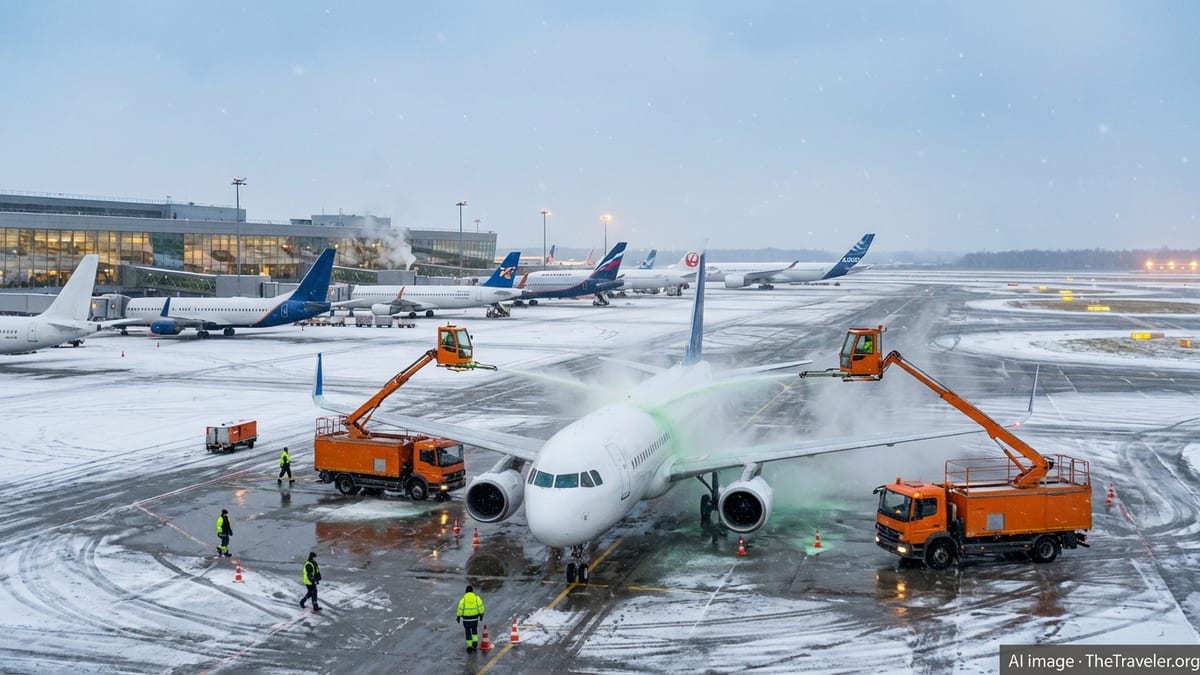
As another powerful winter storm season snarls airports from Dallas to Boston, much of the public frustration focuses on cancellations and delays. Largely unseen is the elaborate, time-critical ritual unfolding on frozen ramps and de-icing pads, where crews in cherry pickers and specialized trucks battle snow, ice and invisible frost so that aircraft can safely leave the ground.
The Invisible Threat of Ice on Modern Airliners
To most travelers, a dusting of snow on the wing might look harmless, especially on a 200-ton jet with engines the size of a small car. For pilots and regulators, even a thin film of frost is a red line. Ice contamination on wings and control surfaces can disrupt the smooth airflow that allows a wing to generate lift, raising stall speed, lengthening takeoff distance and compromising the aircraft’s ability to climb away safely in an emergency.
Decades of accident investigation have shaped this uncompromising stance. Events in which aircraft attempted takeoff with undetected ice on the wings have led to loss of control shortly after liftoff, inspiring stringent “clean wing” rules worldwide. Today, major aviation authorities insist that no aircraft may depart if there is any adhering snow, ice or frost on critical surfaces, a policy that turns de-icing from a convenience into a safety-critical requirement.
Winter 2025–26 has offered a stark reminder of how quickly conditions can turn hazardous. The sprawling North American winter storm in late January, dubbed Winter Storm Fern by broadcasters, brought heavy snow, freezing rain and sub-zero windchills to dozens of states and parts of Canada, with more than 10,000 flights canceled or delayed as airports struggled to keep runways and aircraft free of ice. At the heart of every flight that did depart was a carefully timed de-icing operation, often completed in brutal weather.
Inside a De-icing Operation: More Than Just Spraying Fluid
For passengers watching from fogged cabin windows, de-icing can look like a simple washdown with green or orange fluid. In reality, it is a structured, regulated process involving specialized equipment, trained crews and meticulous communication with the flight deck. The operation typically unfolds in two stages: de-icing, which physically removes existing snow and ice, and anti-icing, which applies a protective layer designed to prevent further accumulation during taxi and in the queue for takeoff.
Crews work from de-icing trucks equipped with heated, high-pressure nozzles and enclosed buckets that can be raised to reach the tail and high wing surfaces of large jets. Type I fluid, a heated mixture of glycol and water, is commonly used to strip away ice that has already formed. Once the aircraft’s surfaces are confirmed clean, crews often follow with a thicker, unheated Type IV or similar fluid. This second coat clings to the wing and fuselage, resisting new accumulation while the aircraft waits its turn for departure.
Timing is everything. Regulators publish detailed “holdover time” tables that specify how long a given fluid can protect an aircraft under specific combinations of precipitation type, temperature and wind. In light freezing drizzle, that window might be measured in tens of minutes; in heavier snow and low temperatures, it can shrink dramatically. If a flight does not take off before the protection period expires, the procedure must be repeated from the beginning, adding to queues but preserving a non-negotiable margin of safety.
Storms, Queues and Costly Delays: When Safety Collides With Schedules
When a major winter system sweeps across a busy aviation corridor, the demands on de-icing infrastructure surge. Airlines can schedule extra crews and equipment, but they cannot change the physics of ice or the regulatory requirement for clean wings. The result is familiar to passengers across North America and Europe: long lines of aircraft inching toward de-icing pads, followed by slow procession to the runway as holdover clocks tick down.
This season, the late-January storm that buried parts of the Midwest and Northeast illustrated how swiftly operations can unravel. Data compiled by industry analysts indicate that nearly 12,000 flights were canceled over a single weekend as heavy snow, sleet and freezing rain forced airports to cycle aircraft through de-icing in difficult conditions. At some hubs, more than 80 percent of scheduled departures were scrapped, and carriers warned that it would take days to restore normal schedules.
In Europe, the stakes were highlighted in early January when Air France-KLM reported a multimillion-euro financial hit linked in part to a de-icing fluid supply crunch at Amsterdam’s Schiphol Airport. As a severe cold snap gripped the Netherlands, demand for fluid surged and deliveries struggled to keep pace. Airlines were forced to cancel hundreds of flights, not because aircraft or runways were unavailable, but because there was insufficient certified de-icing fluid to guarantee safe departures.
For travelers, these disruptions can feel like overcaution. For safety officials, they are the visible cost of preventing something far worse. When departure banks stack up and storms intensify, adherence to holdover time limits often leaves airlines with no choice but to cancel. The alternative is attempting to thread narrow gaps between weather and fluid protection, a strategy that regulators, pilots and safety experts broadly reject.
How De-icing Protects Passengers Without Them Realizing It
In practice, aircraft de-icing is one of the least visible but most rigorously controlled elements of winter flying. At large hubs, operations centers begin planning hours before a storm arrives, analyzing forecast data to estimate fluid demand, staffing needs and pad throughput. Airlines adjust schedules, consolidate flights and reposition aircraft to airports less likely to see heavy icing, all with the aim of reducing the number of departures that will need treatment at the height of the storm.
On the ramp, ground crews and pilots follow detailed checklists. Before spraying begins, pilots brief the crew on the fluid type, mixture ratio and areas to be treated. During the operation, communication continues over dedicated radio channels, allowing the flight deck to monitor progress and confirm that all critical surfaces, sensors and engine inlets have been properly treated while avoiding overspray into sensitive areas such as cabin doors and static ports.
Once de-icing is complete, the crew records the exact time and conditions. This timestamp, along with the fluid type, is used to determine the protection interval available under current weather. Just prior to takeoff, pilots conduct a visual inspection from the cockpit, and at some airports, trained observers on the ground provide an additional check. If there is any doubt that the aircraft’s surfaces remain free of contamination, departure is delayed and the process is repeated, even at the cost of schedule disruption.
For passengers, much of this work goes unnoticed. Announcements may simply reference “waiting for de-icing” or “holding for takeoff clearance.” Yet behind these bland phrases lies a web of procedures refined through years of experience, designed to ensure that the aircraft accelerates down the runway with wings that can generate exactly the lift engineers intended, regardless of what is happening outside the cabin window.
Environmental Concerns and the New Generation of De-icing Technology
One reason de-icing has long operated in the background is environmental sensitivity. The glycol-based fluids that protect aircraft can be harmful if they enter waterways in large quantities, prompting regulators to require airports to capture and treat runoff. In the early years of widespread de-icing, this often meant expensive hauling and disposal, or large treatment ponds adjacent to runways, adding to the operational costs of winter flying.
In recent seasons, however, a quiet technological shift has begun to change that equation. Airports from Scandinavia to North America are investing in systems that capture spent de-icing fluid on dedicated pads, separate it from stormwater and then distill and purify the glycol for reuse. At Syracuse Hancock International Airport in New York state, a purpose-built recycling facility was commissioned with the capacity to treat millions of gallons of contaminated water and produce thousands of tons of usable glycol each year, sharply reducing both disposal volumes and greenhouse gas emissions associated with manufacturing virgin fluid.
These projects illustrate how environmental stewardship and safety can align. By lowering the volume of new glycol that must be produced and transported, recycling systems reduce the carbon footprint of winter operations. At the same time, they give airports and airlines greater confidence that they will have adequate fluid supplies during protracted cold spells, decreasing the risk that flights will be grounded not by weather alone, but by shortages of a critical safety commodity.
Manufacturers, meanwhile, continue to refine fluid formulations. New blends are designed to cling longer to aircraft surfaces, shed ice more efficiently during the takeoff roll and biodegrade more rapidly after use. For travelers, these advances are all but invisible, yet they form part of the reason why winter flying has become steadily safer even as traffic and climate volatility increase.
Training, Checklists and the Human Factor on the Ramp
Even the best equipment and fluid technology cannot make up for gaps in training or discipline. Industry groups have repeatedly warned that winter operations are only as strong as the people executing checklists on dark, icy ramps. The International Air Transport Association, which audits airline safety programs, has identified ground de-icing and anti-icing procedures as a key risk area when airlines are unprepared or staff are insufficiently trained.
To counter that risk, airlines and ground-handling companies run intensive annual refreshers before the northern winter. Crews learn to recognize different precipitation types, interpret holdover tables, operate booms and nozzles safely in high winds, and coordinate with cockpit crews under time pressure. They also practice emergency procedures, such as halting operations if fluid spills outside containment areas or if a crew member spots ice in a hard-to-reach location late in the process.
The human factor is equally present in the cockpit. Pilots must be prepared to request a return to de-icing even if it means missing a slot and enduring a long delay. Standard operating procedures in many carriers explicitly empower captains to make conservative calls based on their own assessment of conditions, with the understanding that on-time performance targets will never outweigh the imperative to avoid wing contamination.
In recent years, some airports have added fixed de-icing gantries and centralized pads that separate the operation from crowded gate areas, reducing the risk of miscommunication or rushed procedures. These investments, while costly, help streamline workflows and allow supervisors to oversee multiple treatments simultaneously, bolstering the safety net that stands between winter weather and the traveling public.
Climate Volatility and the Growing Importance of De-icing
While climate change is often associated with hotter summers and stronger hurricanes, it is also reshaping winter weather patterns in ways that matter deeply to aviation. Many meteorologists have noted that warmer average temperatures can still produce intense cold snaps and heavy snow when conditions align, as Arctic air plunges south and meets moisture-laden systems. The result is a pattern of fewer, but potentially more severe, winter storms that place sudden, enormous stress on airport operations.
The sprawling storm systems that have affected North America in recent winters fit this trend, delivering historic snowfall and ice across regions unaccustomed to sustained sub-freezing conditions. Airports in the southern United States and parts of Europe, built for milder climates, have had to invest in additional de-icing trucks, training and fluid storage to cope with occasional but crippling cold outbreaks. When those storms hit, the margin for error around de-icing shrinks sharply.
For global airlines, this volatility complicates planning. Fleets may spend part of the week operating in tropical heat and part of it in driving snow, with aircraft and crews rotating across continents. Ensuring that the right equipment and expertise are in place wherever a storm might strike has become a central challenge for operations planners. It has also made de-icing an increasingly prominent factor in network resilience and customer communications.
As winter travel demand continues to grow, particularly for long-haul leisure trips and ski tourism, the quiet choreography of de-icing will only become more important. Every time an aircraft is surrounded by trucks on a snowy evening, passengers are witnessing a safety system that has been refined over decades, one that routinely prevents accidents so effectively that most people forget the hazard it is designed to combat.