

More news on this day
From Tokyo to Sydney and beyond, airlines are rapidly tightening rules on power banks in aircraft cabins, moving from quiet advisories to outright in‑flight bans as regulators respond to a surge in battery‑related fire scares.
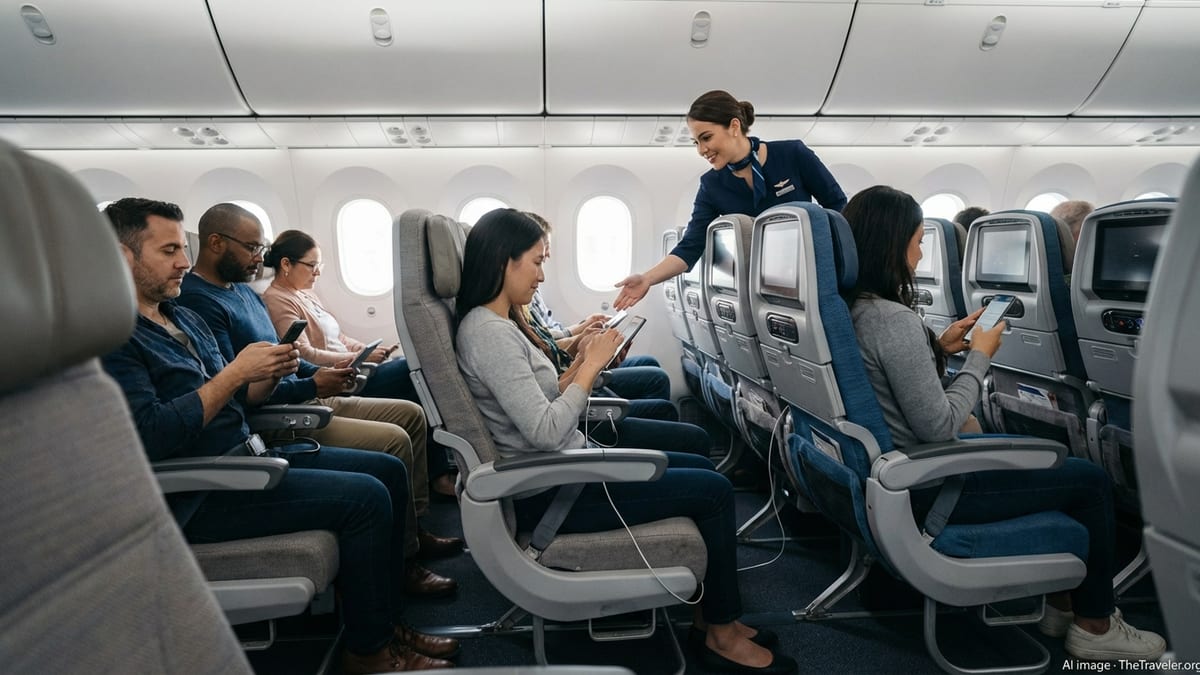
Japan Leads With a Nationwide In‑Flight Use Ban
Japan is at the forefront of the latest clampdown. The country’s transport ministry has notified domestic carriers that the use of power banks on board will be prohibited from April, following a string of incidents in which lithium batteries have emitted smoke or caught fire during flights. Passengers will still be allowed to bring portable chargers into the cabin, but they will no longer be able to use them to charge devices or plug them into seat‑back power outlets while airborne.
The move comes less than a year after Japan introduced rules requiring travelers to keep power banks within sight instead of stowing them in overhead bins, a measure intended to ensure that any early signs of overheating could be spotted quickly. Officials are now moving further, citing international incidents in which fires thought to be linked to portable batteries forced emergency landings or destroyed aircraft on the ground.
Under Japan’s framework, power banks are classified as spare lithium batteries. They are banned from checked baggage and tightly limited by capacity thresholds, following international standards. Most travelers using everyday chargers under 100 watt‑hours will still be able to carry them, but will be expected to rely on airport and in‑seat charging instead of their own battery packs during the flight.
Australia and Asia-Pacific Carriers Tighten the Screws
Across the wider Asia-Pacific region, airlines and regulators are introducing similar or even stricter limits. In South Korea, a dramatic tarmac fire on an Air Busan aircraft, traced to a power bank in an overhead bin, prompted authorities to require that batteries be kept within arm’s reach and properly protected against short circuits. Several Korean carriers now prohibit passengers from using power banks in flight at all, directing them instead to use built‑in seat power where available.
In Southeast Asia, Singapore Airlines and its low‑cost arm Scoot banned the in‑flight use and charging of power banks in 2025, while still allowing compliant devices to be carried in the cabin. Thai Airways and AirAsia have adopted similar policies, barring passengers from charging with power banks even on long regional routes. Taiwan’s EVA Air and China Airlines have also moved to prevent mid‑air charging, citing the same safety concerns.
Australian travelers are increasingly affected because key regional partners, including Singapore Airlines, Cathay Pacific and various Korean and Thai carriers, now enforce some form of in‑flight restriction. Although Australia’s own aviation authorities continue to focus mainly on capacity limits and a ban on lithium batteries in checked bags, local airlines such as Qantas and Virgin Australia are aligning with regional practice by steering passengers toward in‑seat power and away from personal battery packs, particularly on international services.
Europe, the United States and the Role of Global Guidance
Beyond Asia-Pacific, regulators and carriers in Europe and North America are under mounting pressure to respond. The European Union Aviation Safety Agency has advised against charging or using power banks in flight, and some European airlines have begun hardening their rules, either restricting high‑capacity batteries or discouraging in‑flight use altogether. Certain leisure and long‑haul carriers have started to prohibit charging with power banks, while still permitting smaller units in carry‑on luggage within defined watt‑hour limits.
In the United States, the Federal Aviation Administration has long barred spare lithium batteries and power banks from checked baggage, a rule now broadly mirrored worldwide. More recently, attention has shifted to how batteries are used in the cabin. Southwest Airlines, for example, now requires that any power bank in use must be visible, such as on a tray table or in a seat pocket, rather than buried in a carry‑on bag in the overhead bin. The change is intended to allow cabin crew and passengers to act quickly if a device overheats.
International standards bodies such as the International Civil Aviation Organization and the International Air Transport Association continue to recommend that power banks be treated as spare lithium batteries, carried only in hand luggage, individually protected against short circuit and subject to strict capacity caps. Airlines are using these baseline rules as a platform for tougher, airline‑specific bans on in‑flight use as incident numbers rise.
The Fire Risk Behind the Crackdown
At the core of the shift lies concern about thermal runaway, a chain reaction inside lithium‑ion cells that can cause intense heat, smoke and flame. Power banks concentrate multiple cells in compact housings, and can be stressed by drops, poor manufacturing, overcharging or exposure to heat. Even a small fire inside a pressurized cabin presents a serious risk, especially if it starts in an inaccessible place such as an overhead bin filled with luggage.
Investigations into several recent incidents have pointed to inexpensive or counterfeit power banks, with inadequate protection circuits or misleading capacity labels, as particular problems. Authorities note that as travelers carry more devices and rely on their phones for boarding passes, payments and entertainment, the number of batteries in the cabin has risen sharply, raising the statistical chance of a failure in flight.
Aviation safety experts stress that while the overall risk remains low compared with the volume of flights and passengers, the consequences of a battery fire are severe enough to justify conservative rules. Banning in‑flight use, they argue, removes one major trigger for overheating by stopping continuous high‑load charging and discouraging passengers from burying active batteries in bags where heat cannot dissipate.
What Air Travelers Need to Do Now
For passengers, the changing rules mean more homework before flying. Travelers can no longer assume that a power bank that was acceptable on one carrier will be allowed for use on another, even on the same route. Policies now vary not only by country but by airline, and sometimes by route or aircraft type. Checking the lithium battery section of the airline’s conditions of carriage before departure is becoming as important as confirming baggage allowances.
In practical terms, most carriers still allow up to two reasonably sized power banks in carry‑on bags, provided they are under the airline’s stated watt‑hour ceiling and have clearly marked capacity labels. Devices should be kept in good condition, with exposed terminals covered or stored in cases, and removed from checked luggage altogether. Where in‑flight use is either banned or heavily restricted, the safest strategy is to fully charge phones and tablets at the airport, then rely on in‑seat power if available rather than on a personal battery pack.
As more countries follow Japan and key Asia-Pacific airlines in prohibiting in‑flight power bank use, habits developed over a decade of constant charging will have to shift. For now, informed travelers who understand the new rules, carry only certified devices and keep batteries visible and cool on board are best placed to avoid both safety risks and unwelcome surprises at the gate.