

More news on this day
After years of vague announcements about “operational issues,” more airlines are beginning to spell out exactly why flights are delayed, a shift driven by new U.S. rules, federal dashboards, and intensifying public scrutiny of air travel disruptions.
Get the latest news straight to your inbox!
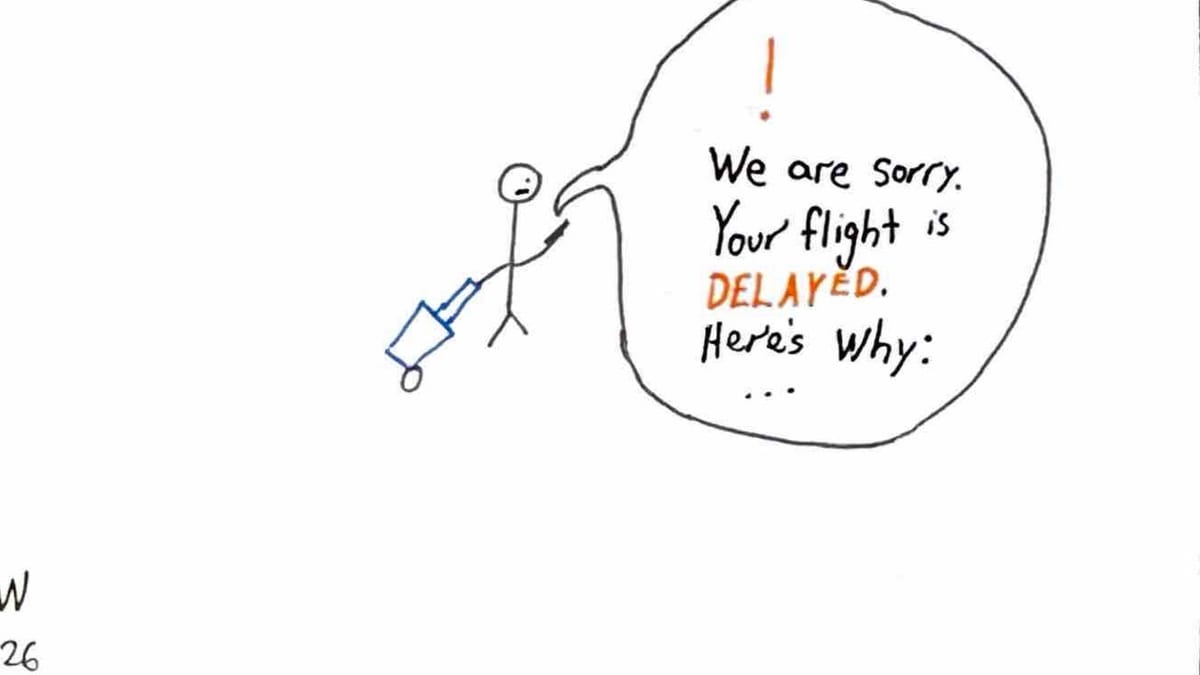
Image by USA Today
A Shift From Vague Announcements to Specific Reasons
Travelers in the United States are increasingly seeing clearer explanations for late or canceled flights, both at the airport and in their inboxes. Where carriers once leaned on generic phrases, notifications now more often distinguish between weather, air traffic control, crew scheduling problems, mechanical issues, or airline technology failures. Publicly available information indicates that this change reflects both regulatory momentum in Washington and growing competitive pressure among major carriers.
Over the last few years, the U.S. Department of Transportation has tightened expectations around how airlines communicate disruptions, including guidance on “material information” that can affect when passengers decide to go to the airport or whether to seek alternative arrangements. Draft and proposed rules have specifically asked whether airlines should be required to provide the cause of a flight disruption, and how that information should be framed for consumers when a delay is beyond the carrier’s control, such as during severe storms or major airspace restrictions.
Alongside these regulatory efforts, airlines have upgraded their mobile apps, email systems, and airport displays. Many carriers now provide automated alerts that identify whether a delay is due to a late-arriving aircraft, crew timing limits, maintenance inspections, or congestion in the national airspace system. The result is a more granular picture of disruption that, while still imperfect, is markedly more detailed than what most travelers saw just a few years ago.
This shift has coincided with several headline-making disruption events, from mass cancellations linked to technology outages to large-scale schedule reductions during a prolonged government shutdown. Each incident increased pressure on airlines and regulators to distinguish what was actually under airline control from what was not, and to make those distinctions more visible to the public.
Controllable vs. Uncontrollable: Why the Label Matters
At the heart of the new transparency is a deceptively simple question: was the delay controllable by the airline or not? Federal dashboards and rulemaking documents now frequently use this framing, and airlines have adopted similar language in customer service plans and public-facing policies. Issues such as crew scheduling, aircraft maintenance planning, and airline information technology are generally treated as controllable, while extreme weather, air traffic control restrictions, and security events are typically categorized as outside the carrier’s control.
That distinction is not just semantic. In recent years, airlines have used it to decide when to offer vouchers, hotel rooms, or meal credits, often promising more generous help when a disruption stems from something they could reasonably have prevented. The DOT’s Airline Customer Service Dashboard, launched in 2022 and expanded since, compares what major U.S. carriers voluntarily commit to provide when a significant delay or cancellation is within their control. Publicly available corporate filings indicate that most large airlines now pledge at least complimentary rebooking, and many commit to covering lodging during overnight disruptions they caused.
However, there is still no across-the-board federal requirement that airlines compensate passengers with cash for controllable delays, and a Biden-era proposal to mandate such payments has been withdrawn. Reports indicate that the rule, which would have brought U.S. practice closer to Europe’s model of standardized compensation, was formally abandoned in late 2025 after opposition from the airline industry. That decision put even more weight on the distinction between controllable and uncontrollable delays and on the voluntary commitments carriers choose to advertise.
For travelers, the growing use of specific delay labels can be double-edged. On one hand, clearer wording can make it easier to see when an airline is taking responsibility. On the other, the line between categories can be blurry. Complex events, such as aircraft recalls or cascading delays after a major technology outage, can involve both regulatory mandates and airline planning choices, raising questions about which bucket they belong in and what, if anything, passengers should receive in return.
Data Transparency and the Federal Dashboard Effect
The federal government’s growing reliance on data has amplified the push toward clearer delay explanations. The Bureau of Transportation Statistics has long tracked airline performance by cause, but revisions to how those categories are defined and reported have aimed to give a more accurate picture of when airlines are responsible. Public documents describe efforts to refine the breakdown between carrier-driven factors, the national aviation system, late-arriving aircraft, and extreme weather, responding to concerns that previous groupings masked meaningful differences.
The DOT’s Airline Cancellation and Delay Dashboard has turned some of this information into a traveler-facing comparison tool. Launched initially to highlight service commitments on controllable disruptions, the dashboard now serves as a public scorecard on which airlines promise hotels or meal vouchers and which simply offer rebooking. Airlines and consumer advocates both reference the dashboard in regulatory filings, underscoring how prominently it now figures into debates about delay causes and customer care.
As delay-cause data becomes easier to parse, analysts can more readily identify patterns that suggest structural issues. Publicly available analysis submitted to the DOT has argued that a substantial portion of severe U.S. delays and cancellations are tied to factors within airlines’ control, in contrast with lower disruption rates reported for many European carriers. These comparisons have, in turn, fueled arguments for stronger baseline protections and for clearer, earlier communication when problems emerge.
The same data also shapes enforcement decisions. When a wave of disruptions follows an outage, a government shutdown, or a safety directive, regulators review airline reporting to determine whether carriers appropriately categorized the causes and whether their customer commitments aligned with those labels. The prospect of scrutiny, including potential penalties for misreporting, gives airlines a tangible incentive to document delay reasons more carefully.
How Clearer Explanations Change Traveler Behavior
For travelers, the growing detail in delay notifications is more than a matter of curiosity. Knowing whether a disruption is tied to an isolated maintenance issue, a broader weather system, or systemic congestion can meaningfully change decisions on the ground. A notice that specifically attributes a delay to national airspace constraints may suggest that switching carriers will not help, while a message citing an aircraft swap or crew reassignment could prompt passengers to look for alternative flights, even on a different airline.
More precise explanations also make it easier for passengers to advocate for themselves. When a message or app screen indicates that a delay is within the airline’s control, travelers can point to the carrier’s own commitments on the federal dashboard or in its customer service plan when requesting hotels, meal credits, or rebooking. Consumer groups note that documentation of the stated cause, such as screenshots of app notifications, can be important when seeking refunds or filing complaints.
In practice, this added clarity can help frequent travelers fine-tune their risk calculations. Some may choose earlier departures to guard against afternoon congestion, avoid tight connections through historically delay-prone hubs, or select airlines whose publicly posted policies offer stronger support during controllable disruptions. Others may invest in travel insurance or flexible fares after noticing how often delays at specific airports are tied to factors no single carrier can control.
Still, transparency has limits. Even the most detailed explanation does not get a plane airborne faster, and for many travelers the immediate priority remains simply reaching their destination. But over time, consistent disclosure of causes can influence which airlines win customer loyalty and how passengers plan high-stakes trips, from international vacations to tight-turnaround business travel.
What Comes Next for Delay Disclosure
The regulatory landscape around delay disclosure remains in flux. An advance notice of proposed rulemaking issued in late 2024 asked pointed questions about when and how airlines should inform passengers about disruptions, including whether more detailed standards are needed for notifications of both cause and expected duration. Additional items on the DOT’s agenda contemplate clarifying refund rights, fee transparency, and the obligations airlines owe travelers when flights are substantially delayed for any reason.
At the same time, industry groups have urged the government to scale back consumer-facing dashboards and new reporting rules, arguing that existing disclosures and competitive pressure already incentivize good behavior. Public filings show that airlines have asked regulators to reconsider investigations launched in recent years and to narrow or withdraw several proposed consumer protection measures, including some related to delay compensation.
International comparisons will likely continue to shape the debate. Regions such as the European Union, Canada, Brazil, and the United Kingdom maintain established frameworks that combine clear delay categories with standardized compensation in many situations. U.S. policymakers and airlines frequently reference those systems when arguing either for or against stronger domestic rules, and travelers themselves increasingly compare experiences across borders.
For now, what is changing most quickly is not how much money passengers receive when things go wrong, but how much information they get about why. As airlines refine their data systems and regulators sharpen their expectations, the vague “operational reasons” of the past are giving way to more specific, if sometimes contested, explanations. For travelers navigating crowded airports and tight schedules, that added clarity is becoming an important part of how they measure trust in the airlines they choose.