

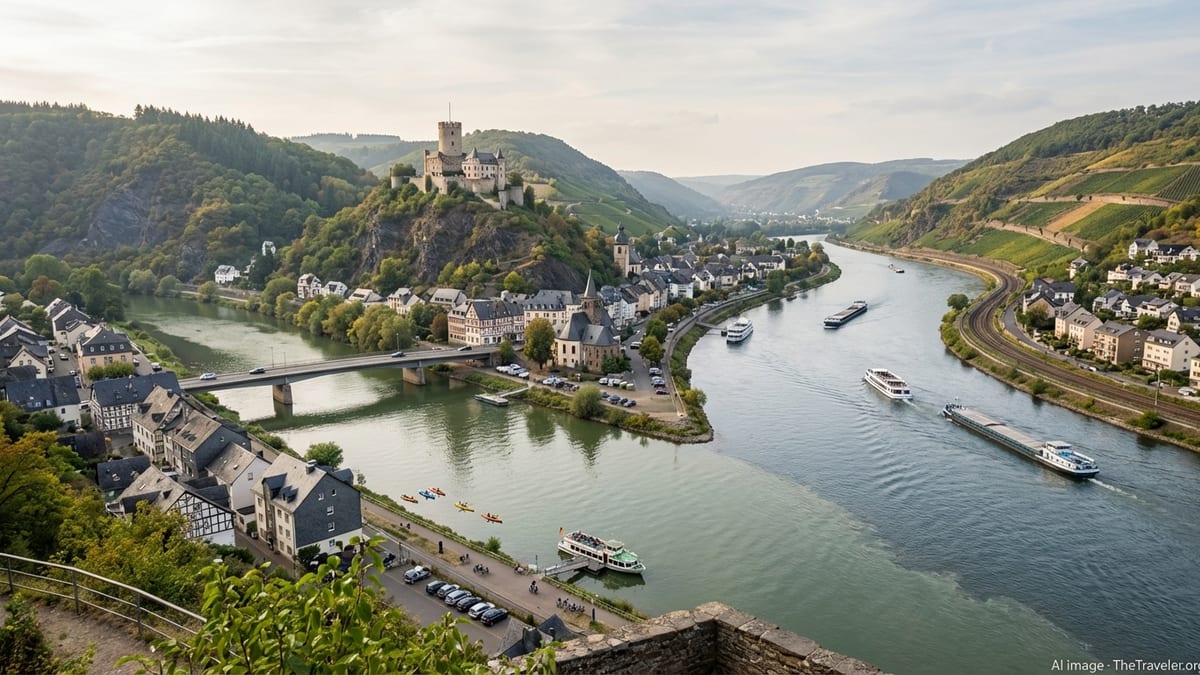
Lahnstein is one of those river towns you can pass in minutes on a Rhine cruise and yet spend years trying to fully understand. Perched at the confluence of the Lahn and the Rhine in western Germany, it looks at first like a peaceful stop between bigger names such as Koblenz and Rüdesheim.
But beneath the slate roofs and vineyards lie layers of Roman frontier history, medieval power politics, river engineering, romantic art, and modern tourism policy. To ask why Lahnstein matters is really to ask how two rivers, a narrow valley and shifting borders have shaped one place into a surprisingly significant crossroads.
The Meeting of Two Rivers
This background leads naturally into the question of whether Lahnstein is worth visiting today. Stand on the riverbank where the Lahn joins the Rhine and you immediately see why geography gave Lahnstein its role. The Lahn descends about 600 meters from its source in the Rothaargebirge before winding through central German university towns and castle landscapes to reach its end at Lahnstein.
By the time it arrives, it has carved a narrow valley that separates two upland blocks: the Taunus to the south and the Westerwald to the north. The Rhine, flowing north through the gorge of the Upper Middle Rhine Valley, is the main artery, but the Lahn is an important capillary feeding traffic, water, and ideas into the system.
This confluence creates what geographers call a “gate” in the landscape. At the Lahnsteiner Pforte, the tight canyon of the Middle Rhine relaxes into the broader Neuwied Basin. Moving upriver from Koblenz, ships encounter a point where side valleys open, terraces widen, and connections inland become easier. For centuries, that made the Lahn mouth a natural checkpoint for tolls, customs, and military control. Whoever held the rock above the confluence could see and shape the flow of both river trade and military movement.
The rivers matter in more subtle ways too. The Lahn’s gentler gradient and partly canalized course allow small barges to reach as far upstream as Giessen, while the lower Lahn’s many dams and locks form a carefully managed corridor through rugged terrain. The Rhine at Lahnstein, by contrast, remains a deep, heavily trafficked international waterway. The town’s daily life plays out between these two characters: the working Rhine with its cargo and cruise ships, and the more leisurely, meandering Lahn popular with kayakers, small excursion boats, cyclists, and walkers tracing the water’s edge.
From Roman Watchtower to Frontier Town
Lahnstein’s story begins not with charming timbered houses but with Rome’s hard-edged northern frontier. Around the year 369, Roman engineers constructed a burgus, a small stone watchtower, at the mouth of the Lahn on what is now Niederlahnstein. This tower guarded the river crossing and formed part of the broader defensive network along the Rhine border. Remnants of the larger Limes Germanicus, the fortified line separating the empire from Germanic territories, still run through the forests above the town, a quiet reminder that Lahnstein once sat right on the edge of a world power.
The Roman tower gave Lahnstein its name. In the Middle Ages, sources referred to a “fortified house on the Lahn,” a direct echo of that watch post. Over time, a small settlement grew around this protected site. The Lahn was not just a defensive line; it was also a highway inland into central Germany. River crossings and nodes like Lahnstein naturally attracted merchants, craftsmen, and boatmen, knitting military infrastructure into a civilian town.
As the Roman world dissolved and medieval polities emerged, Lahnstein found itself between powerful regional players: the ecclesiastical states of Mainz and Trier, the secular counts of Nassau and Katzenelnbogen, and the developing imperial cities. Control of such a strategically positioned river town meant customs receipts and influence, and Lahnstein’s fortunes rose and fell with the rivalries of these lords. The riverside plain might look peaceful today, but for centuries it existed in a climate of shifting alliances, sieges, and negotiated privileges.
Medieval Lahnstein: Castles, Tolls, and Power
The most visible symbol of medieval Lahnstein is Lahneck Castle, crowning a steep rock spur directly above the confluence. Built in the early 13th century by the Archbishop of Mainz, Lahneck was designed to protect Mainz’s newly acquired holdings around Oberlahnstein and a nearby silver mine. Its rectangular ground plan and rare pentagonal tower reflect the military thinking of the high medieval period, balancing defense with the need to project authority over the river landscape.
Lahneck was part fortress, part customs station, part political stage set. From its walls, Mainz could watch ship traffic on both the Lahn and Rhine and enforce tolls that enriched the prince-archbishopric. The burgraves of Lahneck, as the castle’s guardians, held considerable regional power. That power occasionally collided with imperial politics. In 1298, King Adolf of Nassau visited Lahneck shortly before a fatal clash with his rival Albert of Habsburg; a decade later the castle’s own burgrave would be executed after conspiring against that same Albert.
Lahnstein also hosted one of the more dramatic political acts of the late medieval Holy Roman Empire. In 1400, the four Rhenish prince-electors called King Wenceslaus of Germany to appear in Oberlahnstein to answer accusations that he had failed to maintain public order. When he did not come, they met, deliberated, and ultimately declared him deposed. The next day, in nearby Rhens, they elected Rupert of the Palatinate as the new “King of the Romans.” It was a rare moment when the balance of imperial power shifted on the basis of consultations held not in a great imperial city but in a relatively small river town perched between two streams.
Down by the water, medieval Lahnstein developed into twin communities. Oberlahnstein, under Mainz, grew around Lahneck and its fortifications, while Niederlahnstein, under Trier, built its own customs tower and town defenses on the opposite bank of the Lahn. The result was a classic Rhine valley puzzle of divided jurisdictions, where different lords controlled adjacent streets and quaysides, and where the two rivers framed a complex political border as much as a geographic feature.
War, Destruction, and the Long Nineteenth Century
Lahnstein’s strategic advantages also made it vulnerable when Europe went to war. During the Thirty Years War in the 17th century, both Oberlahnstein and Niederlahnstein endured repeated occupations by Swedish, Imperial, Hessian, and French troops. Lahneck Castle suffered heavy damage in these campaigns, and later, during the wars of the late 17th century, French forces destroyed large parts of the fortress. The rivers that brought trade and prosperity also brought armies and artillery.
In the early modern period, Lahnstein’s rulers changed as the old ecclesiastical states were dissolved. The archbishopric territories were secularized in the early 19th century, and Lahnstein fell under new, more centralized administrations. The confluence remained important, but the means of controlling it shifted from castles and feudal tolls to laws and tax offices. River traffic grew with the rise of the Rhine as an industrial corridor, and Lahnstein’s role subtly pivoted from stronghold to service stop.
The 19th century brought another transformation: the railway. Lahnstein became part of the Nassau state railway system, and later Prussia absorbed these lines. Stations in Niederlahnstein and nearby Koblenz assumed much of the traffic, turning Lahnstein into a key junction between east-west rail routes and north-south river routes. The first permanent bridge over the Lahn, completed in 1873, finally tied Oberlahnstein and Niederlahnstein together physically even as they remained administratively separate. The new link recognized what geography had always implied: you could no longer treat the two riverbanks as distinct worlds.
By the late 19th and early 20th centuries, Lahnstein had joined the Rhine’s romantic circuit as well. The ruins and partial restorations of Lahneck appealed to Victorian and German travelers drawn by medievalism and dramatic scenery. Writers such as Johann Wolfgang von Goethe had already immortalized the views of castles on the Lahn; landscape painters and, later, photographers did the same for the Lahn-Rhine confluence. The town was reshaping its war-scarred geography into a stage of picturesque nostalgia that still draws visitors today.
The Upper Middle Rhine Valley and Lahnstein’s Landscape
Today, Lahnstein stands at the northern threshold of the Upper Middle Rhine Valley, a cultural landscape recognized as a World Heritage Site for its blend of natural geology and human history. This stretch of the Rhine between Bingen and just past Lahnstein is famous for its narrow gorge, steep vineyards, and dense concentration of castles. At the Lahnsteiner gate, the river exits the tightest canyon and begins to breathe again, opening toward the Neuwied Basin and beyond. That turning point gives Lahnstein a particular role in how travelers perceive the valley: the town is both finale and overture, depending on your direction of travel.
The surrounding hills show exactly how geography has shaped human use. On sunny slopes, terraced vineyards cling to thin soils above slate and sandstone, a legacy of centuries of winegrowing that once provided key income for monasteries and noble estates. On shadier or steeper faces, forests take over, now protected by regional nature and forestry laws designed to safeguard both biodiversity and the scenic value that underpins tourism. The Lahn valley itself is narrower and more intimate than the Rhine gorge, with smaller villages, campgrounds, and river meadows softened by willow stands and orchards.
This landscape is not frozen in time. Regional planners and conservation bodies have to balance infrastructure needs, such as roads, rail lines, and flood defenses, with preserving historic views and habitats. Bridges like the modern Rudi-Geil Bridge over the Lahn, which connects the two halves of the town, are built and rebuilt in cycles of war damage, structural fatigue, and technological change. The result is a layered environment where medieval towers, 19th-century rail embankments, 20th-century road bridges, and contemporary riverfront promenades coexist along a few kilometers of water.
The confluence itself has evolved as well. Old side channels of the Rhine visible in 19th-century art have been filled or reshaped by river engineering, and flood management now plays a central role in local planning. Yet the essential drama of two currents meeting remains. On calm days, you can see the different colors of the Rhine and the Lahn mingling slowly; after rain, the Lahn sometimes charges into the main river with a visible force, a small but vivid demonstration of how even “secondary” tributaries command respect.
Tourism, Culture, and Everyday Life in a River Town
Lahnstein’s contemporary identity rests on this interplay of quiet daily life and high-profile heritage. Since the administrative merger of Oberlahnstein and Niederlahnstein into a single city in 1969, local authorities have worked to position the town as both a livable community and an attractive gateway to the Rhine and Lahn river landscapes. Historic architecture has been restored, riverfronts opened for walking and cycling, and cultural events promoted to capitalize on the town’s setting.
One of the most visible initiatives is the annual festival at Lahneck Castle, where open-air theatre and concerts breathe new life into the medieval walls that once echoed with the orders of knights and archbishops. Within the town, themed historical trails explain key sites from Roman times through the Middle Ages and modern era, connecting the dots between river, street, and hillside. Visitor centers emphasize not just monuments but also stories: of Templar legends at Lahneck, of a Scottish girl whose tragic death there in the 19th century captured Victorian imaginations, and of soldiers, traders, and emigrants who passed through on their way along or across the rivers.
Outdoor tourism is just as important. The Lahn is one of Germany’s most popular recreational rivers for paddling, with rental fleets, campsites, and low‑traffic side roads that favor cyclists and walkers. The confluence at Lahnstein marks a key milestone for multi-day journeys: end of the river for paddlers, or for others, a place to transfer from cycle routes along the Lahn to those on the Rhine. Elevated hiking trails on the surrounding hills offer classic views toward Stolzenfels Castle across the Rhine or up the Lahn valley, confirming why artists from the 19th century onward chose similar vantage points for their sketches and canvases.
All of this exists alongside a functioning small city that hosts schools, local businesses, and regional services. Trains pass, commuters drive over the Lahn bridge, and the riverbanks host not just tourists but anglers and dog walkers. That combination of everyday realism and historic romance is a large part of why Lahnstein appeals to travelers who want a Rhine town with fewer crowds than the major stops, yet with just as deep a story etched into its stones and shorelines. This historical context explains many of the key things to do in Lahnstein.
The Two Rivers as Living Infrastructure
To understand why Lahnstein still matters beyond tourism, it helps to look at its rivers as living infrastructure rather than just scenic backdrops. The Rhine remains one of Europe’s core transport corridors, carrying large volumes of cargo between industrial regions and seaports. Barges, container ships, and tankers that pass Lahnstein are part of supply chains spanning multiple countries. Ports and handling facilities in larger nearby cities such as Koblenz benefit from this, and Lahnstein sits within that sphere of economic gravity.
The Lahn’s role is more modest but still important. Although it no longer functions as a major commercial artery, its canalized lower reaches support leisure navigation, local transport, and water management. Each dam and lock along the Lahn between Lahnstein and Runkel is part of a system that stabilizes levels, reduces erosion, and enables controlled release during periods of high water. Energy generation and ecological restoration projects often intersect here, with debates over how much the river should be allowed to behave like its old, wilder self versus remaining a tightly managed channel.
Flood risk underscores this complexity. Both the Rhine and Lahn can swell rapidly during heavy rains or snowmelt, and Lahnstein’s low-lying riverfront is vulnerable. Modern embankments, warning systems, and zoning regulations attempt to protect built-up areas, but the town cannot detach itself from the rhythms and occasional violence of its waters. Climate change adds uncertainty, encouraging planners to revisit long-held assumptions about flood frequencies and to renovate infrastructure with greater flexibility and resilience.
At the same time, environmental awareness has grown. Efforts to improve water quality, restore fish migration routes, and re-naturalize sections of riverbank bring biologists into conversations once dominated by engineers and merchants. The confluence at Lahnstein becomes not simply a strategic spot for human control but a meeting point for ecosystems. Migratory fish, riparian birds, and riverine plant communities experience it as a junction of habitats, and conservationists increasingly frame the town’s identity around this more-than-human geography as well.
The Takeaway
Lahnstein matters because it turns a simple geographic fact the meeting of two rivers into a multi-layered human story. From Roman tower to medieval stronghold, from war-torn frontier to romanticized tourist stop, from railway junction to modern cultural town, it has constantly reinterpreted its position at the Lahn-Rhine confluence. Geography set the stage, but politics, technology, and imagination wrote the script.
For travelers, Lahnstein offers a compact way to grasp how central European rivers shape history. You can walk from the Roman frontier to a Gothic castle, watch cargo vessels pass vineyards that first enriched medieval counts, and follow in the footsteps of monarchs and painters while still finding a quiet café by the water. The town is not a museum preserved in amber. It is a living community negotiating the demands of heritage, ecology, economy, and everyday life within a landscape that is both spectacular and constrained.
Above all, Lahnstein shows that “small” places at the junctions of larger systems can carry an outsized significance. The two rivers that meet here have long linked hinterlands to heartlands, uplands to channels, local stories to continental currents. To stand where the Lahn flows into the Rhine is to feel those connections converge in one view, where stone, water, and history come together in a way that quietly but convincingly explains why this town still matters.
FAQ
Q1: Where exactly is Lahnstein located?
Lahnstein lies in western Germany in the state of Rhineland-Palatinate, just south of Koblenz, at the point where the Lahn River flows into the Rhine.
Q2: Why is the confluence of the Lahn and Rhine important?
The confluence forms a natural gateway where the narrow Middle Rhine gorge opens into a wider basin and where an inland river route from central Germany meets the major north-south Rhine corridor. This made Lahnstein strategically valuable for trade, tolls, and military control.
Q3: What is special about Lahneck Castle?
Lahneck Castle is a 13th-century fortress built on a rock above the Lahn-Rhine confluence. It guarded trade routes, hosted important political meetings, and today offers panoramic views and cultural events that highlight Lahnstein’s medieval heritage.
Q4: How did Lahnstein feature in Roman times?
In late Roman times, a stone watchtower was built at the mouth of the Lahn as part of the empire’s frontier defenses along the Rhine. This installation gave rise to the fortified site that eventually developed into the town of Lahnstein.
Q5: What happened in 1400 that made Lahnstein historically significant?
In 1400, Rhenish prince-electors met in Oberlahnstein to summon King Wenceslaus of Germany and, after his failure to appear, moved to depose him. The following day, they elected Rupert of the Palatinate as the new king, marking a rare change of imperial ruler initiated in a small river town.
Q6: Are Oberlahnstein and Niederlahnstein still separate towns?
No. The formerly separate communities of Oberlahnstein and Niederlahnstein were administratively merged in 1969 to form the modern city of Lahnstein, although the historic distinction between the two areas is still visible.
Q7: Is Lahnstein part of the UNESCO-listed Upper Middle Rhine Valley?
Lahnstein stands at the northern threshold of the Upper Middle Rhine Valley cultural landscape recognized by UNESCO. It effectively marks the point where the steep Rhine gorge ends and the valley opens toward the Neuwied Basin.
Q8: What can visitors do on the Lahn River near Lahnstein?
Visitors can paddle by canoe or kayak, take small excursion boats, cycle along river paths, and hike trails that rise into the surrounding hills. The confluence at Lahnstein is a popular endpoint for multi-day trips down the Lahn.
Q9: How have war and conflict affected Lahnstein?
Because of its strategic location, Lahnstein saw repeated occupations and damage during conflicts such as the Thirty Years War and later French campaigns. Lahneck Castle was heavily damaged and partially destroyed, and the town suffered bomb damage during the Second World War.
Q10: Why should travelers include Lahnstein in a Rhine itinerary?
Lahnstein offers a quieter, less commercialized alternative to some larger Rhine towns while condensing Roman frontier history, medieval castles, river landscapes, and modern culture into a small, walkable area anchored by the dramatic meeting of two rivers.