

Germany offers a relatively stable economy and strong tenant protections, but residential housing has become one of the most significant bottlenecks for relocations. In many cities, demand for rental units far exceeds available supply, vacancy rates are extremely low, and competition for suitable apartments is intense. Understanding why finding housing in Germany can be difficult is essential for assessing the practicality and timing of any relocation decision.
Structural Housing Shortage and Low Construction Volumes
Germany is experiencing a structural housing shortage, particularly in large and economically dynamic cities. Demographic growth, sustained urbanization, shrinking household sizes, and high levels of internal and international migration have increased the number of households faster than new homes are being built. National policy targets have aimed at around 400,000 new homes per year in recent years, yet actual completions have fallen significantly short, with annual figures closer to the low 200,000s in recent periods. This persistent gap has accumulated into a multi‑year shortage that cannot be resolved quickly.
Several factors limit new construction. Higher interest rates since 2022 have increased financing costs for developers and private builders, while energy efficiency regulations and construction standards raise building costs. At the same time, skilled labor shortages in the construction sector and lengthy planning and approval processes have slowed project delivery. Municipalities sometimes face political resistance to densification or large new developments, further restricting supply.
Because residential buildings are durable and demolition rates in Germany are low, the housing stock adjusts only slowly. Even if approvals and construction accelerate, the structural deficit built up over many years means that tight market conditions in key cities are likely to persist in the medium term. For individuals considering relocation, this translates into limited choice, higher search times, and a greater need for flexibility on location and housing type.
The result is a market where new or renovated units are quickly absorbed, and older stock is rarely vacant for long. In many urban neighborhoods, an advertised apartment can receive dozens or even hundreds of applications within days. This structural imbalance is the foundation of why finding housing in Germany can be difficult, especially in the most sought‑after locations.
Regional Imbalances and City‑Level Pressures
The difficulty of finding housing in Germany is highly location‑dependent. Large metropolitan regions such as Munich, Frankfurt, Hamburg, Stuttgart, Cologne, Düsseldorf and Berlin are characterized by especially tight markets. Recent data indicates that average asking rents in major cities can reach or exceed around 17 euros per square meter for existing and new apartments, with premium districts significantly higher and top cities like Munich posting average levels above 23 euros per square meter. In some central neighborhoods of Munich or Berlin, specific properties are advertised at basic asking rents well above 20 euros per square meter, reflecting extremely strong demand relative to local supply.
By contrast, many smaller towns and rural areas still exhibit significantly lower rents, sometimes closer to 6 to 8 euros per square meter, along with higher vacancy rates. However, these locations may not align with where job opportunities are concentrated. Highly qualified professionals and international transferees are often tied to major employment centers, which are precisely the areas with the most pronounced housing constraints.
Within each city there are also marked intra‑urban differences. Central business districts and established residential quarters with good public transport links command the highest prices and attract the greatest competition. Peripheral districts or satellite towns may offer relatively more availability, but with trade‑offs in commuting time and local amenities. A relocation that appears affordable at a national or regional level can become far more challenging once the search is narrowed to a specific high‑pressure district near an employer.
For decision‑makers, the key implication is that Germany presents a patchwork housing landscape. Relocating to a less pressured region may be manageable, while moving to a core metropolitan zone can involve prolonged searches, multiple unsuccessful applications, and the need to compromise on space, condition, or commute.
Price Levels, Affordability and Competition
In high‑demand German cities, asking rents have risen faster than incomes over many years, although the pace of increase has recently moderated. Recent analyses of dozens of large and mid‑sized cities indicate an average asking rent in the mid‑teens per square meter on a national big‑city basis, with the most expensive markets substantially above that level. For a typical 60 square meter apartment in a major city, this can translate into a cold rent in the range of 900 to 1,300 euros or more per month, excluding utilities and heating. Smaller units frequently command a higher price per square meter than larger dwellings, intensifying affordability pressures on single occupants.
Affordability is further stretched by deposit requirements and ancillary costs. Standard practice is a security deposit of up to three months’ cold rent, which must often be transferred in full before move‑in. Prospective tenants also need to budget for the first month’s rent, utility prepayments, and, in some cases, a one‑time payment for fixtures such as fitted kitchens if these are not already installed. For many newcomers, assembling the necessary liquidity significantly raises the barrier to entry, particularly in cities with higher rent levels.
These cost conditions feed directly into competition. In strained markets, landlords can choose among many qualified applicants who can satisfy both income and liquidity expectations. Some listings attract large numbers of inquiries within a short time window, after which no further applications are considered. For individuals without a long local credit history, permanent employment contract, or sufficient income multiple, the probability of acceptance decreases markedly.
As a result, finding housing in Germany is not just a function of willingness to pay the market rate. It also depends on the ability to meet strict financial thresholds, provide comprehensive documentation, and distinguish oneself in a crowd of similarly qualified candidates. For many relocating professionals, this combination of high price levels and intense competition is a key friction in the relocation process.
Legal Framework and Strong Tenant Protections
Germany’s legal framework strongly protects sitting tenants, which provides security once a lease is secured but reduces overall mobility in the market. Tenancies are commonly open‑ended, with limited grounds for termination by the landlord. Evictions are subject to strict legal safeguards and can be time‑consuming and costly. As a result, many tenants remain in the same property for long periods, particularly where existing rents are below current market levels.
Rents in ongoing tenancies are regulated by a combination of local rent indexes and statutory caps on the pace of increases. Over multi‑year periods, this tends to limit rent escalation for established tenants, especially compared with new leases for the same type of property. The outcome is a dual market: long‑standing tenants pay comparatively moderate rents, while newly advertised apartments often command significantly higher prices.
For landlords, this framework makes re‑letting a property a major decision. Once a tenant is accepted, the ability to adjust the rent to future market conditions is constrained, and recovering the unit for own use or sale is complex. In tight markets, owners therefore seek to minimize perceived risk at the allocation stage, preferring applicants with stable long‑term income, strong credit records, and no anticipated complications. This risk‑averse behavior adds another layer of difficulty for newcomers, who may not yet fit the profile of the ideal low‑risk tenant in the eyes of landlords and property managers.
The same legal protections that make the German rental system attractive from a long‑term stability perspective thus contribute to a scarcity of turnover and a cautious selection process. For relocating households, this is an important factor: once an apartment is secured, it is relatively stable, but reaching that point can require significant time and effort.
Regulation of Initial Rents and Its Side Effects
Germany has introduced various instruments to moderate rent levels in tense markets, notably local rent indexes and a statutory “rent brake” that restricts how far initial rents in designated areas may exceed the reference rent for comparable dwellings. In theory, these mechanisms are intended to protect new tenants from being charged excessive rents in areas with strong demand and limited supply.
In practice, the regulatory framework is complex and contains numerous exceptions. Certain types of new construction, comprehensive refurbishments, and cases where the previous tenant already paid a higher rent can be exempt from the rent brake. Documentation requirements can be intricate, and tenants must usually assert their rights actively, often with legal support. For international transferees unfamiliar with German rental law, navigating these rules can be difficult.
The existence of rent regulation also creates strategic responses from landlords. Some seek to position their units within exempt categories by undertaking qualifying modernizations or focusing on newly built stock. Others structure offers in ways that test the limits of the rules, knowing that enforcement is often weak and that many tenants are reluctant to initiate formal disputes. In very tight markets, demand remains high even when asking rents push toward the practical boundaries of what is legally permissible.
For relocation planning, the key point is that rent regulation has not eliminated high asking rents in major cities, and it can introduce additional complexity when assessing whether a particular advertised rent is reasonable. Prospective tenants may find it challenging to evaluate if a rent aligns with local norms or if there is scope to challenge the level, particularly under time pressure during a relocation.
Landlord Selection Criteria and Documentation Demands
Landlord selection practices significantly shape how difficult it is to secure housing in Germany. In markets where supply is tight, landlords and property managers typically apply strict filters before inviting applicants to viewings or sign contracts. Standard documentation includes proof of income for several months, an employment contract, a credit extract from a German credit bureau, references from previous landlords, and confirmation that no rent arrears exist.
For many relocating individuals, especially those coming from abroad, assembling this documentation at short notice is challenging. International credit histories are not always recognized, employment contracts may still be provisional, and previous landlords may be located in other jurisdictions with different documentation standards. This can place otherwise solvent and reliable tenants at a disadvantage compared with local applicants who can provide the standard documentation set in German format.
In practice, landlords often favor applicants with permanent employment, higher income relative to rent, and fewer perceived risks. Households with pets, larger families, or nonstandard working arrangements may find themselves filtered out in early selection rounds. In some cases, informal criteria also play a role, particularly when private owners personally meet candidates and can choose among many similar applications.
These selection dynamics do not necessarily violate formal equality rules, but they create a competitive environment where newcomers must work harder to demonstrate reliability. For relocation planning, it is important to anticipate documentation demands and understand that the tenant screening process in Germany can be as decisive as the raw availability of units.
Market Practices That Complicate the Search
Specific market practices in Germany add further complexity to the housing search. Many apartments are advertised unfurnished and may be rented without a fitted kitchen or light fixtures, requiring tenants to install or purchase these items themselves. This affects both cost and timing, as a tenant may need to coordinate deliveries and installation work immediately after move‑in. Some departing tenants negotiate payments for fixtures or built‑in elements, introducing an informal “key money” element that increases total acquisition costs.
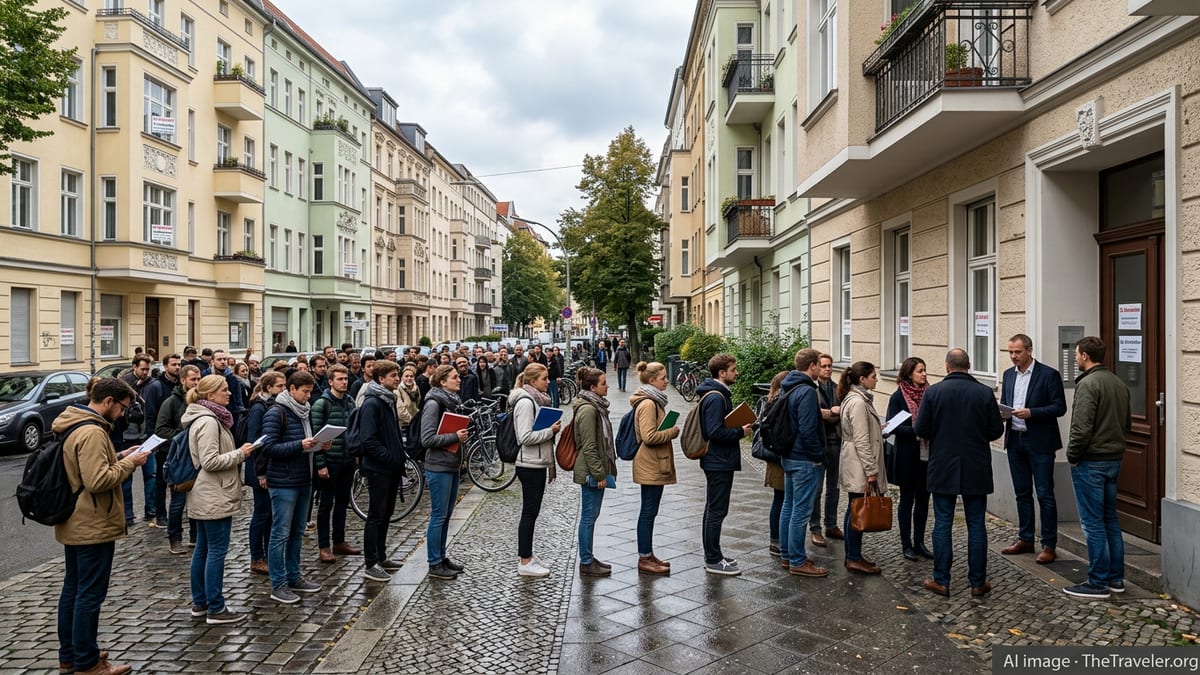
Viewing procedures also influence the difficulty of securing a home. Open group viewings are common in high‑pressure markets, where a large number of prospective tenants attend a short viewing window. Decisions are then made quickly after landlords review application packages submitted on the same day. Individuals who are not physically present in the city, or who cannot attend at short notice due to work or travel constraints, may be effectively excluded from consideration.
Digitalization has improved transparency to some extent, but many landlords still prefer in‑person impressions and original documents. Remote applications are sometimes accepted, particularly for corporate lets, but they remain less common in the standard private rental market. For those moving from abroad, synchronizing arrival dates, temporary accommodation, and repeated in‑person viewings can be logistically demanding.
Finally, language can be a practical barrier. While English is increasingly used in metropolitan listings, many advertisements, contracts, and building rules remain solely in German. Misunderstandings about obligations, house rules, or maintenance responsibilities can arise if tenants are not fully familiar with the terminology. Taken together, these practices can slow down the search process and increase the risk of missteps for newcomers, even when they have the financial means to rent.
The Takeaway
Finding housing in Germany is difficult primarily because structural and regulatory factors combine to keep urban rental markets tight and competitive. New construction has not fully kept pace with the formation of new households, especially in major employment centers, resulting in a persistent supply‑demand imbalance. This is reflected in elevated rent levels, low vacancy rates, and intense competition for each advertised unit.
Strong tenant protections and regulated rent increases provide security for established tenants but reduce turnover and encourage cautious tenant selection by landlords. Relocating individuals must therefore meet stringent documentation and income requirements while competing with locally established applicants. Regional disparities, intra‑urban differences in pressure and pricing, and complex rent regulation instruments add further layers of difficulty to the search.
For anyone evaluating a move to Germany, these housing market realities should be treated as a central factor in relocation feasibility. Success in securing suitable accommodation often depends on early planning, geographical flexibility within commuting distance of the workplace, and a clear understanding of how the German rental system functions. While the system offers long‑term stability once a tenancy is secured, reaching that stage can require significant time, financial resources, and adaptability.
FAQ
Q1. Why is it so hard to find an apartment in major German cities?
High demand from population growth, urbanization and migration meets limited new construction and low vacancy rates, creating intense competition for each available unit.
Q2. Are housing difficulties the same across all parts of Germany?
No. Large cities and economically strong regions face severe shortages and higher rents, while many smaller towns and rural areas have more availability and lower price levels.
Q3. How expensive is renting in Germany’s big cities compared to the national average?
In major cities, average asking rents in the mid‑teens per square meter are common, with top markets significantly higher, often well above national averages that include less pressured regions.
Q4. Do strong tenant protections make it harder to find housing?
Yes. Robust protections give sitting tenants security and limit rent increases, but they also reduce turnover and make landlords cautious, which can make access harder for newcomers.
Q5. Does rent regulation in Germany keep initial rents low?
Rent indexes and the rent brake limit certain increases, but exemptions and complex rules mean that initial rents in high‑pressure areas can still be high by international standards.
Q6. What documentation do landlords typically expect from applicants?
Most landlords expect proof of income, an employment contract, a recent German credit report, identification documents and sometimes references or proof of previous rent payments.
Q7. How large are typical upfront costs when renting in Germany?
Tenants usually pay a security deposit of up to three months’ cold rent plus the first month’s rent and utility prepayments, and sometimes additional costs for fixtures or fittings.
Q8. Is it easier to secure housing if I am willing to live outside the city center?
Often yes. Peripheral districts and nearby towns can offer more availability and lower rents, but this comes with trade‑offs in commute times and immediate access to urban amenities.
Q9. Can I usually rent an apartment in Germany from abroad without visiting in person?
It is possible but less common. Many landlords prefer in‑person viewings and meetings, so remote applicants may face disadvantages compared with candidates already on the ground.
Q10. How should housing difficulties influence a decision to relocate to Germany?
Housing constraints should be treated as a central planning factor, influencing timing, budget, preferred locations and the need for temporary accommodation during the search process.