


I realized how much I truly disliked crowds the morning a tour bus reversed over my hiking boots in southern Iceland. The parking lot at the trailhead had turned into a stadium, selfie sticks jabbed in every direction, and the quiet I had flown across an ocean to find had been replaced by drone buzz and shouted countdowns for group photos. A year later, standing on the rim of a volcanic crater lake in the middle of the Atlantic, I heard something I had not experienced at a famous viewpoint in years: nothing. No engines, no megaphones, no queues. Just wind, distant cowbells, and a lone fisherman’s truck in the distance. This was the Azores, and if you hate crowds, it might be one of the best places to travel right now.
Discovering a Quiet Atlantic Alternative
I flew into Ponta Delgada on São Miguel expecting a greener, sleepier version of the Canary Islands. Instead, I landed someplace that felt closer to a rural Atlantic Vermont with volcanoes. The airport was busy enough to feel connected to the world, but when I picked up my rental car, there were only three of us in the queue. The agent casually circled half the island on a paper map and said, “You’ll have the roads mostly to yourself if you avoid Sunday afternoons.” He was right. Over a week of driving, I spent more time slowing down for cows than for other cars.
What makes the Azores stand out right now is not that they are undiscovered. Tourism has grown here, and local statistics talk about record overnight stays in recent years. But in practical terms, the numbers are still tiny compared with European sun-and-sand heavyweights. Regional reports describe the Azores welcoming under half a million visitors in 2024, compared with many millions in the Canary Islands in the same year. On the ground, that difference is profound. Viewpoints have parking spaces still edged with wild hydrangeas, not guardrails and ticket booths. Lakeside towns feel lived in first and touristic second.
The other surprise was how normal life still feels. In Ponta Delgada’s Mercado da Graça, I watched grandmothers buy local Sao Jorge cheese and enormous bunches of kale without once glancing at the handful of visitors wandering between stalls. There were no cruise groups funneling through, just a quiet rhythm of people shopping before lunch. For someone used to dodging tour groups in cities like Barcelona or Dubrovnik, the absence of that mass choreography felt like exhaling.
That is not to say the Azores are empty. In peak whale watching months, boats fill up and popular hot spring pools are busy at midday. But the scale is human. At the busiest thermal spa I visited, the “crowd” meant waiting behind two couples to rent a locker, not joining a half-hour line just to enter.
Why the Azores Work So Well If You Hate Crowds
The Azores occupy a sweet spot that is increasingly rare in 2026. They are connected enough to be practical, but remote enough to deter mass tourism. There are direct flights from several European and North American cities, yet the archipelago’s position in the middle of the Atlantic filters out travelers looking for quick city breaks or cheap party weekends. You do not accidentally end up here on a whim.
Another important factor is scale. São Miguel, the largest island, takes around two hours to cross by car, but its tourism infrastructure still feels modest. Visitor numbers have grown, yet recent regional reports point to a cooling in winter tourism and a relatively small total compared with Mediterranean hubs. Local guesthouses talk about a good summer season but worry aloud about empty rooms between November and March. For travelers who dislike crowds, that seasonality can be an advantage. In late spring, when mainland Europe is bracing for its first wave of peak-season arrivals, I drove for thirty minutes at a time without seeing another rental car, only small delivery vans and school buses.
There is also a cultural element. Locals I spoke with in Furnas and Sete Cidades were happy to see tourism grow, but wary of repeating the path of overtouristed European islands. They pointed to news about protests in parts of Spain’s Canary Islands and new tourist taxes in other North Atlantic destinations as examples of what they hope to avoid. The Azores have leaned toward nature-focused, small-scale travel: rural guesthouses, hiking, whale watching, and farm-to-table restaurants, rather than mega-resorts and cruise docks. That shapes the kind of visitor who comes and helps keep the atmosphere calmer.
Finally, prices here are a quiet crowd-control mechanism. You will not find the rock-bottom package deals that fuel mass tourism elsewhere, but you also will not face the eye-watering costs of Iceland in high season. In March this year, I paid around the cost of a mid-range hotel room in Lisbon for a full day private hike-and-hot-springs tour on São Miguel, with coffee and pastries thrown in. It is not cheap, but it rewards travelers who are willing to plan, stay longer, and move at a slower pace.
A Morning Alone at Sete Cidades
My most vivid Azores memory starts in the dark. I left Ponta Delgada just after 5:30 a.m., coasting past shuttered cafés and the faint glow of bakery ovens. The drive up to Sete Cidades, the famous twin crater lakes, took about forty minutes on a two-lane road that wound through dairy farms and forest. Every few minutes I passed a small tractor or a fisherman’s van heading the other way. That was it.
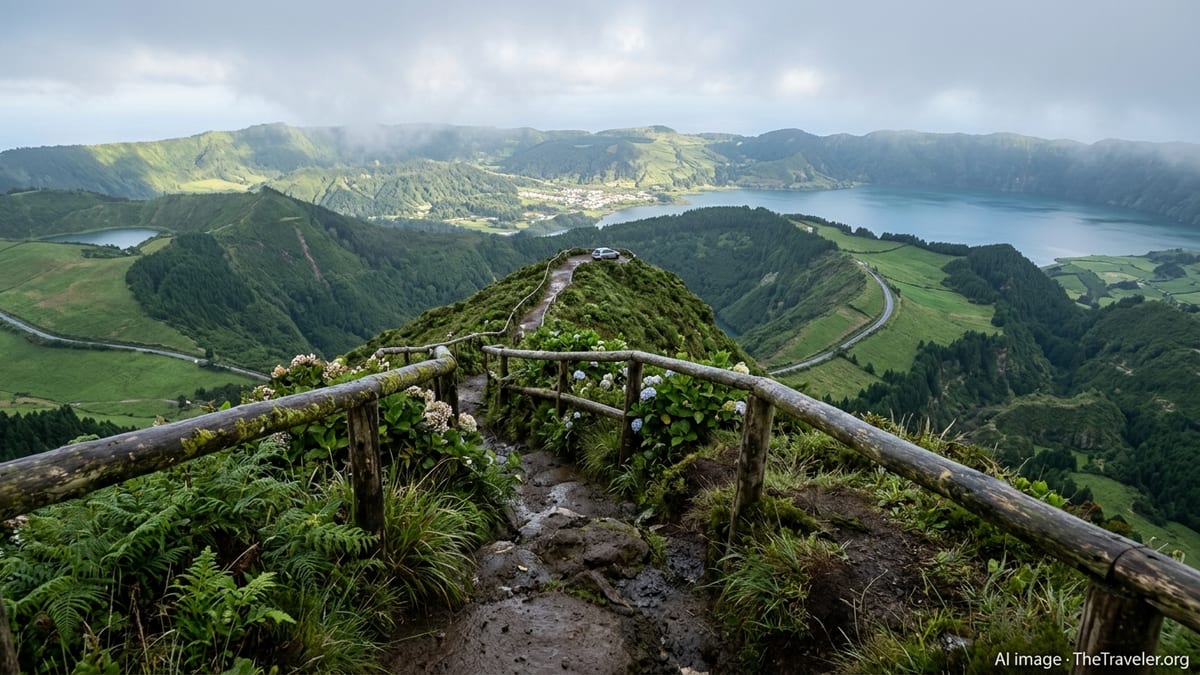
By the time I reached the Miradouro da Boca do Inferno trailhead, the sky was just turning from black to indigo. In Iceland or along Norway’s most famous fjords, the parking lot would already be humming: campervans jockeying for spots, drone pilots testing batteries, early tour buses idling with their interior lights glowing. Here, one small hatchback sat under a eucalyptus tree, its windows fogged from someone sleeping inside. I parked beside it and began the short walk up to the viewpoint.
At the top, the wind was strong enough to sting my eyes, and clouds drifted in low from the Atlantic. For twenty minutes, I watched the classic Azores scene appear and disappear: the turquoise lake on one side, the deeper blue on the other, patchwork fields in between, and a thin line of ocean beyond the crater rim. Only as the sun lifted did I hear footsteps behind me. A local trail runner in a faded football jersey nodded hello, then passed without breaking stride. No tour leader with a microphone arrived. No one asked me to move aside for their panoramic shot.
By 9 a.m., a few more cars had trickled in. A French couple stood quietly at the edge, a family from mainland Portugal pointed out different shades of green to their kids, and a solo traveler laid a thermos of coffee on the wall. At its “busiest,” the viewpoint held perhaps fifteen people, each content to find their own angle without crowding anyone else. It felt like how famous landscapes used to feel before they went viral.
Hot Springs, Empty Roads and Realistic Costs
If you care more about avoiding crowds than pinching every last euro, the Azores reward you with calm, steady value rather than bargains or blowouts. On São Miguel, I based myself in a modest guesthouse in Ribeira Grande, a surf town on the north coast. My room overlooked a small church square where local teenagers practiced skateboard tricks after school. In April, the nightly rate sat comfortably below what a standard room might cost in central Lisbon, and included a breakfast of local cheese, homemade bread, and strong coffee.
From there, I spent most days stringing together short drives: twenty minutes to a cliffside viewpoint, fifteen minutes to a black sand beach, half an hour along nearly empty roads to Caldeira Velha, a set of hot spring pools shaded by ferns and volcanic rock. I had expected the usual spa choreography: pre-booked time slots, numbered wristbands, loud music. Instead, I arrived at 10 a.m. on a weekday, paid a straightforward entry fee at the gate, and stepped into a quiet, steamy garden where the loudest noise was the waterfall feeding the main pool. There were perhaps twenty people spread between several pools, many speaking Portuguese with soft island accents.
Meals followed the same pattern. At a family-run restaurant in Furnas, one of the island’s geothermal hubs, the specialty is cozido, a meat and vegetable stew slowly cooked in volcanic soil. Locals had reserved most of the tables. The owner squeezed me into a corner seat with a smile, not because of a social media buzz, but because I happened to arrive just before the Sunday lunch rush. My bill for a generous portion of cozido, a glass of Azorean wine, and coffee would barely cover a cocktail and a snack in central Reykjavik or a beach bar in Santorini.
Whale watching, a marquee activity in the Azores, does bring more people together. Boats run regularly in peak season, and popular departures do sell out. But even here, the scale is single-digit vessels, not flotillas. On my trip, the boat held around two dozen people and left from a modest harbor where fishermen offloaded their catch beside us. The guide talked more about marine conservation and local weather patterns than social media shots. When a pod of dolphins finally surfaced, there was excitement and camera clicking, but there were no drones leapfrogging each other over the animals or neighboring boats crowding in.
Planning a Crowd-Free Azores Trip Right Now
To get the most out of the Azores if you dislike crowds, timing and routing matter more than obsessing over “hidden gems.” The archipelago has nine islands, but for a first visit focused on quiet, São Miguel and at least one smaller island like Pico, Faial, or Flores make a good combination. Inter-island flights and ferries are regular in summer, but far from overwhelming. It is wise to build in buffer days in case Atlantic weather disrupts schedules.
Shoulder seasons are your friends. April to early June and late September to October offer a balance of mild weather, open services, and fewer visitors. Recent tourism data out of the region shows high season spikes in July and August, especially around whale watching, but also notes a sharper drop in winter months. That means if you can travel just before or after school holidays, you effectively trade a few degrees of warmth for mostly empty trailheads and quiet thermal pools.
On São Miguel, staying outside Ponta Delgada can make a big difference. Towns like Ribeira Grande on the north coast or Vila Franca do Campo on the south offer easy road access but a calmer, residential feel. You can still drive into the capital for dinner, but you will wake up to church bells and roosters instead of early-morning tour departures. Booking a rental car is almost essential if you want to dictate your own schedule and abandon viewpoints the moment a crowd does appear.
Finally, keep your expectations grounded. This is the mid-Atlantic, not a curated spa resort. Weather changes fast. Clouds can swallow entire lakes. A viewpoint might be empty at sunrise and hold three tour vans by lunchtime. But compared with major European hotspots now introducing daily visitor caps, cruise ship limits, and steep tourist taxes, the Azores remain remarkably relaxed. You are still more likely to compete with local dog walkers for space on a trail than with a hundred-person tour group.
The Takeaway
In an age when overrun cities are fighting back against mass tourism with fines, bans, and protests, it is increasingly difficult to find places that feel both accessible and genuinely uncrowded. The Azores are one of those rare exceptions right now. The islands are not empty, and they are not immune to the pressures that have reshaped other destinations. But for the moment, visitor numbers, geography, and a cautious approach to development have combined to create a kind of travel sweet spot.
Standing on the rim of Sete Cidades or soaking in a fern-framed hot spring, it is easy to forget how unusual that is in 2026. You can rent a car without entering a traffic jam every morning. You can visit a famous viewpoint and recognize the photos you once saw online, minus the throngs of people. You can eat in restaurants where the menu has not been rewritten solely for foreign tastes. Perhaps the most telling sign is how quickly conversations in cafés shift back to local concerns once you pay your bill and leave.
If crowds have been quietly pushing you away from travel, the Azores offer a compelling argument to start again. The archipelago asks you to accept a bit of Atlantic unpredictability in exchange for space, calm, and the feeling that you are stepping into someone’s home rather than an open-air theme park. Right now, as headlines about overtourism grow louder elsewhere, that feels like a luxury far rarer than any rooftop infinity pool.
FAQ
Q1. Are the Azores really less crowded than places like Iceland or the Canary Islands?
The Azores receive far fewer visitors than major Atlantic and Mediterranean hotspots, so while you will see other travelers, the scale and density of tourism are much lower.
Q2. When is the best time to visit the Azores if I want to avoid crowds?
April to early June and late September to October usually offer mild weather, open services and noticeably fewer visitors than the July and August high season.
Q3. Which Azores island should I choose for a quiet first trip?
São Miguel is the easiest starting point, and pairing it with a smaller island like Pico or Flores gives you a quieter, more rural experience without complicated logistics.
Q4. Do I need to rent a car to escape the crowds in the Azores?
Public buses exist but are geared toward local needs. Renting a car gives you the freedom to visit popular sites early or late and to explore lesser-known viewpoints at your own pace.
Q5. Are the famous hot springs in the Azores overcrowded?
Some thermal pools get busy at midday in high season, but outside peak hours and during shoulder seasons they tend to feel relaxed rather than packed.
Q6. How expensive is it to travel in the Azores compared to other European islands?
Prices are generally moderate: more than budget beach destinations but usually lower than Iceland or top-tier Mediterranean islands, especially if you eat locally and book simple guesthouses.
Q7. Is it possible to find completely empty hiking trails?
Yes, especially on less-visited islands or if you start early in the morning. Even on São Miguel, venturing beyond the most famous viewpoints quickly thins out the foot traffic.
Q8. Are there still authentic local towns, or has tourism taken over?
Most Azorean towns remain firmly rooted in local life. You will see everyday routines in markets and village squares, with tourism layered on top rather than dominating everything.
Q9. Will the Azores stay uncrowded in the future?
No destination stays the same forever, and visitor numbers are growing, but the islands’ remote location and measured approach to tourism should slow the pace of change compared with easier-to-reach hotspots.
Q10. Is it safe to travel solo in the Azores if I am looking for quiet and solitude?
The Azores generally feel very safe, including for solo travelers, as long as you take normal precautions and respect the powerful Atlantic weather when hiking or driving in remote areas.