

More news on this day
A powerful late February blizzard centered on the Northeast is rippling across the United States rail network, forcing widespread Amtrak cancellations from New York and Washington D.C. to Boston, Philadelphia, Chicago, Pittsburgh, Cleveland and beyond just as peak winter travel coincides with school breaks and business trips.
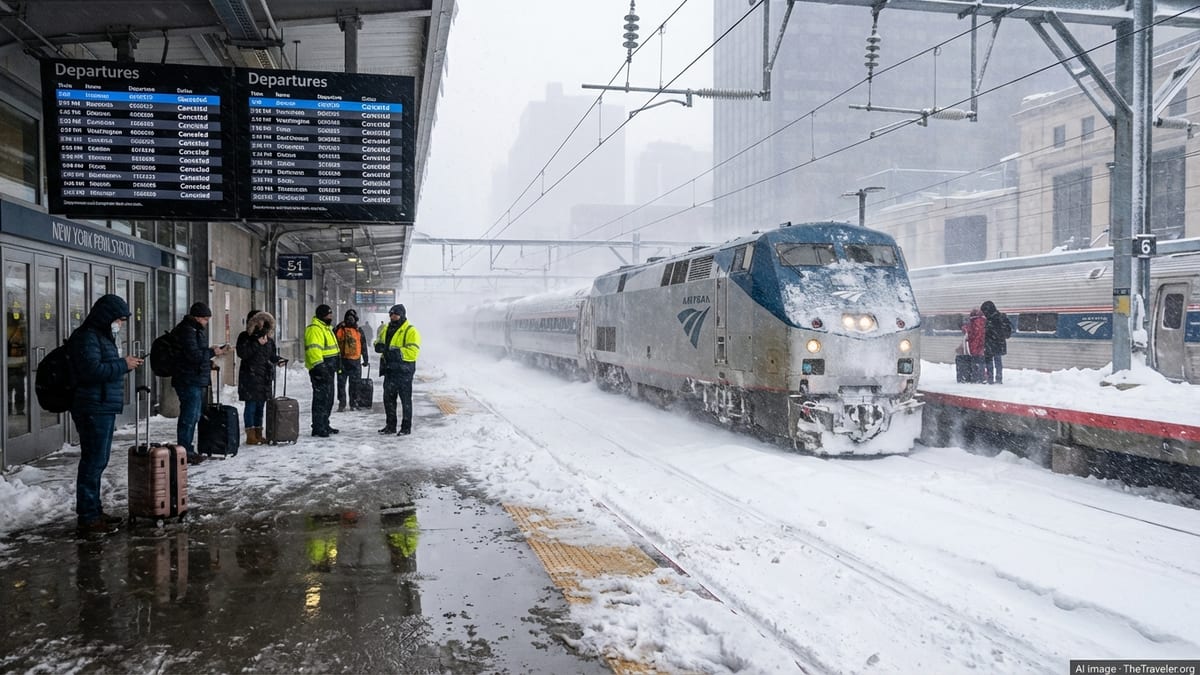
Blizzard of 2026 Shuts Down the Northeast Corridor
New York City has emerged as one of the epicenters of the February 2026 blizzard, with blinding snow and fierce winds prompting rare citywide travel bans and rail shutdowns. Amtrak suspended all service between New York’s Moynihan Train Hall and Boston’s South Station for much of Monday, as crews struggled to clear drifts and inspect overhead power lines along the busy Northeast Corridor.
New York joined Washington D.C., Boston and Philadelphia in seeing some of the most severe disruptions on Amtrak’s flagship Acela and Northeast Regional routes. Multiple Acela departures were scrubbed, while a long list of Northeast Regional trains between Virginia, the Mid-Atlantic and New England were canceled outright or offered only limited service. Rail operators said the combination of deep snow, high winds and frozen switches made it unsafe to run high-speed services.
State and city officials across the corridor encouraged residents to stay home, effectively emptying concourses at New York Penn, Washington Union Station and Boston South Station just as they would normally be filling with commuters and long-distance travelers. Inside New York’s major terminals, departure boards were dominated by “canceled” notices as only a skeleton schedule of trains crept in and out.
For passengers, the result was a cascade of missed connections and abandoned itineraries. Some travelers arriving on the final trains into New York and Washington found themselves stranded without onward options, relying on hotel vouchers, overnight station stays or last-minute rebookings later in the week once the storm passes and tracks can be fully cleared.
Ripple Effects Reach Chicago, Pittsburgh, Cleveland and the Midwest
Although the heart of the storm sits over the Northeast, its reach extends deep into the national grid, affecting long-distance trains linking the East Coast to the Midwest. Chicago, a key Amtrak hub, has seen disruptions and delays on services that rely on Northeast Corridor connections, including routes that normally continue eastward to New York, Boston and Washington.
In Pittsburgh and Cleveland, travelers reported heavily delayed departures and, in some cases, cancellations of overnight and long-haul trains that traverse the Great Lakes and Ohio Valley before turning toward the East Coast. While snow totals in parts of the Midwest remain lower than in New England, dispatchers and schedulers must juggle trainsets and crews that are out of position after days of storm-related disruption farther east.
National rail planners face the added complication of already tight winter schedules. Many long-distance trains were running near capacity even before the storm, with limited spare rolling stock available to plug gaps. When a section of a multi-state route shuts down, it can leave trains and personnel stranded far from their next scheduled origin, forcing cancellations hundreds of miles from the worst of the weather.
These knock-on effects are being felt from the lakeshore platforms of Cleveland to Chicago’s Union Station, where passengers bound for the East Coast are confronted with truncated routes that now terminate in the Midwest or skip key northeastern stops. For some, the only immediate alternative is to accept travel credits and wait several days for the network to normalize.
Washington, Boston and Philadelphia Face Near-Standstill Rail Travel
In Washington D.C., normally brisk Amtrak operations along the Washington to New York spine slowed to a crawl as the blizzard intensified and moved up the coast. While some regional trains operated on reduced schedules between the capital and intermediate Mid-Atlantic cities, many were canceled outright, particularly those slated to continue north into the hardest-hit zones of New Jersey, New York and New England.
Boston, at the northern end of the Northeast Corridor, saw all service temporarily halted between South Station and New York, effectively isolating New England’s largest city from the rest of the national rail system. Commuter lines feeding into Boston also cut back or stopped, leading authorities to warn that rail travel could remain severely limited even after the heaviest snow bands move out.
Philadelphia, a major intermediate hub, became a pinch point as trains that might otherwise have run through were turned back or terminated early. On platforms at 30th Street Station, passengers accustomed to frequent corridor service instead encountered long gaps between departures, with staff reiterating that safety and infrastructure checks would dictate when full service could resume.
Rail officials across these cities emphasized that the storm’s combination of record-setting snowfall, intense wind gusts and extreme cold created particularly hazardous conditions for catenary lines, track beds and signaling. Until crews could safely inspect and repair problem spots, they said, aggressive cancellations were the only way to avoid equipment damage and protect passengers and staff.
Travelers Confront Cancellations, Rebookings and Limited Alternatives
For holidaymakers, students and business travelers, the wave of Amtrak cancellations arrived on top of thousands of grounded flights at major airports such as JFK, LaGuardia, Newark and Boston Logan, leaving few viable routes into and out of the blizzard zone. Many who had opted for rail in hopes of avoiding airport chaos instead found themselves in the same predicament, scrambling to rebook journeys or extend hotel stays.
Amtrak advised travelers on canceled trains that they could change their reservations without additional fees, and that full refunds would be available for trips scrubbed because of the storm. Even with those policies, though, rebooking proved challenging in some corridors, as future departures quickly sold out and rolling stock remained scattered across the network.
At stations from New York and Washington to Chicago and Cleveland, staff distributed updates over loudspeakers and digital boards, urging passengers to check alerts frequently and avoid coming to stations unless they had confirmed departures. Lines at ticket counters grew with travelers looking for alternate dates or different routes, only to learn that bus operators and regional rail services were also curtailing service due to the conditions.
Some passengers turned to rental cars or ride-hailing services once road bans began to lift, but icy highways and lingering visibility issues made driving a slow and sometimes risky alternative. Others opted to postpone trips entirely, underscoring how a single powerful winter system can upend mobility across multiple modes of transportation at once.
Recovery Efforts and What Travelers Should Expect Next
As the storm begins to pull away from the coast, Amtrak and local transit agencies are pivoting from crisis response to recovery. Crews are working round the clock to plow tracks, clear switches and remove snowbanks from platforms, while maintenance teams inspect overhead wires and signal equipment for ice damage and wind-related failures.
Rail officials caution that, even after snowfall tapers off, travelers should expect at least several days of residual disruption. Trains will likely run on modified schedules with fewer frequencies, and some long-distance routes may remain shortened or rerouted as equipment and crews are repositioned. Priority is expected to go to restoring core Northeast Corridor services linking Washington, Philadelphia, New York and Boston, before full normal operations resume on more distant routes.
For now, travel experts recommend that passengers with flexible plans postpone nonessential trips through the affected regions, and that those who must travel build in significant extra time and prepare for sudden changes. Checking official alerts before heading to a station, carrying chargers and basic supplies, and having backup accommodations lined up can help mitigate the worst of the disruption.
With winter still far from over, the Blizzard of 2026 serves as a stark reminder of how vulnerable even the nation’s busiest and most modern rail corridor remains to extreme weather. From New York and Washington to Chicago, Pittsburgh and Cleveland, the storm has temporarily redrawn the map of train travel in the United States, leaving millions waiting for the rails to thaw and the schedules to stabilize.