

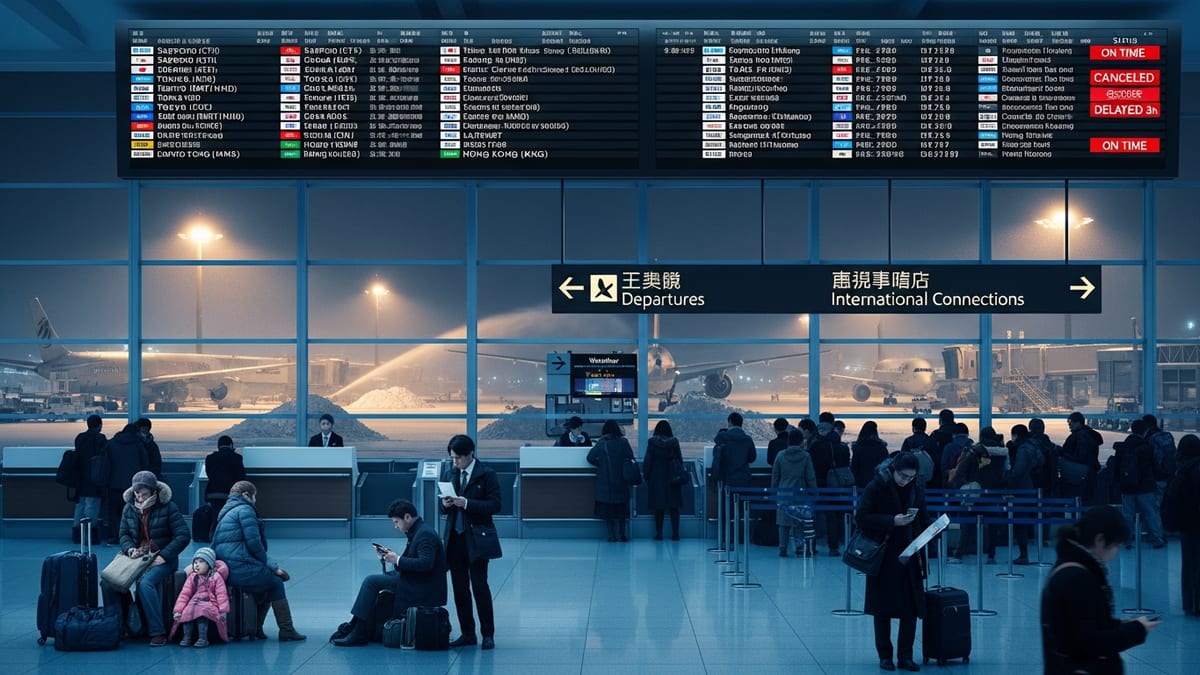
Hundreds of travelers found themselves stranded and anxious across Japan on January 20, 2026, as a wave of cancellations and delays rippled through major airports in Sapporo, Osaka, and Narita.
At least 39 flights were reported canceled and many more delayed, affecting operations of ANA Wings, All Nippon Airways, Korean Air, Cathay Pacific, Jetstar Japan, and several regional carriers.
The disruption, which followed days of already strained schedules, underscored the fragility of winter aviation networks in Northeast Asia and left passengers scrambling for alternative routes, overnight accommodation, and updated information.
More News
- Fallen Tree Causes Major Morning Disruption on London Overground’s Windrush Line
- Canada Tightens ‘Avoid All Travel’ Warnings for Six High-Risk African Nations
- China Flight Chaos: Hundreds of Cancellations Snarl Major Hubs Amid Winter Travel Rush
Wave of Cancellations Hits Sapporo, Osaka, and Narita
The latest disruption unfolded across a core trio of Japanese hubs serving both domestic and international traffic. New Chitose Airport near Sapporo, Kansai International Airport serving Osaka, and Tokyo Narita each reported fresh clusters of cancellations and late departures, compounding operational issues that have built over recent weeks. Flight tracking data and airport status boards showed 39 outright cancellations on January 20 alone, while additional services departed hours behind schedule.
ANA Wings and its parent All Nippon Airways were again among the hardest hit, continuing a pattern seen throughout January as they adjusted schedules and aircraft rotations in response to weather and regional capacity constraints. Korean Air and Cathay Pacific, key foreign carriers linking Japan with Seoul, Hong Kong, and broader Asia, also reported disrupted rotations into and out of Sapporo and Osaka, prompting knock-on delays at their home hubs. Jetstar Japan, which operates a dense web of low cost domestic and short haul routes, faced a particularly challenging day as delays on early morning sectors cascaded into its afternoon and evening banks.
The situation at Narita was especially sensitive because it serves as a major international gateway. Even a relatively small number of cancellations at such a hub can leave long haul passengers with limited options, particularly when connecting services are full or similarly delayed. Airport staff reported growing lines at airline service counters and rebooking desks as the day progressed, with many travelers facing overnight stays or improvised routings via other Japanese and regional airports.
Recent Pattern of Travel Turbulence Across Japan
The latest round of 39 cancellations and associated delays did not occur in isolation. Throughout late December 2025 and early January 2026, Japan’s air transport system has endured repeated shocks, including earlier waves of cancellations tied to winter weather, capacity shortages, and broader regional constraints. On several days in late December, major Japanese carriers including All Nippon Airways, Japan Airlines, ANA Wings, and others jointly accounted for more than a hundred cancellations and well over a thousand delays nationwide, affecting Tokyo, Osaka, Sapporo, Fukuoka, and other airports.
Earlier in January, analysts tracked cases where ANA Wings, Ibex, Hokkaido Air System, and All Nippon Airways temporarily suspended or reduced dozens of domestic flights, particularly on routes to or from Sapporo, Narita, and Osaka. These disruptions, often blamed on poor weather and operational knock on effects, set the stage for the current wave of irregular operations by leaving carriers with thin margins for recovery. Even relatively modest new disruptions have been enough to push the system back into visible stress, especially during the busy winter leisure season.
Travel trade publications have described these cumulative effects as a form of “rolling turbulence” in Japan’s domestic and regional air travel market. Airlines have been increasing some frequencies on popular routes to respond to pent up demand, while simultaneously confronting periodic capacity reductions and schedule adjustments, creating a dynamic and at times unstable operating environment. For passengers, this has translated into a higher likelihood of schedule changes, rebookings, and long waits for available seats when events like the current 39 flight cancellation wave unfold.
Passengers Stranded, Rebooked, and Rerouted
For travelers caught up in Monday’s disruptions, the effect was immediate and personal. At New Chitose, travelers reported long waits at ANA and Jetstar Japan counters, where staff worked to secure scarce seats on later departures to Tokyo, Nagoya, and Osaka. Hotel desks at the airport and in nearby Sapporo saw brisk business as travelers who had hoped to depart by evening were instead offered flights departing the following morning or even later in the week.
At Kansai International Airport, delays on inbound services from Seoul and other regional points created missed connections for onward flights within Japan. Korean Air passengers aiming to connect onward to domestic destinations were in some cases rerouted via Tokyo Haneda or Itami, adding hours and additional security and immigration checks to their journeys. While airlines generally provided meal vouchers and, where necessary, hotel accommodation, some passengers took to social media to complain about limited information at departure gates and difficulty reaching call centers.
Narita, accustomed to handling transpacific and long haul traffic, faced its own unique set of passenger challenges. Travelers arriving from Europe and North America found that their onward domestic legs had been canceled or heavily delayed, leaving them to choose between waiting for rebooked domestic flights or transferring by rail and bus to reach cities like Sendai, Nagano, and Kanazawa. Several travel agents based in Tokyo reported a surge in last minute rail reservations, as passengers sought alternatives to disrupted domestic air services out of Narita.
Airlines Struggle to Balance Capacity and Reliability
The strain on ANA Wings, All Nippon Airways, Jetstar Japan, and their regional partners has been magnified by an increasingly complex balancing act between capacity deployment and operational resilience. Over the winter 2025 to 2026 season, airlines introduced seasonal additions such as extra domestic flights on trunk routes linking Tokyo with Sapporo, Osaka, and Fukuoka to capture holiday and ski travel demand. At the same time, they have faced constraints including aircraft undergoing heavy maintenance, unexpected technical events on individual jets, and sharply reduced capacity on some international routes to and from neighboring China.
Industry schedule data for January and February 2026 shows that several Chinese carriers have significantly cut back flights into major Japanese gateways, including Osaka Kansai, Sapporo New Chitose, Nagoya, and Tokyo Narita, slashing overall seat capacity on China to Japan sectors by more than half compared with previous schedules. While those reductions mainly affect inbound tourism from China, they also reduce the overall elasticity of the regional network, making it harder for airlines to reroute displaced passengers via alternative hubs when Japanese domestic operations falter.
Within Japan, All Nippon Airways and its affiliate ANA Wings continue to tweak their domestic network plan for the 2025 to 2026 winter season, adding non scheduled flights at peak times while suspending or trimming others. The constant fine tuning, while commercially rational, can leave operations vulnerable when a new shock, such as a burst of poor weather or unexpected staffing shortages, emerges. Jetstar Japan, with its high utilization model, has even less slack in the system; a delay on a single morning departure can echo through multiple later flights, forcing cancellations like some of those recorded at Sapporo and Osaka on January 20.
Regional and International Knock On Effects
While Monday’s disruptions have been most keenly felt by passengers inside Japan, the impact has spread to neighboring markets as well. Korean Air and Cathay Pacific operate important links connecting Sapporo and Osaka with Seoul and Hong Kong, where passengers transfer to flights across Asia, Europe, and North America. Delays on Japanese sectors can therefore create a chain reaction, forcing short notice retimings or missed connection handling at foreign hubs.
In South Korea, recent aviation disruptions, including heightened safety scrutiny following high profile incidents, have already placed pressure on airline schedules. When Korean Air faces delays or cancellations of flights into Japan, it must juggle aircraft rotations to ensure that other regional services, including domestic Korean routes and long haul flights, can operate as close to schedule as possible. That juggling act becomes more difficult when multiple regional airports, such as New Chitose and Kansai, experience concurrent irregular operations.
Hong Kong based carriers such as Cathay Pacific are in a similar position. Their Japan services form an important part of broader Asia Pacific connectivity, particularly for business travelers and tourists heading to North America and Southeast Asia. A canceled or significantly delayed flight between Osaka and Hong Kong can lead to missed onward connections and a need for hotels and rebookings at the downstream hub, magnifying the financial and logistical impact of what might originally have been a single operational issue in Japanese airspace.
Persistent Weather and Seasonal Pressures
Although precise causes of each individual cancellation differ, the broader seasonal picture is dominated by winter weather and the operational pressures that accompany it. Northern Japan, including Hokkaido and the Sapporo region, regularly faces heavy snowfall, strong winds, and reduced visibility during January, conditions that can force runway closures, extended deicing operations, and tightened air traffic control spacing. Even when airports remain technically open, airlines often preemptively cancel flights to avoid long on board delays and to maintain some semblance of schedule predictability.
Osaka and Narita, while less prone to prolonged blizzard conditions, are not immune to winter volatility. Strong crosswinds, icing conditions at altitude, and weather systems moving across the Sea of Japan and Pacific coast can all contribute to air traffic flow restrictions and ground handling challenges. When multiple airports in the same region face constraints on the same day, airlines often have little choice but to concentrate resources on key trunk routes and trim frequencies elsewhere, which is reflected in the tally of 39 cancellations and multiple delays reported on January 20.
The seasonal spike in leisure demand, including ski trips to Hokkaido and New Year onward travel, continues to keep load factors high, leaving fewer empty seats that can be used to absorb displaced passengers. That dynamic can turn even a relatively moderate wave of cancellations into a high profile disruption event, as standby lists grow and travelers discover that the next available confirmed seat may be a day or more away.
Advice and Outlook for Affected Travelers
For travelers currently in Japan or planning imminent trips, the January 20 disruptions serve as a pointed reminder to build flexibility into winter itineraries. Airlines operating in and out of Sapporo, Osaka, and Narita continue to update their flight status pages frequently, and same day changes remain common. Passengers are advised to check their flight status several hours before departure, enroll in airline notification services, and consider routing options that provide more generous connection times, especially when transferring between domestic and international flights.
Travel agents and tour operators report increased interest in multi modal itineraries that combine air and rail, particularly on routes where Japan’s high speed rail network provides a realistic alternative. While not immune to weather and capacity constraints of its own, rail can offer more predictable travel times on key corridors such as Tokyo to Osaka or Tokyo to northern Honshu, potentially reducing reliance on short haul flights that are frequently targeted for cancellation during disruptive weather events.
In the short term, airlines are expected to continue using a mix of schedule thinning, aircraft swaps, and ad hoc additional flights to manage both demand and operational risk. For passengers, that means ongoing uncertainty but also more tools than in the past to monitor and manage disruption, from mobile apps with real time rebooking options to digital vouchers and automated hotel booking offers. As the winter season progresses toward late February, aviation authorities and airline planners will be closely watching whether the pattern of recurring cancellations and delays eases or persists, and how deeply the current wave of irregular operations will influence traveler confidence in Japan and across the wider Northeast Asian market.