

Set amid the wide skies and rolling fields of southeastern Saskatchewan, Wolseley is the kind of prairie town that invites you to slow down, wander on foot, and linger by the water. Nicknamed the “Town Around A Lake,” this small community on the Trans‑Canada Highway blends restored historic buildings, a tranquil central lake with a beloved swinging bridge, and a surprisingly rich cultural scene. Whether you are detouring off the highway for an afternoon stroll or planning a quiet weekend escape, Wolseley offers an easygoing slice of small‑town prairie life.
Getting Oriented in Wolseley
Wolseley sits in southeastern Saskatchewan, just off Highway 1 between the larger centres of Regina and Brandon. The town grew up around the Canadian Pacific Railway in the 1880s, and its layout still reflects that early linear pattern, with the rail corridor and commercial streets on one side and Fairly Lake forming a natural focal point in the middle. Today, visitors arriving by car will likely first see fuel stations and services near the highway before turning into the older residential and downtown streets that give Wolseley its character.
The community is small enough to explore comfortably on foot. Fairly Lake and the swinging bridge are central landmarks, with heritage buildings and main‑street businesses clustered a short walk away. Most accommodations, local eateries, and essential services are within a compact radius, making Wolseley a convenient overnight stop or a relaxed base for short prairie drives to neighbouring towns and rural attractions.
Wolseley is sometimes promoted as one of Canada’s prettiest and most historic small towns, a reputation rooted less in grand monuments and more in an atmospheric mix of lakeside views, turn‑of‑the‑century architecture, and tidy residential streets. Visitors should not expect a resort town with constant activity; what Wolseley offers instead is an unhurried pace, friendly greetings on the sidewalk, and the simple pleasure of walking from the café to the water in a matter of minutes.
The town’s tourist information centre, operating seasonally near the highway, makes a helpful first stop for maps and insight on current opening hours for local attractions. Staff and volunteers can point you toward self‑guided heritage walks, seasonal events, and quiet corners around the lake that you might otherwise miss when simply passing through.
History and Heritage: A Prairie Town with Deep Roots
Settled in the early 1880s, Wolseley was shaped by the arrival of the railway, agricultural settlement, and the ambitions of merchants and civic leaders who saw opportunity on the open prairie. Many of the town’s most notable buildings date from a prosperous period around the turn of the twentieth century, when substantial brick and stone structures began to replace simpler wooden storefronts and homes. Today, Wolseley’s commitment to preserving these buildings is a big part of its appeal for history‑minded travelers.
Among the standout structures is the Wolseley Town Hall and Opera House, completed in 1907. Designed in an Italian Baroque style, this two‑storey brick and fieldstone building originally housed municipal offices, a fire hall, a library, and a performance space. Its presence speaks to the aspirations of a small prairie community that wanted not just basic services but also culture and civic pride. The building now functions as a community hall and hosts everything from concerts to meetings, its ornate façade still a focal point of the town centre.
Nearby streets are lined with heritage homes and commercial blocks that collectively tell the story of Wolseley’s growth. The Perley Block, rebuilt in 1906 after fire destroyed the previous structures, anchors a stretch of downtown where original brickwork has been preserved while interiors have evolved to accommodate modern businesses. A former Beaver Lumber store and one of Saskatchewan’s earliest public libraries reflect the town’s early role as a regional service centre.
Wolseley’s heritage extends beyond architecture. Long‑time residents, community organizations, and local publications have worked to document stories of early settlers, Indigenous presence in the broader region, and the role of agriculture and the railway in shaping daily life. Walking through town, the layers of history are not presented as a museum piece but as a lived backdrop: restored façades with contemporary signage, century‑old houses with children’s bicycles on the lawn, and a lakeside that has shifted from industrial utility to community gathering place.
Fairly Lake and the Iconic Swinging Bridge
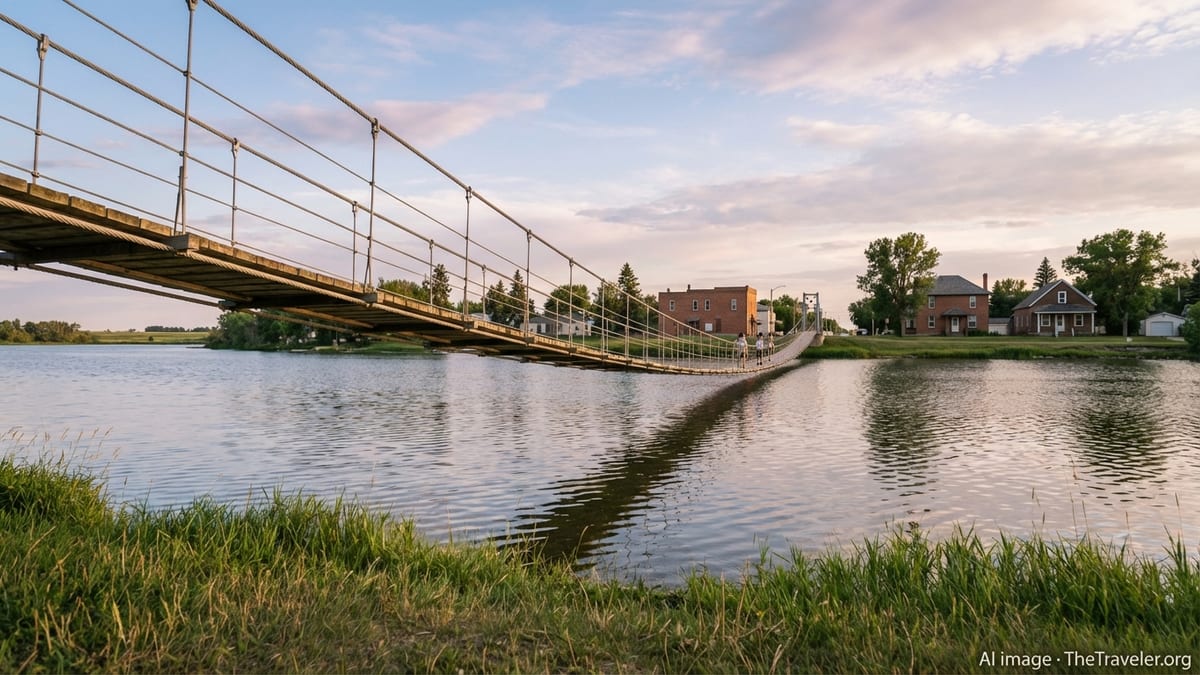
Fairly Lake is Wolseley’s defining feature and the reason for its “Town Around A Lake” nickname. The lake originated when the Canadian Pacific Railway dammed a local creek in 1902 to create a water supply for steam locomotives. Over time, the utilitarian reservoir evolved into a recreational asset, with a shoreline that now hosts walking paths, picnic spots, and one of the town’s most photographed structures: the swinging bridge.
The first swinging bridge was constructed in 1905, giving residents a direct pedestrian route across the lake. Since then, several iterations have been built, with earlier versions lost to windstorms and later replaced. The current bridge, a long, gently swaying structure suspended by cables, draws visitors who come as much for the experience as for the view. Crossing it offers a close perspective on the water, reeds, and birdlife, with open prairie sky reflected in the calm surface below.
Fairly Lake is also where locals head to cool off in summer. A modest swimming beach, seasonal dock, and grassy areas create a simple but appealing lakeside scene. Children paddle in the shallows while anglers cast for fish from shore. The atmosphere is low‑key, defined more by families with picnic coolers than by organized activities or rentals. Visitors should come prepared with their own towels, sunscreen, and snacks, as services around the lake remain intentionally limited.
For travelers who appreciate unstructured time outdoors, a loop walk that incorporates the bridge and the lakeside paths is one of Wolseley’s essential experiences. Sunrise and sunset are particularly rewarding, when soft light washes the brick of nearby buildings and the bridge’s silhouette stands out against pastel sky. Even in cooler months, the lake provides a scenic focal point for short walks, with the quiet surface edged by frost or snow and the bridge standing as a year‑round landmark.
Exploring Downtown: Architecture, Cafés, and Local Life
Wolseley’s compact downtown is just steps from Fairly Lake, making it easy to pair lakeside strolling with a wander through heritage streets. Sherbrooke Street and Front Street form the core of the commercial district, where early twentieth‑century brick blocks and updated storefronts sit side by side. Even if you are simply pausing on a longer drive, parking the car and exploring these streets on foot reveals details you would not notice from the highway.
The Perley Block is a good starting point, its two‑storey brick façade a reminder of early commercial ambition. Over the years it has housed a variety of shops and services; today, its ground floor is used by modern businesses such as a café, professional services, and small retailers, while the upper level has been converted into apartments. Across the street, a similar mix of preserved exteriors and updated interiors defines the town’s other commercial buildings, demonstrating how Wolseley has adapted its built heritage to contemporary needs.
Hospitality options in town reflect its scale. Expect a handful of friendly cafés and casual eateries rather than a wide slate of restaurants. Many visitors gravitate toward local coffee shops and bakeries for fresh pastries, simple lunches, and a chance to overhear the rhythms of town life. Service is generally personal and unhurried, with staff often ready to share their own suggestions for scenic walks or day trips.
As you walk downtown, look for small but telling details: transom windows above doors, decorative brickwork, and original signage or ghost lettering on side walls. The Leland Hotel, operating on Sherbrooke Street since the 1920s, stands as another link to the town’s travel history, when railway passengers and motorists alike needed a bed for the night. Today, even if you do not stay, it adds a sense of continuity to a streetscape that has welcomed travelers for generations.
Cultural Life, Arts, and the Twilite Drive‑In
For a town of its size, Wolseley nurtures an active arts community. Local writers, photographers, and artisans find gathering space in an art gallery downtown that hosts meetings, workshops, and small exhibits. Travelers interested in creative life on the prairie may find notices for open mic nights, seasonal craft sales, or readings posted in shop windows or at the community centre. Programming varies from year to year, so checking locally on arrival is the best way to find out what is happening during your visit.
One of Wolseley’s most distinctive cultural experiences is the Twilite Drive‑In Theatre, located just outside town. Operating in the warmer months, it is among a small number of remaining drive‑in cinemas in Saskatchewan, showing current films and family favourites under the open sky. For many visitors, an evening at the drive‑in is a highlight: the novelty of watching a movie from your vehicle, the glow of the screen against dark prairie fields, and the communal feel of a crowd gathered in rows of cars.
Beyond film, Wolseley’s community calendar includes seasonal fairs, sports tournaments, and fundraising suppers that draw residents and visitors together. The town’s arena and curling rink host winter leagues and events, while summer brings golf at the local nine‑hole course and informal gatherings at lakeside picnic areas. Travelers willing to be flexible and join in whatever is happening often find themselves welcomed quickly into local routines.
Although information about smaller events may not always be widely advertised online, the tourist information centre, municipal office, and local bulletin boards are valuable sources. A quick stop at a café or gas station can also yield timely tips about upcoming performances in the Town Hall, special screenings at the drive‑in, or community suppers where visitors are welcome.
Outdoor Activities and Nearby Day Trips
Wolseley’s outdoor appeal is subtle rather than dramatic. This is not a destination of mountains or dense forests; instead, its charm lies in gentle landscapes, open fields, and long horizons. Within town limits, the main outdoor pursuits revolve around Fairly Lake, where you can walk, run, or simply sit on a bench and watch the play of light on the water. Birdlife varies with the seasons, and patient observers can spot waterfowl, songbirds, and occasional raptors riding thermal currents overhead.
Recreation facilities in town include a small marina area on the lake, a public beach for warm‑weather swimming, and playgrounds for younger children. The local golf course, with nine holes laid out on the edge of town, offers an accessible round with classic prairie views: sky, fields, and the distant outline of grain elevators or farmsteads. For many travelers, the appeal here is not in challenging terrain but in an easy, uncrowded game.
Wolseley also makes a convenient base for exploring nearby communities in southeastern Saskatchewan. Short drives lead to other small towns with their own histories, museums, and heritage buildings. Regional attractions may include historic houses repurposed as museums, rural churches, or agricultural displays that highlight the evolution of prairie farming. Distances are modest by Canadian standards, making it realistic to combine a morning in Wolseley with an afternoon visit to a neighbouring town and a return in time for an evening walk by the lake.
Road conditions and services in the region are generally good, but travelers should keep an eye on fuel levels and plan ahead, especially in winter or outside peak travel times when some smaller businesses operate on reduced hours. Weather can change quickly on the prairie, so dressing in layers, carrying water in summer, and preparing for snow and ice in colder months will help ensure that outdoor time around Wolseley remains enjoyable.
Practical Tips: When to Go and How Long to Stay
Wolseley can be visited year‑round, but the experience varies significantly with the seasons. Late spring through early autumn is the most popular period for travelers, when Fairly Lake is open for walking and swimming, the swinging bridge offers comfortable crossings, and the Twilite Drive‑In is typically in operation. Summer brings long evenings, warm temperatures, and the fullest roster of community events, making it ideal for those who want to pair highway travel with an overnight stay in a lively but low‑key small town.
Autumn offers its own rewards, with changing foliage around the lake and quieter streets as harvest progresses in surrounding fields. Temperatures can drop quickly, so warm layers and windproof outerwear are essential, but the lower visitor numbers add to the sense of calm. Winter visits are quieter again; snow and ice transform the lake and parklands, and some attractions either close for the season or reduce their hours. Travelers visiting in the colder months should be prepared for prairie winter driving and check locally for current conditions.
For most visitors, Wolseley works well as either a half‑day stop or a full overnight. A brief visit might include a stroll across the swinging bridge, a walk around part of the lake, and a coffee or meal downtown before continuing on along Highway 1. Staying overnight allows more time to explore heritage buildings, attend an evening showing at the drive‑in when in season, or simply enjoy the slower rhythm of small‑town evenings by the water.
Accommodation options in and around Wolseley are modest but adequate for the town’s size, typically including small inns, motels, and bed‑and‑breakfast properties. Booking ahead is advisable during peak summer weekends or when regional events are taking place. Outside of those times, travelers will often find vacancies even with relatively short notice, although individual property policies and operating seasons vary.
The Takeaway
Wolseley is not a place of headline‑grabbing attractions or elaborate tourist infrastructure. Its appeal is quieter and more cumulative, revealed through successive small impressions: the slight sway of the swinging bridge underfoot, the warm brick of downtown buildings in late‑day light, the low murmur of conversation at a local café, and the glassy surface of Fairly Lake reflecting an immense prairie sky.
For travelers who value authenticity, history, and unhurried time outdoors, this “Town Around A Lake” rewards the decision to leave the highway for more than a fuel stop. It offers a glimpse into how a small prairie community has carried its built heritage forward while continuing to serve as a living, working town. A day or night in Wolseley will not feel like an orchestrated getaway so much as a pause in a real place, where everyday life continues around you.
Whether you come for a lakeside walk, an evening at the drive‑in, or a gentle introduction to Saskatchewan’s small‑town charm, Wolseley provides a memorable, human‑scaled counterpoint to the long, straight miles of the Trans‑Canada. In a province defined by distance and sky, this compact town around a man‑made lake offers exactly what many travelers crave: somewhere to stretch your legs, meet a few locals, and feel, if only for a short while, like part of the community.
FAQ
Q1. Where is Wolseley located in Saskatchewan?
Wolseley is in southeastern Saskatchewan, just off the Trans‑Canada Highway between Regina to the west and the Manitoba border to the east.
Q2. What is Wolseley best known for?
The town is best known for Fairly Lake and its swinging bridge, a preserved historic downtown core, and its reputation as a particularly scenic prairie community.
Q3. When is the best time of year to visit Wolseley?
Late spring through early autumn is ideal, when the lake is accessible, the swinging bridge is comfortable to cross, and seasonal attractions such as the drive‑in are typically operating.
Q4. How much time should I plan to spend in Wolseley?
You can see key highlights in a few hours, but an overnight stay allows time for relaxed walks, a lakeside sunset, and potential evening events.
Q5. Is Wolseley a good stop for families traveling along Highway 1?
Yes. The lakeside park, swinging bridge, playgrounds, and casual dining options make it a convenient and low‑stress break for families on a road trip.
Q6. Can you swim in Fairly Lake?
Yes, there is a public swimming area on Fairly Lake that residents and visitors use in warm weather, though facilities are simple and conditions vary with the season.
Q7. Are there hiking trails near Wolseley?
There are short walking paths around Fairly Lake and through town. For longer hikes, visitors typically drive to regional parks and natural areas elsewhere in southeastern Saskatchewan.
Q8. Do I need to book accommodation in advance?
Booking ahead is recommended in peak summer or during regional events, while at quieter times some properties may have availability on shorter notice.
Q9. Is Wolseley accessible in winter?
Yes, Wolseley is accessible year‑round, but winter conditions can be severe. Travelers should be prepared for snow, ice, and reduced daylight when driving.
Q10. Where can I get local visitor information when I arrive?
In season, a tourist information centre near the highway provides maps, attraction details, and current information on events and opening hours.