

Across Saskatchewan, small towns scatter the prairie like beads on a string: grain elevators, main streets, and hockey rinks repeating in a familiar rhythm. Yet Wolseley, a modest community in the province’s southeast, often lingers in travelers’ minds long after the odometer has clicked past. With a natural lake at its center, a rare turn-of-the-century opera house and courthouse, and a surprisingly active cultural life, Wolseley offers a layered experience that feels different from many of its rural neighbours. Comparing Wolseley with other small towns across Saskatchewan reveals how history, landscape, and community spirit can combine to create a place that is quietly, confidently unique.
A Town Shaped Around a Lake, Not a Highway
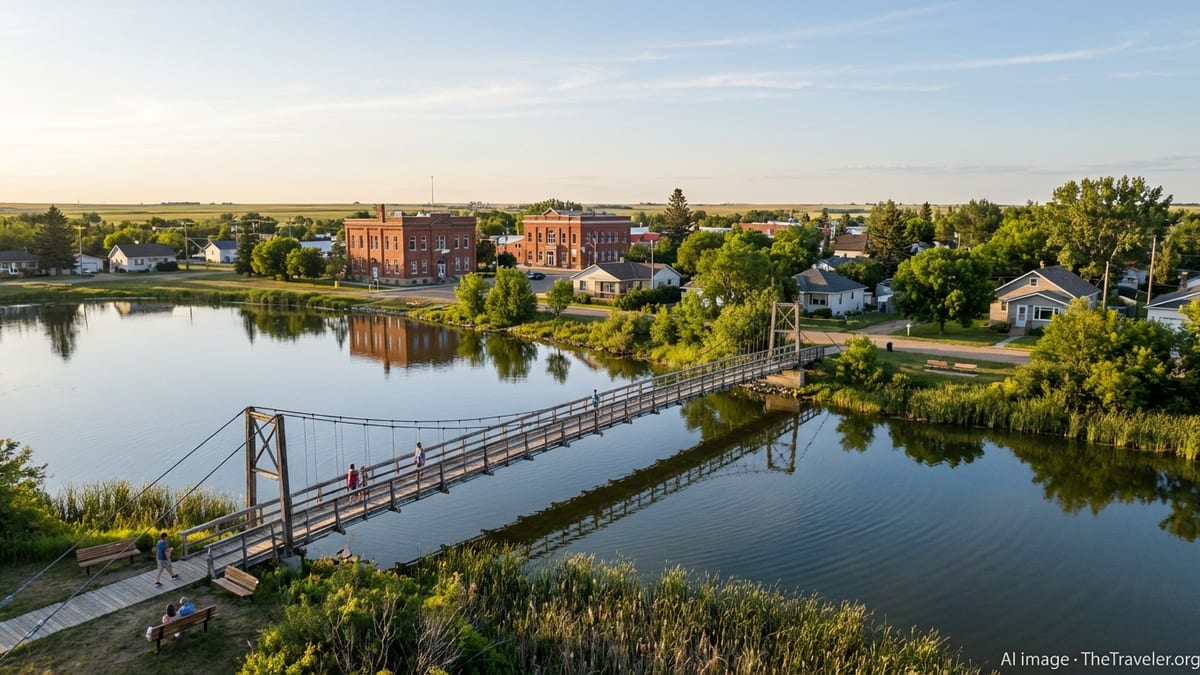
Most small towns in Saskatchewan grew up with their backs to the railway and their faces to the highway. Main streets typically run perpendicular to the tracks, with services strung along the road used by long-haul trucks and farm pickups. Wolseley breaks that pattern. Its identity is wrapped around Fairly Lake, an unexpected pocket of water created in the early 1900s when a creek was dammed to supply locomotives. Over time, that utilitarian reservoir evolved into the town’s emotional and visual center, giving Wolseley the nickname Town Around a Lake and shaping how visitors move through the community.
Instead of parking beside grain bins or gas pumps, travelers in Wolseley often begin at the lakeshore. Mature trees ring the water, and walking paths weave between parkland, beach, and residential streets. In summer, picnics and swimming take the spotlight; in shoulder seasons, the lake becomes a reflective backdrop for strolls beneath big skies. While other prairie towns certainly have dugouts, riverbanks, or nearby reservoirs, it is rare to find such an intimate body of water framed directly by heritage buildings and civic life the way Fairly Lake is in Wolseley.
This lakeside layout influences the town’s pace. In communities where the highway dominates, the soundtrack is traffic and the scenery is signage. In Wolseley, the view from a park bench takes in ripples on the water, the arch of a pedestrian bridge, and the outlines of early 20th-century architecture. The result is a small town that feels less like a brief pit stop and more like a place to linger, even if you only planned for a coffee break.
The Swinging Bridge: A Signature Experience You Can Walk Across
Many Saskatchewan towns promote a single landmark, whether a giant roadside statue, a vintage grain elevator, or a museum. Wolseley’s signature feature is tactile, kinetic, and woven into daily life: the swinging bridge over Fairly Lake. First built in the early 1900s so residents could cross the water easily, the bridge has been rebuilt several times after storm damage, most recently as a sturdy yet gently swaying span that has become both symbol and attraction.
Where some small-town landmarks are primarily for photographs, Wolseley’s swinging bridge is meant to be used. Locals walk it for errands, children race across it on summer evenings, and visitors test their balance as the planks move subtly underfoot. It offers a playful dose of movement in a landscape known for stillness, and the perspective from its midpoint captures the essence of Wolseley: lake reflections below, heritage facades at one end, and prairie sky stretching in every direction.
Compared with other Saskatchewan communities, few can claim a comparable piece of infrastructure that is both practical and experiential. Many towns have walking trails, and some have historic bridges nearby, but a long pedestrian suspension bridge directly in the heart of the settlement is uncommon. The sense of arrival when you step off Wolseley’s swinging bridge onto downtown streets is part of what makes the town feel more like a destination than a detour.
Heritage Deeply Preserved, Not Just Remembered
Saskatchewan’s rural history is rich, but in many places it survives mainly through plaques and photographs. Wolseley stands out because much of its built heritage still functions in everyday life. The town has gained recognition for maintaining and restoring notable structures, including the provincial courthouse, one of the oldest in Saskatchewan, and the former Beaver Lumber store, remembered as the first in Canada. Instead of existing as static relics, these buildings are integrated into the town’s current identity.
At the center of this heritage network is the Wolseley Town Hall and Opera House, a stately brick and stone building completed in the early 1900s. It once housed municipal offices, the fire brigade, a library, and a multi-purpose performance hall. Unlike similar combination town hall and opera house buildings in other Saskatchewan communities that have been demolished or largely retired, Wolseley’s has been restored and remains in regular use as a community gathering place. Weddings, concerts, and performances take place in a space where the walls literally speak of a century of public life.
Other small towns across the province, such as Whitewood, Broadview, or Grenfell, boast proud main streets and historic churches. Yet many heritage buildings in those communities have gradually shifted to private uses or fallen into disrepair. By contrast, Wolseley has intentionally positioned its heritage as an economic and cultural asset. The result is that a walk through town feels less like examining a museum and more like stepping into a living story, where residents still work, gather, and celebrate inside structures their great-grandparents might recognize.
Culture and Creativity in a Town of a Few Hundred
Arts and culture often gravitate toward larger centers, and in Saskatchewan that usually means Regina or Saskatoon. Yet Wolseley has cultivated a creative scene that feels disproportionately vibrant for a community of a few hundred people. Local galleries, writers’ groups, photography clubs, and artisan collectives use downtown spaces as hubs, organizing exhibits, workshops, and informal meet-ups that overlap with the town’s tourism season.
This cultural energy sets Wolseley apart from many other towns of similar size, where arts activity can be more sporadic or limited to seasonal festivals. Here, creativity is built into the routine of community life. A visitor might wander into a small gallery showing prairie photography one weekend and return later in the season to find a literary reading or craft market in the same venue. The overlap between heritage spaces and contemporary arts gives Wolseley a layered atmosphere that feels both nostalgic and current.
Adding to that character is the Twilite Drive-In Theatre on the edge of town, one of only a handful of drive-in cinemas still operating in Saskatchewan. For travelers, watching a movie under the open prairie sky is an experience that blends retro charm with a very present sense of community. Other towns may have small multiplexes or rely on occasional movie nights in halls, but few can offer a classic drive-in framed by distant farm lights and constellations.
Everyday Amenities with a Lakeside Twist
At first glance, Wolseley’s amenities might resemble those of many rural hubs scattered along Saskatchewan’s highways: a modest commercial core, a couple of schools, a health facility, and basic services. Look closer, and the configuration reveals something different. The town’s public beach lies within walking distance of downtown businesses, and a nine-hole golf course is close enough that a morning round can blend easily into a lakeside lunch without a long drive. A modern arena and curling rink anchor winter recreation, while summer gravitates toward Fairly Lake’s shoreline.
Compared with other small towns that serve primarily as agricultural service centers, Wolseley’s offerings are tilted toward both residents and visitors. The presence of a hospital and long-term care home reflects its role as a regional hub, but the coexistence of swimming areas, walking paths, and heritage sites speaks to a lifestyle that privileges daily access to nature and culture. Many prairie communities rely on driving to nearby regional parks or lakes for these experiences; in Wolseley, they exist at the front door.
For travelers crossing Saskatchewan by car, that difference is tangible. Stopping in many highway towns might mean refueling at a service station and stretching your legs along a commercial strip. In Wolseley, a short detour leads not only to coffee and groceries but also to a sandy beach, shaded picnic tables, and a view of brick facades reflected in still water. It is a reminder that in some places, everyday errands and leisurely pauses share the same landscape.
Comparing Wolseley With Other Notable Small Towns
Saskatchewan is dotted with character-rich communities, each showcasing a particular aspect of prairie life. Towns such as Whitewood, for example, highlight transportation heritage and crossroads commerce, sitting at the junction of major highway routes with a history tied closely to rail and road traffic. Others, like Manitou Beach or Regina Beach, build their identity primarily around larger lakes and resort-style recreation, with summer cottages, marinas, and seasonal entertainment defining the local rhythm.
Against this backdrop, Wolseley occupies an interesting middle ground. It is not a full-fledged resort town, nor is it exclusively a service center. Instead, it pairs a modest scale with a surprisingly diverse set of experiences. Travelers can encounter heritage architecture of provincial significance, a functioning drive-in theatre, lakeside green space, and an active arts community, all within a compact area that can be comfortably explored on foot. The town demonstrates that a place need not be large or heavily commercialized to offer depth.
In comparison with many agricultural towns across the province, Wolseley also feels less dominated by industrial-scale infrastructure. Grain elevators and equipment dealerships exist in the landscape, but they do not visually overpower the lakefront or core streets. This gives visitors a different mental image of the prairies: one where water, brick, and trees share equal billing with fields and trucks. For first-time travelers to Saskatchewan, this balance makes Wolseley an accessible introduction to rural life, while returning visitors appreciate the town’s ability to reveal new details on each stop.
Planning a Stop: When and How Wolseley Works Best
Because Wolseley lies directly on the Trans-Canada Highway in southeastern Saskatchewan, it is an easy add-on for road trips between Regina and Manitoba or as a pause on longer cross-country journeys. Unlike some small towns that sit several kilometres off major routes, Wolseley invites spontaneous detours. The lake is visible from nearby streets, and signage points toward attractions such as the swinging bridge and historic town hall, making navigation straightforward even for first-time visitors.
Season shapes the kind of experience you will have. In summer, the town feels almost resort-like, with families heading to the beach, travelers crossing the swinging bridge in sandals, and the drive-in theatre drawing cars at dusk. Shoulder seasons emphasize walking and photography, with the mix of architectural detail and changing foliage around Fairly Lake providing ample material for slow exploration. Winter reveals a quieter side of Wolseley while still highlighting its compact, walkable layout and the comforting presence of historic buildings lit against the snow.
Compared to other Saskatchewan towns that might be best known for a single festival or event, Wolseley is more about steady appeal than one-off spectacles. Its attractions are largely perennial: the bridge, the opera house, the courthouse, the galleries, and the lakefront parks are there whether or not a major celebration is underway. For many travelers, that reliability is part of the charm. It means that an unplanned stop on a weekday afternoon can be just as rewarding as a weekend visit.
The Takeaway
When viewed alongside other small towns in Saskatchewan, Wolseley stands out not because it is dramatically larger or more famous, but because its assets work together in a way that feels unusually cohesive. The lake at its heart shapes not only views but daily routines. The swinging bridge turns a simple crossing into a vivid memory. Heritage buildings serve as active community anchors rather than static monuments, and an undercurrent of artistic activity gives the town an energy that belies its population.
Other prairie communities offer striking main streets, rich histories, or access to lakes and parks. Wolseley quietly assembles all three, then layers on details like a functioning drive-in theatre and a walkable core that can be taken in at a human pace. For travelers accustomed to seeing small towns as brief service stops along the highway, Wolseley challenges that assumption. It encourages you to slow down, step onto the bridge, and experience a version of Saskatchewan where past and present, water and brick, everyday life and travel all meet in one compact, memorable place.
FAQ
Q1. Where is Wolseley located in Saskatchewan?
Wolseley is in southeastern Saskatchewan along the Trans-Canada Highway, roughly between Regina and the Manitoba border, making it an easy stop on a prairie road trip.
Q2. What makes Wolseley different from other small towns in the province?
Wolseley is distinguished by its central lake, historic swinging bridge, preserved heritage buildings, and an active arts and cultural scene unusual for a town of its size.
Q3. What is special about Fairly Lake?
Fairly Lake was originally created as a water supply for railway operations and has evolved into the town’s focal point, with parkland, a beach, and walking paths right beside historic streets.
Q4. Can visitors still use the swinging bridge?
Yes. The swinging bridge across Fairly Lake has been rebuilt and is open to pedestrians, offering a gently swaying crossing and one of the best views of Wolseley.
Q5. How does Wolseley’s heritage compare with other Saskatchewan towns?
While many towns have historic roots, Wolseley stands out for keeping key buildings like its courthouse and town hall opera house in active use rather than treating them only as static monuments.
Q6. Is Wolseley a good destination for families?
Wolseley suits families well, with a lakeside beach, parks, the novelty of the swinging bridge, and seasonal attractions like the drive-in theatre that appeal to both adults and children.
Q7. Do I need a lot of time to explore Wolseley?
Many highlights can be enjoyed in a few hours, but half a day allows for a relaxed walk around the lake, time at the bridge, a look at heritage buildings, and a meal or coffee stop.
Q8. How does Wolseley compare to Saskatchewan’s resort towns?
Unlike larger resort communities built around big lakes and extensive tourist infrastructure, Wolseley offers a quieter, small-scale lakeside experience paired with notable heritage and culture.
Q9. When is the best season to visit Wolseley?
Summer offers the fullest range of activities, from swimming to the drive-in theatre, though spring and autumn are excellent for photography, lakefront walks, and exploring heritage architecture.
Q10. Is Wolseley worth a detour for travelers crossing Canada?
Yes. For cross-country travelers, Wolseley provides a memorable contrast to highway service stops, with its lake, bridge, and historic core all within a short distance of the main route.