

More news on this day
Low-cost carrier Zipair has switched on SpaceX’s Starlink satellite internet aboard its Boeing 787 Dreamliner fleet, debuting Asia’s first Starlink-equipped passenger service between Tokyo Narita and Seoul Incheon and signaling a step change in how travelers stay connected across the region and beyond.
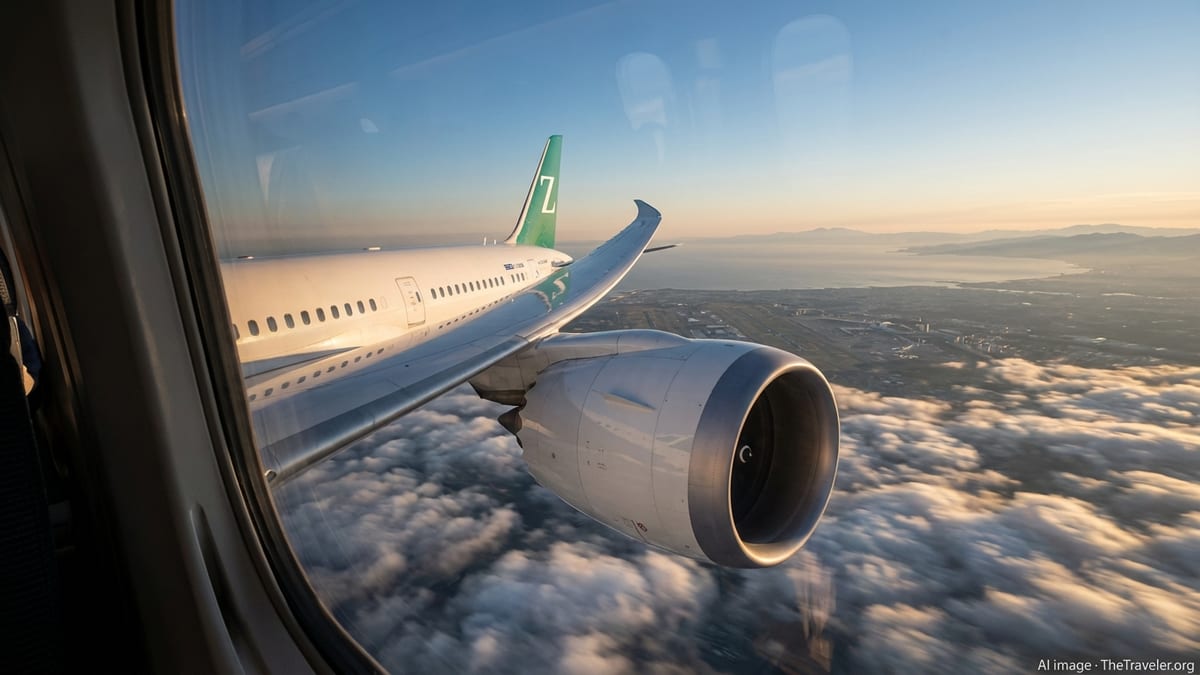
Asia’s First Starlink-Equipped Passenger Flights Take Off
Zipair confirmed this week that it has begun operating commercial flights with Starlink onboard, with the inaugural service flying as ZG045 from Tokyo Narita to Seoul Incheon. The Japan Airlines subsidiary becomes the first Asian airline to offer the low Earth orbit satellite system in regular passenger operations, placing it among a growing but still select group of global carriers betting on next-generation in-flight connectivity.
The rollout follows nearly three years of technical trials and certification work with SpaceX. Zipair first revealed plans to adopt Starlink in 2023, but only received final approvals and began physical installations on its Boeing 787 Dreamliners in early February 2026. The service is currently available on a portion of the fleet, with aircraft progressively entering service after modification and testing.
According to the airline, all Zipair 787s will be equipped by spring 2026, allowing the carrier to offer a fully Starlink-enabled fleet across its network. That network extends well beyond the short hop to South Korea, linking Tokyo with Bangkok, Singapore and a string of destinations in the United States, including Honolulu, Los Angeles, San Francisco, San Jose, Houston and limited charter services to Orlando.
Positioning itself as a digital-first low-cost airline, Zipair is keeping access simple: Wi-Fi remains free of charge for all passengers, even as performance moves from basic browsing speeds to broadband-like connectivity capable of handling video calls, streaming and cloud-based work tools.
What Starlink Changes for the Onboard Experience
Starlink’s constellation of low Earth orbit satellites is designed to deliver high-speed, low-latency internet comparable to ground-based broadband, a significant shift from earlier generations of in-flight connectivity that often struggled with congestion and lag. For passengers flying Zipair’s Dreamliners, that translates into realistic prospects for real-time messaging, video conferencing, high-definition streaming and even online gaming throughout much of the flight.
Early trial reports shared by the airline and passengers on social media point to stable speeds and low latency on the Tokyo to Seoul sectors, despite the relatively dense air traffic along the corridor. Travelers have highlighted the ability to maintain live video calls and upload large files without the stuttering or dropouts long associated with legacy satellite systems.
Crucially for budget-conscious flyers, Zipair has committed to keeping the service free, in contrast to pay-per-session models still common in parts of the industry. The carrier frames always-on connectivity as part of its “new basic” for travel, arguing that reliable internet has become as essential to modern flyers as power outlets and personal device entertainment.
For business travelers, the combination of a long-haul capable Dreamliner cabin and robust Wi-Fi creates a more viable “office in the sky,” especially on routes connecting Tokyo with major North American tech and finance hubs. Leisure passengers, meanwhile, can stream content from their own subscriptions, stay active on social media in real time or coordinate onward travel plans without waiting to land.
Behind the Scenes: A Connected Cabin From Nose to Tail
Zipair’s Starlink deployment extends beyond passenger devices. The carrier is deeply integrating the service into its proprietary inflight service system, tying together internet access, digital menus, duty-free sales and other ancillary services over a single onboard network. That architecture allows for real-time payment authorization and inventory updates, reducing manual reconciliation and unlocking new retail possibilities.
The always-connected cabin also gives crews more reliable access to operational tools, from updated weather and rerouting information to digital briefings and service logs. Over time, this could streamline workflows and reduce turnaround times, especially on tightly scheduled regional rotations such as Tokyo to Seoul and Bangkok.
On the technical side, Starlink’s low Earth orbit design reduces the latency that has long hampered virtual private networks and cloud applications at cruising altitude. Dynamically steered antenna arrays installed on the 787 fuselage track passing satellites, handing off connections as the aircraft moves across coverage footprints. For a carrier like Zipair, which mixes shorter regional flights with trans-Pacific services, that flexibility is key to maintaining consistent performance across varied geographies.
Industry analysts note that the integration of cabin and operational systems over a common high-speed link can also generate richer data for the airline, supporting predictive maintenance, fuel optimization efforts and better demand forecasting for onboard sales. For a low-cost carrier operating a relatively small, uniform widebody fleet, these efficiencies can have an outsized impact on margins.
Raising the Bar for Asian Low-Cost and Long-Haul Travel
Zipair’s move places competitive pressure on other Asian carriers, particularly low-cost and hybrid operators serving similar markets from Japan and South Korea. While several global airlines, including United, Hawaiian and WestJet, have already introduced or committed to Starlink on parts of their fleets, Asia has so far lagged in large-scale deployments of next-generation in-flight connectivity.
By racing to become the first in the region with a fully Starlink-equipped fleet, Zipair is attempting to differentiate itself not on frills but on digital infrastructure. On trunk routes between Tokyo and Seoul or Bangkok, where schedules and base fares can be similar across carriers, free high-performance Wi-Fi could become a deciding factor for tech-savvy travelers and younger passengers who treat connectivity as a non-negotiable.
The impact could be even more pronounced on long-haul sectors linking Tokyo with the United States. For travelers choosing between full-service incumbents and a no-frills challenger, the promise of generous personal device usage, streaming and uninterrupted work sessions across the Pacific may help offset perceptions of a stripped-back cabin product.
The timing also aligns with Tokyo’s broader push to deepen tourism and business links with North America and Southeast Asia. With new and seasonal routes such as Tokyo to Orlando drawing attention, the presence of Starlink on Zipair’s Dreamliners provides an additional talking point for tourism boards and airport partners marketing the connections.
What It Signals for the Future of In-Flight Connectivity
Zipair’s Starlink launch reinforces a wider shift in the aviation industry toward treating high-speed Wi-Fi as essential infrastructure rather than a chargeable add-on. As more airlines commit to low Earth orbit constellations, expectations are rising that passengers should be able to use the internet in the air much as they do on the ground, particularly on long-haul and business-heavy routes.
For Asia-Pacific, traditionally a stronghold for full-service carriers with carefully segmented cabin products, the arrival of an all-widebody low-cost airline offering free top-tier connectivity is a notable disruption. It suggests that digital services, rather than only seat pitch or onboard catering, may increasingly define competitive advantage in the region’s post-pandemic travel market.
SpaceX, for its part, gains a prominent showcase customer in a region where rival satellite providers are also vying for airline contracts. If performance on Zipair’s network of regional Asian and trans-Pacific routes matches early reports, it could bolster Starlink’s pitch to larger network carriers in Japan, South Korea and beyond.
With installations accelerating and additional Starlink-equipped flights due to appear on schedules in the coming weeks, passengers flying between Tokyo, South Korea and a growing list of international destinations can expect their next trip aboard Zipair’s 787s to feel markedly more connected than flights of just a few years ago.