

More news on this day
High above the Himalayas, Ladakh is on the cusp of a major transformation as the long-delayed Zoji La Tunnel and an expanding web of air services promise to turn a seasonal frontier into a more accessible year-round destination.
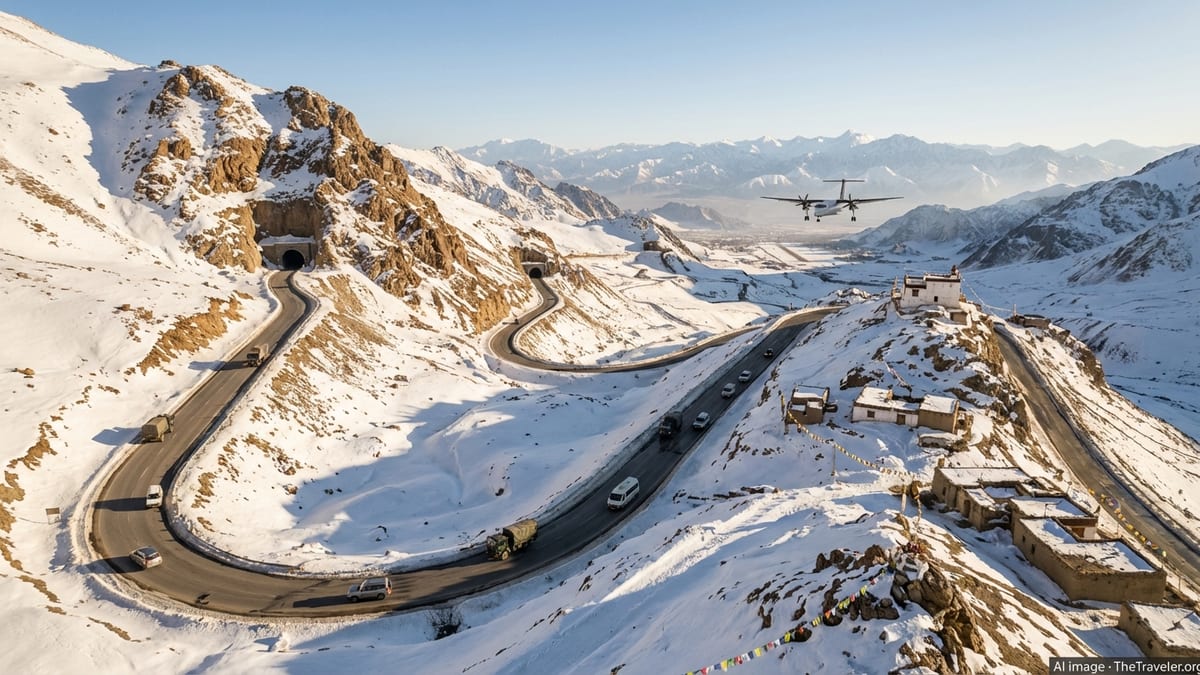
Zoji La Tunnel Redefining Himalayan Access
The Zoji La Tunnel, billed as Asia’s longest bidirectional road tunnel, is steadily reshaping expectations for how and when travelers can reach Ladakh. Carved beneath one of the most treacherous sections of the Srinagar–Kargil–Leh highway, the 13-kilometre main tunnel and its approach roads are designed to replace a high pass that currently shuts for months each winter due to heavy snowfall and avalanches.
According to recent briefings from project officials and government statements, around 60 to 70 percent of physical work has been completed, with engineers reporting that roughly 12 kilometres of the main tube have now been excavated. Authorities have revised the opening timeline to around 2028, pushing back the original target of 2026 but insisting that the project remains strategically on track.
Once operational, the tunnel is expected to cut the Sonamarg to Minamarg journey from several hours to well under an hour, greatly improving safety and predictability for both civilians and the military. For tourism operators, that shift could be decisive: what is now a narrow seasonal window defined by the annual reopening of Zoji La Pass would give way to an all-weather road, enabling longer operating seasons and more flexible itineraries.
Officials and infrastructure analysts note that the tunnel’s impact will also depend on how quickly supporting facilities are developed. Parking, emergency response, toll systems and weather monitoring will all influence whether year-round access translates into genuinely reliable mobility or simply moves bottlenecks elsewhere along the corridor.
From Seasonal Rush to Year-Round Tourism Patterns
For years, Ladakh’s tourism economy has been dictated by the calendar: a frenetic summer peak from roughly May to September, followed by a near standstill once mountain passes close and temperatures plunge. The combination of the Zoji La Tunnel and complementary works such as the already functioning Z-Morh Tunnel near Sonamarg is expected to gradually smooth out these swings.
Travel businesses in Leh and Kargil are already planning for a future in which overland access is not abruptly severed for half the year. Hoteliers are exploring winter-friendly offerings, from stargazing and monastic festivals to frozen-river treks, while transport operators anticipate being able to keep fleets on the road for longer stretches instead of mothballing vehicles once snow sets in.
However, local stakeholders caution that more accessible winters will not automatically translate into mass tourism. Sub-zero temperatures, limited daylight and the need for acclimatization at high altitude remain natural brakes on demand. Policymakers in the Union Territory administration have indicated that this provides an opportunity to promote smaller, higher-value visitor numbers in the colder months, rather than the crowded summer peaks that have strained Leh’s water and waste systems in recent years.
Environmental groups are also pressing for clear carrying-capacity guidelines before the tunnel opens. With the fragile high-altitude ecosystem under pressure from glacier retreat and changing snowfall patterns, they argue that improved access must be matched by strict regulations on traffic, construction and waste management if Ladakh’s landscapes are to remain its main draw.
Expanded Air Connectivity Reshaping Travel Choices
While the Zoji La Tunnel is still several years from completion, Ladakh’s skies are changing faster. In recent seasons, scheduled flights to Leh from major Indian cities have expanded, charter operations have increased, and authorities have leaned on air links to keep the region connected during long winter closures of the high passes.
Beyond fixed-wing services into Leh’s Kushok Bakula Rimpochee airport, the administration has recently inaugurated expanded helicopter connectivity, framed explicitly as a tool for both tourism and essential services. New routes linking Leh with Kargil, Padum in Zanskar, Diskit in Nubra and remote villages such as Lingshed, Dibling, Nyerak and Turtuk are designed to shrink travel times that can otherwise stretch to 10 or 12 hours by road, particularly when snow, ice or landslides intervene.
Subsidised fares under government-backed schemes aim to make these helicopter seats viable not only for affluent tourists but also for local residents and small business owners. Officials say the services are proving particularly vital in winter, when they double as medical evacuation lifelines and supply lines for far-flung settlements cut off by snowbound roads.
For visitors, the growing range of air options is changing how trips are planned. Many now fly into Leh and then use helicopters or local flights to stitch together multi-valley itineraries that would be difficult or impossible within a standard holiday using road transport alone, especially outside the summer peak.
Balancing Connectivity, Culture and Climate Risks
The convergence of major road and air investments is forcing Ladakh to confront a complex balancing act. On one hand, improved access promises economic diversification and better living standards in a region long accustomed to isolation. On the other, there are rising concerns that rapid growth in visitor numbers, vehicle traffic and construction could undermine the cultural and environmental assets that draw travelers to Ladakh in the first place.
Community leaders in Kargil and remote valleys such as Zanskar stress that local voices must shape how tourism expands. Many are calling for homestay-led models, heritage conservation programs and training for youth in guiding, hospitality and mountain safety, so that new income streams are anchored in villages rather than concentrated in a few urban centres.
Climate volatility adds another layer of uncertainty. Shorter snow seasons, erratic snowfall and more frequent extreme weather events are already affecting road maintenance schedules and traditional winter activities. Border Roads Organisation engineers recently highlighted how intensive snow-clearing efforts have reopened Zoji La Pass in record time in some years, yet also warned that avalanches and sudden storms are becoming more unpredictable.
In this context, the Zoji La Tunnel and enhanced air connectivity are seen not as guarantees of seamless access but as tools to reduce, rather than eliminate, Ladakh’s vulnerability to the elements. How these tools are used in the coming decade is likely to determine whether the region evolves into a model of high-altitude sustainable tourism or struggles with the same overdevelopment challenges seen in more accessible mountain destinations.