

More news on this day
China’s 2026 Lunar New Year travel season is on track to be the busiest in history, with transport authorities reporting a 10.8 percent surge in traffic volumes as a record 9.5 billion trips are expected across the 40-day Spring Festival rush.
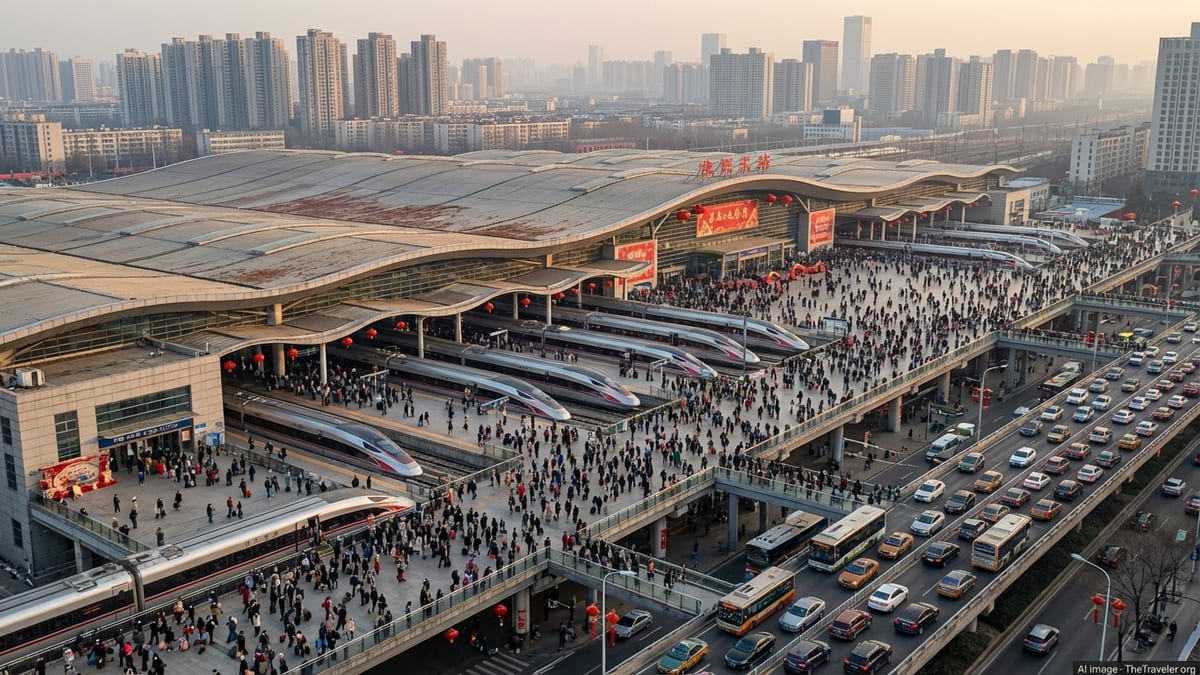
Record-Breaking Chunyun Tests China’s Transport Network
The annual Lunar New Year migration, known as chunyun, has again underscored its reputation as the world’s largest human movement. This year’s travel window, running from February 2 to March 13, is forecast to generate 9.5 billion cross-regional trips as families crisscross the country for reunions and holiday tourism. Officials say both total journeys and single-day peaks are surpassing previous records, reflecting a full rebound in mobility and rising demand for leisure travel after years of more cautious spending.
Preliminary data from the Ministry of Transport show traffic flows up by double digits compared with last year, with overall volumes across road, rail, air, and waterways climbing around 10.8 percent. The first 20 days alone saw 5.08 billion inter-regional trips, already eclipsing midway figures from recent years. For planners, the numbers highlight both the strength of pent-up demand and the challenge of keeping such a sprawling system running safely and on time.
Officials describe the coordination effort as a nationwide operation spanning more than 20 government departments, alongside state-owned rail and aviation operators and local traffic bureaus. Their focus ranges from crowd management and schedule optimization to emergency responses to winter storms in northern provinces and heavy holiday congestion in coastal tourism hubs.
Roads Dominate as Private Cars Lead the Surge
While high-speed trains and packed terminals capture much of the public attention, roads continue to carry the vast majority of China’s Lunar New Year travelers. Transport authorities estimate that roughly 80 percent of all journeys during this year’s chunyun are being made by road, with self-driving trips the dominant choice for families seeking flexibility and last-minute itineraries. Expressways out of major urban centers such as Beijing, Shanghai, and Guangzhou have seen prolonged peak periods, particularly on departure days ahead of the February 17 Lunar New Year’s Day.
Officials report that highway volumes and toll-free holiday policies have combined to produce long but largely manageable queues at key interchanges. Traffic police and road management teams have been deployed in higher numbers, particularly in mountainous and northern regions prone to snow and ice. Real-time navigation apps and dynamic traffic controls are being used to redirect flows and ease bottlenecks, part of a broader digital toolkit that has become central to managing the holiday crush.
Bus networks, from interprovincial coaches to county-level shuttles, are also running at full capacity to serve travelers without access to private cars. Local governments in central and western provinces have laid on additional services to ensure migrant workers and students can reach smaller hometowns that sit beyond the high-speed rail grid, reinforcing roads’ critical role in knitting together China’s vast interior.
Railways Add Night Trains as Passenger Volumes Hit New Highs
On the rails, the Spring Festival rush is setting records of its own. China State Railway Group forecasts that the national network will handle around 540 million passenger trips during the 40-day period, a year-on-year increase of roughly 5 percent and the highest level on record. By the halfway point, railways had already carried more than 250 million passengers, with volume still building for the return leg as workers and students head back to coastal and inland employment hubs.
To absorb the surge, operators have rolled out 22 new lines and more than 50 additional stations participating in the rush for the first time this year, extending high-speed access deeper into regional cities. Peak-day services exceed 14,000 trains, with nearly 1,000 nighttime high-speed services operating on major corridors to spread demand beyond traditional daytime peaks. In regions such as the Yangtze River Delta, the network is expected to carry over 100 million passengers during the season, marking a symbolic milestone for one of the country’s busiest rail clusters.
Inside stations from Beijing South to Chengdu East, scenes of thronged concourses and long security lines have become a familiar part of the holiday calendar. Yet officials say operations remain “safe and orderly,” crediting time-staggered ticketing, expanded waiting areas, and tighter crowd-flow controls. For many travelers, especially migrant workers and students, long rail journeys remain a preferred option over flying, balancing cost, comfort, and reliability during the most important homecoming of the year.
Airports Face Holiday Rush as Domestic and Outbound Travel Rebound
Civil aviation has also moved into record territory this Lunar New Year. The Civil Aviation Administration of China expects airlines to handle around 95 million passenger trips over the chunyun period, up more than 5 percent from last year. Daily passenger volumes are projected to average about 2.4 million, supported by an estimated 780,000 flights nationwide. Major hubs such as Beijing Capital and Shanghai Pudong are bracing for multi-day peaks as the official nine-day holiday window sends vacationers in every direction.
Carriers including Air China and China Southern have boosted capacity on flagship domestic leisure routes to destinations such as Sanya, Harbin, and Kunming, deploying wide-body aircraft on high-demand flights and expanding services to ski resorts and tropical islands. Airlines are also adding frequencies on popular outbound routes as relaxed visa policies and extended holidays spur more international travel, particularly to Southeast Asia and newly visa-free destinations in Europe and the Middle East.
At airports, the seasonal reality is one of crowded check-in halls, full security lanes, and departure boards packed with additional charter and late-night services. Ground crews are operating at maximum staffing levels, while authorities emphasize contingency planning for weather disruptions and slot congestion. Despite the pressures, aviation officials say on-time performance has generally held up, aided by more precise flight scheduling and improved coordination between airports and air traffic control.
Economic Tailwinds and Tourism Hotspots Ride the Travel Boom
The record-setting travel rush carries important economic implications as Beijing looks to domestic consumption to support growth. Extended public holidays and a broad easing of travel restrictions have encouraged households to spend more on leisure, dining, and cultural activities, with tourism boards across the country reporting robust bookings. Online platforms say Lunar New Year hotel reservations in popular cities have jumped compared with last year, while secondary destinations and rural homestays are seeing stronger interest as travelers seek quieter, experience-focused getaways.
Inbound and outbound tourism are also benefiting from the surge. Chinese tourists have made hotel bookings in thousands of overseas cities for the festival period, including strong growth in destinations newly covered by visa-free arrangements. At the same time, more foreign visitors are using the holiday window to explore China’s winter sports venues and historic cities, taking advantage of improved air connectivity and streamlined entry policies.
For policymakers, the 2026 chunyun has become both an economic catalyst and a barometer of confidence. The 10.8 percent jump in traffic volumes signals resilient demand for travel and consumption even amid broader concerns about the pace of recovery. As the final weeks of the Spring Festival season unfold, authorities will be watching closely not only to keep millions moving safely, but also to gauge how far this record-breaking migration can help power the next phase of China’s growth.