

Rochester, New York, rarely shouts for attention, yet it rewards anyone who gives it a full day. With a waterfall thundering through downtown, nationally recognized museums, and walkable neighborhoods layered with history, coffee shops, and street art, the city is compact enough to explore in one ambitious itinerary yet rich enough to leave you planning a return visit.
Morning at the Falls: High Falls and the Genesee River Gorge
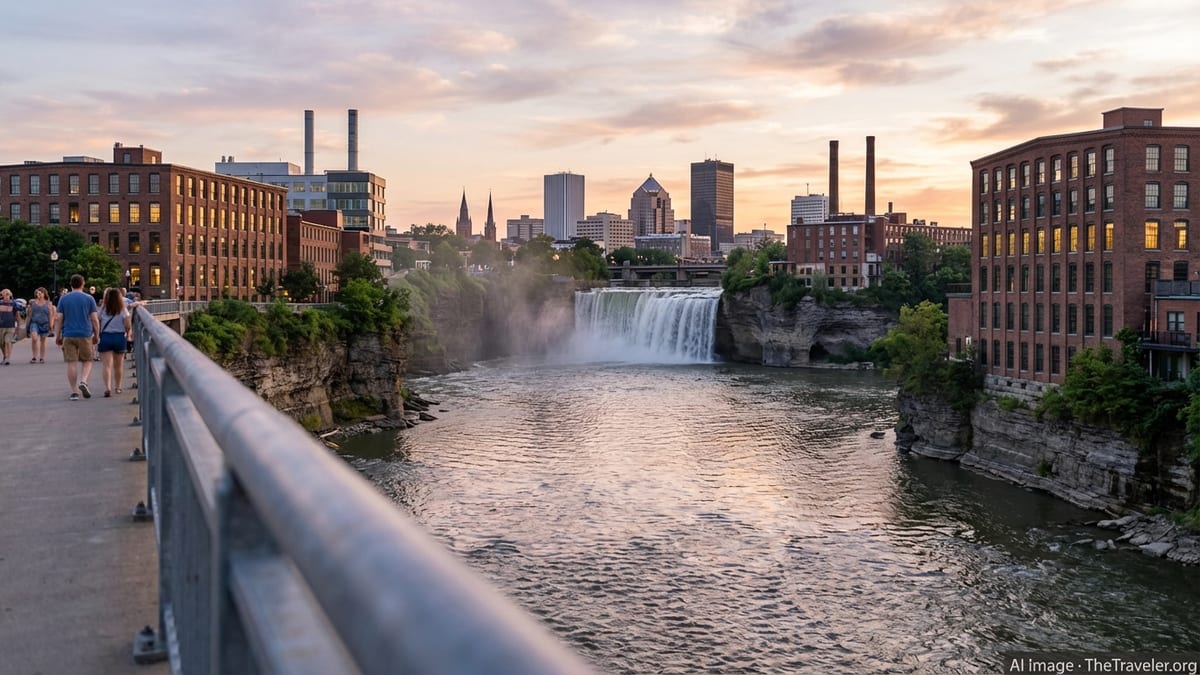
Begin your perfect day in Rochester where the city itself began, at High Falls on the Genesee River. Just north of downtown’s office towers, the river drops nearly 100 feet into a rugged gorge, an industrial skyline of former mills and factories rising from the cliffs. The contrast is striking: brick smokestacks, steel bridges, and a powerful waterfall cutting straight through an urban core. It is one of the rare American cities where you can stand on a viewing platform and feel spray from a major waterfall with the downtown skyline at your back.
The High Falls Heritage Area has been shaped into a compact visitor district, with interpretive signs, public art, and several scenic overlooks. You can take in the view from the Pont de Rennes pedestrian bridge, which spans the gorge and offers a broad, unobstructed look at the falls and the layered rock walls below. On clear mornings, the light tends to be soft and angled, ideal for photographs that capture both the texture of the stone and the plume of water tumbling over the lip.
Just a short walk from the bridge, the Center at High Falls serves as a visitor and heritage center, offering exhibits that explain how the falls powered Rochester’s early flour mills and helped earn the city its nineteenth century nickname as the Flour City. You will see historic images of wooden dams and millraces, early factories, and the transformation into a twentieth century manufacturing hub. Spending even half an hour here adds depth to everything you will see during the rest of the day.
Before you leave the district, wander a few of the surrounding streets to see how many former warehouses have been adapted into lofts, offices, and restaurants. Look for murals on brick walls, traces of old painted advertisements, and views north toward the lower falls. The mix of industrial heritage and current creative energy sets a tone that runs throughout Rochester’s neighborhoods.
Hands-on History and Imagination: The Strong National Museum of Play
From High Falls, walk or drive a short distance to one of Rochester’s most distinctive institutions: the Strong National Museum of Play. Anchoring a growing downtown neighborhood sometimes called the Neighborhood of Play, the Strong is far more than a children’s museum. It is a sprawling complex dedicated to the history and culture of play, home to classic arcade games, storybook landscapes, and extensive collections of toys and video games.
Arriving in the late morning allows you to enjoy the exhibits before afternoon crowds peak. Inside, galleries invite you to step into oversized comic panels, wander through a kid-scale mini city, and experiment with interactive games that blur the lines between nostalgia and current technology. Adults often find themselves drawn to displays that showcase the evolution of board games, consoles, and character franchises that shaped their own childhoods.
The Strong also houses the World Video Game Hall of Fame and research collections that attract scholars and designers from around the world. Even if you are only visiting for a couple of hours, you will get a sense of how seriously the institution takes its mission of preserving and interpreting play as a cultural force. Exhibits are curated with a level of detail and context usually reserved for art and history museums, yet every corner still feels playful and approachable.
When you are ready for a break, step outside into the surrounding Neighborhood of Play, where new residential buildings, public art, and small businesses are reshaping this part of downtown. The district connects easily to nearby parks and streets, making it an ideal bridge between your morning at the falls and an afternoon immersed in Rochester’s arts and sciences.
Art, Photography, and Science: Rochester’s Museum Triangle
Rochester’s compact size is a major advantage for museum lovers. From the Strong, it is an easy drive or rideshare to the cultural corridor that links the George Eastman Museum, the Memorial Art Gallery, and the Rochester Museum and Science Center with its Strasenburgh Planetarium. You could happily devote multiple days to these institutions, but a single afternoon can still provide a satisfying cross section of art, photography, and hands-on science.
Start at the George Eastman Museum, set within the former home and gardens of George Eastman, founder of the company that popularized everyday photography and motion picture film. Inside the historic mansion, you will walk through rooms that reflect early twentieth century luxury, with wood-paneled halls, a pipe organ, and terrace views toward formal gardens. Adjacent exhibition spaces host rotating shows drawn from one of the world’s leading collections of photography and cinema, ranging from early processes to contemporary work.
From there, make your way toward the Neighborhood of the Arts, where the Memorial Art Gallery anchors a lively district of studios, restaurants, and creative spaces. The museum’s collection ranges from antiquities to modern pieces, with regional works that help place Rochester within broader art movements. A sculpture park and installations along sidewalks extend the experience outdoors, blending seamlessly with surrounding murals and galleries in repurposed industrial buildings.
Round out the afternoon at the Rochester Museum and Science Center, a short distance away, where interactive exhibits explore everything from local geology and the Genesee River to astronomy and physics. The adjoining Strasenburgh Planetarium adds immersive star shows and laser programs, particularly appealing if your visit coincides with an evening performance. Even a brief stop gives you a feel for how Rochester’s scientific and industrial heritage continues to shape its identity.
Park Avenue Stroll: Cafes, Shops, and Tree-lined Streets
By late afternoon, shift your focus from museums to street life in one of Rochester’s most beloved neighborhoods, Park Avenue. Stretching between Alexander Street and Culver Road, Park Avenue is a tree-lined corridor of historic homes, small apartment buildings, boutiques, coffee shops, and restaurants. Locals often describe it as a village within the city, and its steady foot traffic and outdoor seating give it a relaxed, urban energy in every season.
This is the perfect time to slow your pace. Wander the sidewalks, ducking into independent bookstores, design shops, or bakeries as they catch your eye. Side streets reveal rows of early twentieth century houses with deep porches and decorative details, many carefully maintained or restored. Pocket parks, flowering medians, and mature trees soften the streetscape, making even a simple loop walk feel like a neighborhood tour.
Park Avenue’s identity has long been tied to creativity and community events. For years it hosted one of the region’s major summer art festivals, and even as large street festivals shift and evolve, the underlying culture remains visible in rotating window displays, small galleries, and impromptu gatherings at sidewalk tables. The neighborhood’s proximity to both the George Eastman Museum and the Memorial Art Gallery reinforces a sense of connection between daily life and the arts.
As evening approaches, choose a spot for an early dinner along the avenue or on one of the nearby side streets linking Park Avenue with Monroe Village and the Neighborhood of the Arts. Many restaurants feature outdoor seating in warmer months, but even in colder weather the glow of interior lights and the hum of conversation spill onto the sidewalk, keeping the street feeling lively and welcoming.
Neighborhood of the Arts and Public Market: Local Color and Community Energy
If your visit falls on a day when the Rochester Public Market is operating, consider starting your morning there instead, then looping back through later to see how the neighborhood shifts throughout the day. Located in the Marketview Heights area just northeast of downtown, the market has hosted vendors since the early twentieth century and now draws hundreds of sellers and large crowds on peak days. Stalls overflow with regional produce in season, baked goods, flowers, and prepared foods that reflect the city’s growing diversity.
Even when the market itself is quiet, the surrounding East Market and Marketview Heights neighborhoods offer a glimpse of Rochester’s evolving creative scene. Repurposed industrial buildings around the market house breweries, coffee roasters, and art spaces. Community organizations and neighborhood associations have been working to strengthen connections between residents, market vendors, and nearby businesses, and you can often see that effort in the form of public art, pop-up events, and shared green spaces.
A short distance away, the Neighborhood of the Arts, often shortened to NOTA, concentrates many of Rochester’s cultural institutions into a walkable grid. Here you will find old factory complexes turned into studios and restaurants, along with long-established anchors such as the Memorial Art Gallery and the Visual Studies Workshop. Street-level murals, artist-run galleries, and creative offices give the area a distinct character, and it is common to encounter an opening reception or live performance if you pass through on a weekend evening.
Spending part of your perfect day in these districts underscores one of Rochester’s central strengths: the ability to weave everyday life with the arts and local enterprise. From market stalls to contemporary galleries, the city’s creative output feels grounded in its residents rather than imported from elsewhere.
Green Spaces and City Views: Cobbs Hill and Highland Park
No perfect day in Rochester is complete without time in one of its parks. Two of the most accessible and rewarding green spaces close to your main route are Cobbs Hill Park and Highland Park, each with its own personality and set of views. If you have a car or are comfortable with rideshares or local buses, you can easily incorporate both into your itinerary, perhaps as a late afternoon or early evening walk.
Cobbs Hill Park rises above the residential streets southeast of downtown and is known for its paved loop around a reservoir. From the upper paths, you can enjoy panoramic views back toward the city skyline, especially striking at sunset when the last light catches downtown’s towers and church spires. Basketball courts, open lawns, and wooded trails provide space for joggers, families, and dog walkers, and in winter the hill becomes a quiet spot for sledding and snow-covered cityscapes.
Highland Park, designed largely by famed landscape architect Frederick Law Olmsted, offers a very different mood. Here the terrain rolls gently through collections of trees, shrubs, and themed gardens. The park is celebrated for its lilacs and other seasonal plantings, which draw visitors during spring festivals, but it remains a rewarding place to wander at any time of year. Paths curve past historic structures, open lawns, and shaded benches, giving you plenty of options whether you have twenty minutes or an hour to spare.
Both parks are close enough to central Rochester that you can squeeze in a visit even on a short trip, yet they provide a sense of retreat that balances out the energy of museums and busy neighborhoods. With views of the skyline on one side and the textures of stone walls, mature trees, and water on the other, they help complete a picture of the city as a place deeply shaped by both nature and design.
The Takeaway
Spending a single day in Rochester reveals a city defined by juxtaposition: a downtown waterfall framed by old factories and new apartments, a museum of play that shares the stage with serious photography and art institutions, and neighborhoods where historic houses stand steps from vivid murals and contemporary cafes. Rather than presenting itself through one dominant attraction, Rochester invites you to connect the dots between its natural setting, industrial history, and present day creativity.
A route that begins at High Falls, tracks through the Strong Museum, arcs across the George Eastman Museum, Memorial Art Gallery, and Rochester Museum and Science Center, and then slows down along Park Avenue and in the Neighborhood of the Arts offers a satisfying overview of what makes the city distinctive. Add in a visit to the Rochester Public Market or a walk in Cobbs Hill or Highland Park, and you will start to sense why residents speak so warmly about their neighborhoods.
By the time you leave, you may find that your strongest memories are not of a single site, but of moments in between: the sound of the Genesee River echoing off the gorge, the sight of a mural tucked between brick warehouses, or an unhurried conversation at a corner cafe. Those details, layered together, are what make a perfect day in Rochester feel like the beginning of a longer relationship rather than a one-time visit.
FAQ
Q1. Is one day really enough to experience Rochester’s waterfalls, museums, and neighborhoods?
One day is enough for a strong overview if you plan carefully, though many visitors find that the city’s museums and neighborhoods reward a longer stay.
Q2. Can I see High Falls and the main museums without a car?
Yes, High Falls, the Strong Museum, and the East Avenue and Neighborhood of the Arts museum district are all within a relatively compact area served by sidewalks and local buses, though rideshares can save time.
Q3. What is the best season to plan this perfect day itinerary in Rochester?
Late spring through early fall offers the most comfortable weather for walking neighborhoods and parks, while winter visits can be appealing if you plan more time indoors at museums.
Q4. Are Rochester’s neighborhoods like Park Avenue and the Neighborhood of the Arts walkable and safe for visitors?
These neighborhoods are known for their walkability, active street life, and engaged communities; as in any city, basic awareness and sticking to well traveled streets is advisable.
Q5. How much time should I budget for the Strong National Museum of Play?
Plan at least two to three hours, especially if you are visiting with children or have a strong interest in games and pop culture, though enthusiasts can easily spend most of a day.
Q6. Is the Rochester Public Market worth visiting if I am in town only briefly?
If your timing coincides with a market day, even a short visit can be memorable thanks to the mix of local produce, prepared foods, and people watching.
Q7. Do I need to purchase tickets in advance for Rochester’s major museums?
Buying tickets in advance is often recommended during peak travel periods or special exhibitions, but on many days you can also purchase admission on arrival.
Q8. Can I photograph High Falls and museum interiors during my visit?
Outdoor photography at High Falls is generally straightforward, while interior photography rules vary by institution, so check posted guidelines or ask staff before shooting.
Q9. How should I dress for a day that includes both museums and parks in Rochester?
Comfortable walking shoes and layered clothing work best, since you will likely move between climate controlled galleries, shady parks, and sometimes breezy river overlooks.
Q10. Is Rochester a good destination for families following this one day itinerary?
Yes, the mix of the Strong Museum of Play, the science museum and planetarium, the waterfall overlook, and walkable neighborhoods makes Rochester particularly appealing for families.