

More news on this day
Premium cabins on flagship Airbus A380 superjumbos are emerging as a powerful engine for luxury travel, as Emirates, Qantas, Singapore Airlines and British Airways expand high-end business class offerings priced between roughly 3,500 and 10,000 dollars, feeding a surge in demand for upscale resorts across the United States, Australia and New Zealand.
Get the latest news straight to your inbox!
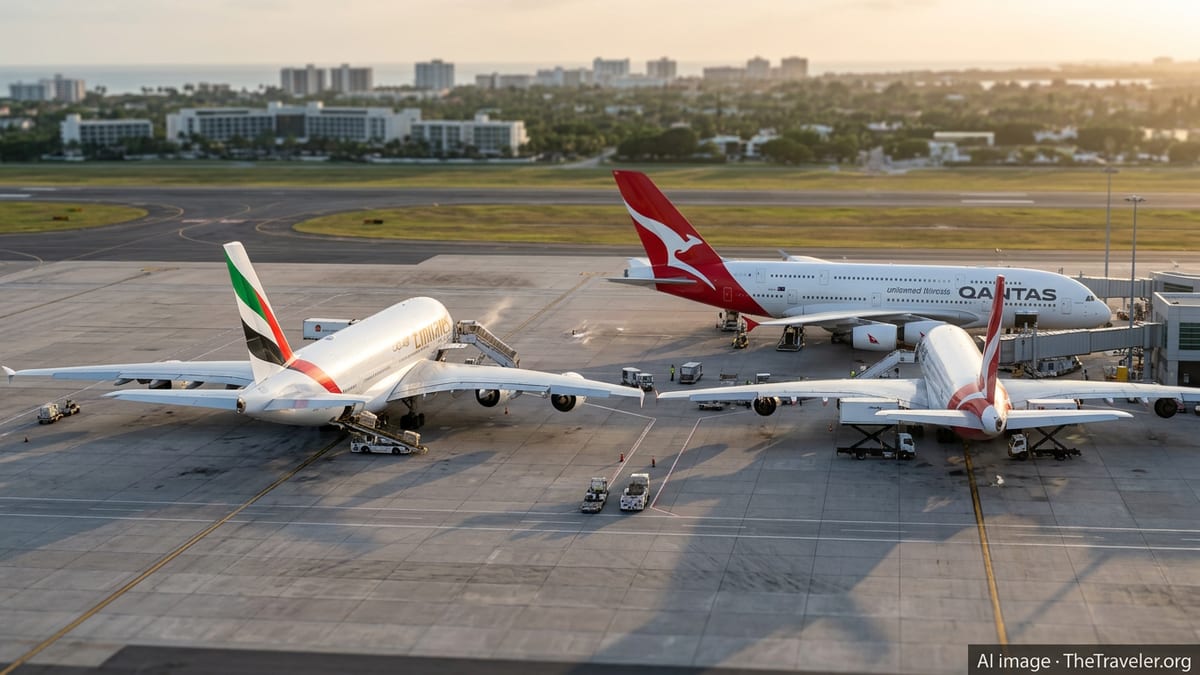
Superjumbo Revival Meets Premium Leisure Demand
The Airbus A380, once viewed as an endangered giant, is regaining prominence on long-haul routes linking North America with Australia and Asia, as well as key transatlantic corridors. Flag carriers are redeploying the double deck aircraft specifically to capture resilient premium demand from business travelers and affluent holidaymakers who are willing to pay several thousand dollars for lie flat comfort and lounge style service.
Publicly available fare data and industry reports indicate that long haul A380 business class tickets on carriers such as Emirates, Qantas, Singapore Airlines and British Airways routinely fall in the range of approximately 3,500 to 10,000 dollars round trip, depending on season, routing and advance purchase. Travel advisers describe a growing segment of passengers who treat these cabins as an integral part of a high end trip, rather than simply transportation to a destination.
At the same time, the supply of A380 business class seats is rising on routes that funnel travelers toward resort regions in the United States, Australia and New Zealand. Airlines are adding capacity where premium cabins are selling strongly, even as some carriers trim economy heavy configurations on underperforming routes.
This combination of plentiful flat bed inventory and robust willingness to pay is reshaping booking patterns for long haul leisure travel, particularly within the so called “premium leisure” market of high income vacationers and remote workers combining work and travel.
Network Shifts Put A380s Back on U.S. and Australia Routes
Qantas has been among the most active in repositioning its A380 fleet, progressively returning stored aircraft to service and assigning them to long haul trunk routes between Australia and the United States. Published schedules and company updates show the superjumbo returning to daily Sydney to Dallas Fort Worth services from early 2026, increasing the number of business class seats on one of the longest flights in the world and strengthening connectivity into the U.S. heartland.
Industry analysis of capacity trends indicates that Qantas is also using the A380 to bolster its broader U.S. network, even as it shifts aircraft away from some markets that have seen softer economy demand. Melbourne to Los Angeles, for example, is transitioning to smaller Boeing 787 aircraft, reflecting a focus on preserving premium seats while reducing the number of lower yielding economy seats on that route.
Emirates, long associated with the A380, continues to operate the aircraft on multiple links between its Dubai hub and U.S. gateway cities including New York, Houston and Los Angeles, as well as to Australian ports such as Sydney, Melbourne, Brisbane and Perth. For travelers originating in North America, this structure effectively turns Dubai into a premium transfer point to beach, wine and nature destinations in Australia and New Zealand via A380 business cabins.
Singapore Airlines and British Airways, meanwhile, are concentrating their A380 deployments on select high demand city pairs where premium cabins fill reliably. While U.S. bound Singapore Airlines flights are largely operated by other widebody types, its A380s on key European and Asian routes still form part of round the world itineraries that combine A380 segments with onward connections to North America and Oceania.
Business Class Price Bands and Cabin Upgrades
Available fare guides and booking data suggest that Emirates and Qantas typically price long haul A380 business class in a band of roughly 4,500 to 8,500 dollars for round trip journeys between North America and Australia when purchased as standard commercial tickets, with promotional and shoulder season fares sometimes dipping closer to 3,500 dollars and peak holiday periods rising toward or above 10,000 dollars. Singapore Airlines and British Airways show similar patterns on ultra long and transatlantic routes, though specific levels vary by market.
Airlines are pairing these price points with upgraded hard products. Qantas refurbished its A380 fleet with a reconfigured upper deck, updated business suites and refreshed premium economy seating, creating more privacy and storage for business passengers. Emirates continues to showcase its flagship A380 business cabin with direct aisle access, on board bar areas and expanded in flight entertainment options, features that distinguish it from smaller widebody jets on similar routes.
Singapore Airlines has invested heavily in its A380 business and suites cabins on routes where the aircraft remains in service, emphasizing wide seats, extensive personal storage and elegant finishes designed to appeal to both corporate travelers and couples. British Airways has used its latest business class seat, introduced progressively across the fleet, to narrow the gap with Gulf and Asian competitors on A380 operated services into North America.
These product upgrades signal a strategic bet that travelers will pay premium prices when the onboard experience mirrors the standards of upscale hotels, with fully flat beds, curated dining and extensive lounge access on the ground. That positioning supports higher average fares even as competition for economy passengers remains intense.
Resort Regions Feel the Ripple Effect
The expansion of long haul A380 business class capacity is feeding directly into resort markets that rely on high spending international visitors. In the United States, increased A380 and other widebody services into Dallas Fort Worth, Los Angeles, San Francisco and New York are channeling more premium passengers toward luxury beach and ski destinations from Hawaii and California to Colorado and the U.S. Southwest.
Tourism boards and hospitality operators in Australia report resilient demand at high end properties in Sydney, the Great Barrier Reef region, Byron Bay, Margaret River and Tasmania, supported in part by travelers arriving in premium cabins on Qantas, Emirates and other partners. Similar patterns are noted in New Zealand, where gateway airports such as Auckland and Christchurch serve as springboards to resort areas including Queenstown, Wanaka and the Bay of Islands.
Travel analysts point out that passengers who spend several thousand dollars on a business class ticket are also more likely to book suites, private villas and bespoke touring once they arrive. As a result, airlines and tourism bodies increasingly coordinate marketing campaigns that highlight both the inflight experience and the resort stay as a single premium journey.
There is also a measurable impact on seasonality. Attractive shoulder season fares in the lower end of the 3,500 to 5,000 dollar range are encouraging travelers with flexible schedules to visit outside traditional peak months, helping resorts in Australia and New Zealand smooth demand and improve year round occupancy.
Outlook: A380 as a Premium Leisure Workhorse
Looking ahead to 2026, timetables and fleet plans indicate that the Airbus A380 will remain a cornerstone of premium long haul strategies for Emirates, Qantas, Singapore Airlines and British Airways, even as newer twin engine jets assume a larger share of global flying. The aircraft’s ability to carry a high number of business and premium economy passengers, particularly on routes with strong connecting traffic, gives it an enduring role as a premium leisure workhorse.
Airlines are expected to keep fine tuning where the A380 flies, shifting the aircraft toward markets where business class cabins fill consistently at higher fare levels and away from routes where economy demand has softened. That could mean more superjumbo services into hubs that feed beach, wine and adventure tourism in the United States, Australia and New Zealand, while secondary routes see smaller aircraft.
For travelers, the near term effect is a wider range of opportunities to experience A380 business cabins at a spectrum of price points, from aggressive promotional offers to five figure peak season tickets. As long as demand for space, privacy and sleep on ultra long flights remains robust, the combination of premium A380 capacity and strong resort appeal in key markets is likely to continue reinforcing each other.
While some carriers have retired the type entirely, the current strategies of Emirates, Qantas, Singapore Airlines and British Airways suggest that for a distinct slice of the long haul market, the four engine superjumbo still represents the preferred way to cross oceans in comfort.