

More news on this day
Africa’s aviation sector is in the midst of a powerful rebound, and new data show Ethiopia setting the pace, recording a 31 percent jump in airline seat capacity that underscores the country’s outsized role in reconnecting the continent with the world.
Get the latest news straight to your inbox!
African Skies Reopen as Capacity Climbs Above Pre‑Pandemic Levels
The latest figures from aviation data providers and industry bodies point to a decisive turning point for African air travel. Across the continent, scheduled airline capacity has climbed well beyond pre‑pandemic levels, with about 182 million departure seats scheduled in the first ten months of 2026, up nearly 14 percent on the same period a year earlier. International routes are leading the way, reflecting renewed demand from business travelers, diaspora communities and tourists.
Industry analysts say the recovery is not just about returning to 2019 baselines. Capacity on many key intra‑African and long‑haul corridors is now markedly higher than before, as carriers respond to structural shifts in trade, tourism and investment. Domestic networks in several markets have expanded rapidly, while international services from major hubs are being rebuilt with larger aircraft and denser schedules.
That momentum comes despite persistent headwinds, from currency volatility and high fuel costs to infrastructure bottlenecks at congested airports. Yet the trajectory is clear: Africa’s skies are busier, more connected and increasingly competitive, with new entrants and established flag carriers both racing to capture demand.
Ethiopia Emerges as Africa’s Fastest‑Growing Major Market
Within this broader resurgence, Ethiopia has emerged as the headline story. A recent analysis by the African Travel & Tourism Association found that Ethiopia’s scheduled seat capacity rose by about 31 percent in the first ten months of 2026, reaching an estimated 17 million departure seats. That growth rate outpaced fellow heavyweights such as Egypt, South Africa, Morocco and Kenya, all of which also reported double‑digit increases.
The numbers confirm Ethiopia’s rapid ascent as an aviation powerhouse anchored by Addis Ababa, which has steadily positioned itself as a transfer hub linking Africa to Europe, North America, the Middle East and Asia. Analysts note that the country’s capacity growth is not limited to long‑haul sectors. Frequencies on regional routes across East, West and Southern Africa have been stepped up, while secondary international destinations in markets such as India and Southeast Asia have been added or upgraded.
The robust expansion also reflects strong underlying demand. Ethiopia’s economic growth, rising middle class and sizeable diaspora have all helped fill additional seats, while the country’s geographic position near the center of the continent makes Addis Ababa an efficient connecting point. For many travelers heading between African cities or linking Africa with the Gulf and Asia, one‑stop itineraries via Ethiopia have become a default choice.
Ethiopian Airlines Bets Big on Fleet and Hub Expansion
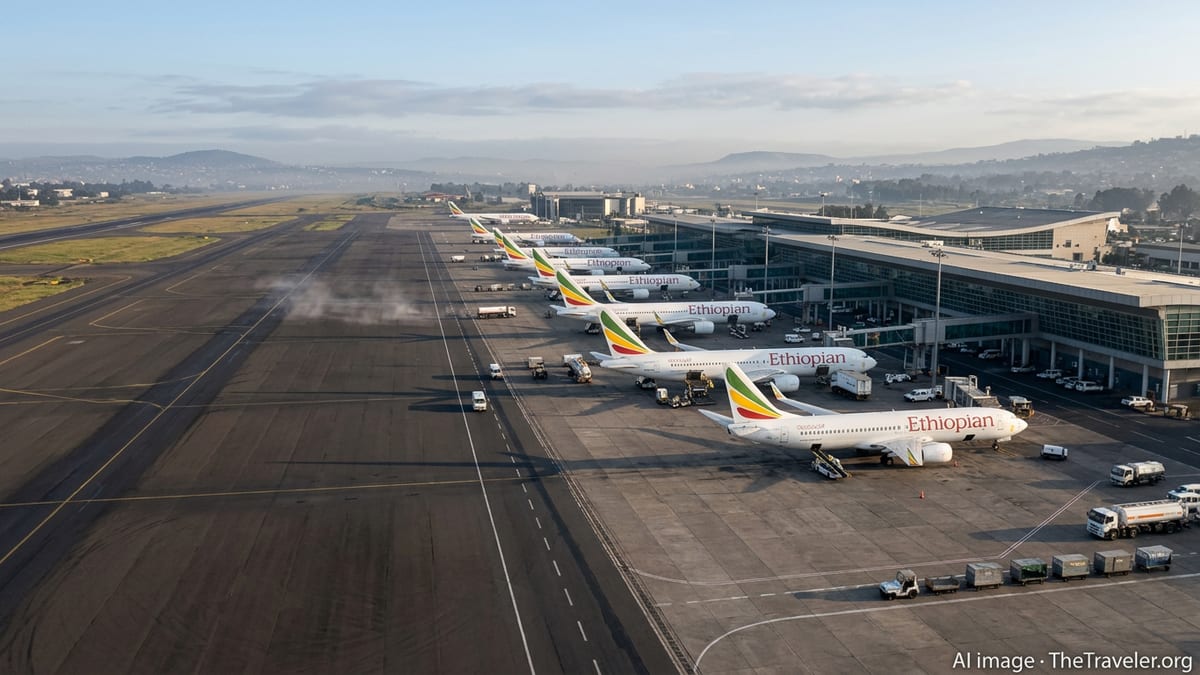
Driving Ethiopia’s capacity surge is Ethiopian Airlines, the continent’s largest carrier and one of its most ambitious. The airline has embarked on one of the most aggressive fleet expansion programs in African aviation, adding new wide‑body jets such as the Airbus A350‑900 and Boeing 787 to increase long‑haul capacity while refreshing its narrow‑body fleet for regional operations.
Over the past two years the carrier has steadily taken delivery of additional aircraft and signed fresh leasing and purchase commitments, allowing it to open new routes and upgauge existing ones. In the 2024–25 financial year alone, industry reports indicate that Ethiopian Airlines added multiple new routes, with further expansions into Asia‑Pacific, the Middle East and key African markets announced for 2025 and 2026. The airline has also invested in cabin upgrades and digital services to improve competitiveness against Gulf and European rivals.
At the heart of this strategy is a long‑term growth blueprint often referred to as Vision 2035, which aims to place Ethiopian among the world’s top global aviation groups. That plan extends beyond passenger traffic to encompass cargo, maintenance, training and airport services, positioning the airline as a diversified aviation conglomerate rather than a standalone flag carrier.
New Mega‑Hub Projects Signal Long‑Term Confidence
Ethiopia’s ambitions are perhaps most visible in its airport infrastructure pipeline. With Addis Ababa Bole International Airport operating close to its practical capacity, the government has moved ahead with plans for a new mega‑hub near Bishoftu, southeast of the capital. Backed in part by financing from the African Development Bank, the project is designed to eventually handle around 100 to 110 million passengers annually, more than quadrupling the capacity of Bole.
Officials present the new airport as a transformative piece of infrastructure that will anchor Ethiopia’s role as a gateway between Africa and the rest of the world. In addition to multiple runways and a major cargo terminal, the Bishoftu hub is expected to support an ecosystem of logistics, hospitality and retail developments, mirroring the aerotropolis models seen in the Gulf and parts of Asia.
For airlines across Africa, Ethiopia’s mega‑hub plans are a signal that the era of constrained infrastructure is beginning to give way to large‑scale capacity investments. Other countries, from Nigeria to South Africa, are also examining terminal expansions, new runways and public‑private partnerships as they seek to capture a larger share of regional and intercontinental traffic flows.
Regional Rivals Accelerate as Connectivity Race Intensifies
Even as Ethiopia sets the pace, it faces stiff competition from other African markets that are rapidly scaling up their own capacity. Egypt, Morocco, Kenya and South Africa have all recorded strong growth in scheduled seats in 2026, supported by a mix of state‑backed flag carriers, low‑cost operators and foreign airlines expanding their African footprints.
In North Africa, carriers based in Egypt and Morocco are deepening links with Europe and the Middle East, capitalizing on tourism and labor migration flows. In East Africa, hubs in Nairobi and Kilimanjaro are courting both safari tourism and business traffic, while West African markets from Lagos to Dakar focus on rebuilding regional connectivity that lagged in the early stages of the recovery.
The competitive landscape is being reshaped not only by national champions but also by foreign airlines from the Gulf, Europe and Asia, which are adding African destinations and capacity. This influx has put pressure on yields in some markets, yet it has also broadened consumer choice and brought down travel times on many cross‑continental routes.
For travelers, the net effect is a continent that feels markedly more connected than even a few years ago. More nonstop options, additional frequencies and newer aircraft are making it easier to stitch together multi‑country itineraries, while growing secondary hubs help spread benefits beyond traditional gateways.
Opportunities and Risks for Africa’s Next Aviation Chapter
Industry observers caution that sustaining the current growth trajectory will require careful management. Airlines remain vulnerable to foreign exchange swings, high financing costs and patchy regulatory environments. Infrastructure gaps still exist at many secondary airports, and air navigation systems and safety oversight need continued investment to keep pace with busier skies.
At the same time, the opportunities are substantial. Implementation of the African Continental Free Trade Area and the gradual rollout of the Single African Air Transport Market are expected to unlock new demand for intra‑African travel and cargo. As trade links deepen and tourism boards promote multi‑country circuits, capacity growth in markets like Ethiopia could be replicated elsewhere on the continent.
For now, Ethiopia’s 31 percent capacity surge stands as a bellwether of what is possible when fleet investment, hub development and strategic geography align. With African airline capacity climbing and more megaprojects on the drawing board, the continent’s aviation story is shifting from recovery to expansion, with Ethiopia at the forefront of the climb.