


More news on this day
Air Algérie is adding Manchester to its growing European network in June 2026, unveiling a twice-weekly Manchester–Algiers service that creates new one-stop links into Sub-Saharan Africa and the Middle East.
Get the latest news straight to your inbox!
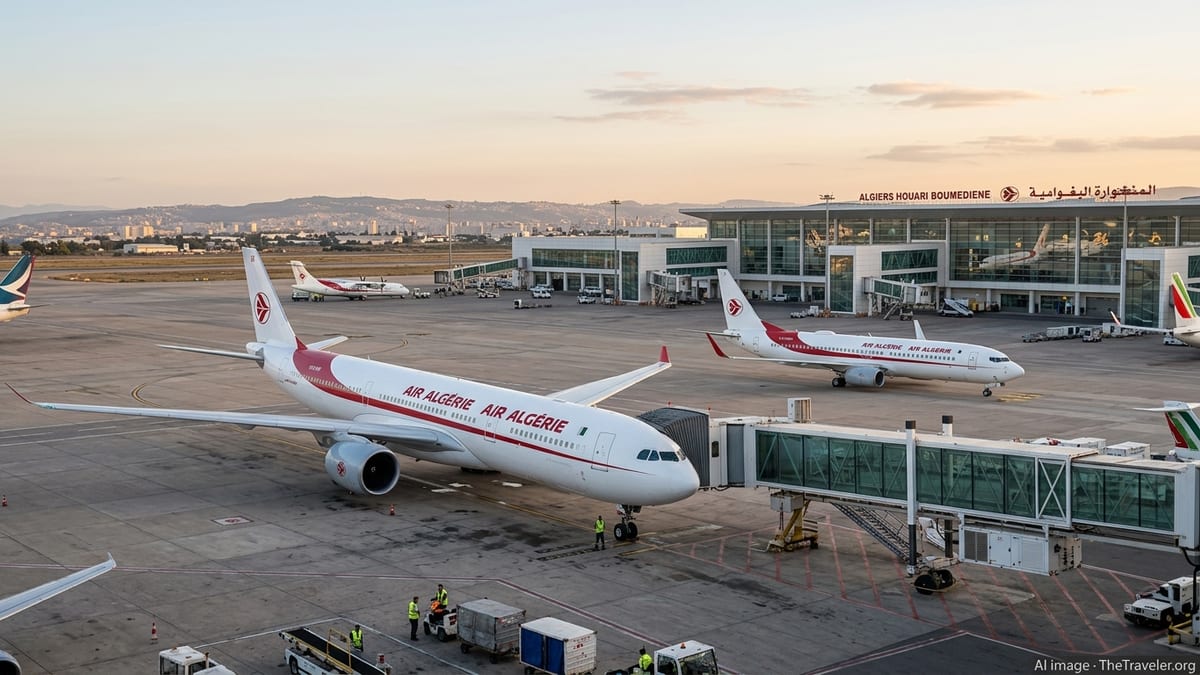
First Direct Link Between Manchester and Algiers
Publicly available timetable data shows that Air Algérie will inaugurate its Manchester–Algiers route on 14 June 2026, providing the first nonstop connection between northern England’s largest airport and the Algerian capital. The service positions Manchester as the only UK airport outside London with a direct link to Algiers, marking a notable expansion of the North African carrier’s presence in the British market.
The route will operate on a seasonal basis for the Northern Hemisphere summer, with two flights per week planned between Manchester Airport and Houari Boumediene Airport. Schedules currently indicate a block flight time of just under three hours, significantly reducing journey times for travelers who previously needed to route through London or continental hubs to reach Algeria.
According to published coverage, Air Algérie’s move builds on a broader strategy to expand frequencies to the United Kingdom for summer 2026. The airline is increasing its overall UK offering to 14 weekly flights by adding Manchester to existing services for Heathrow and Stansted. Market observers view the new route as part of a wider effort to diversify away from a strongly Paris- and Marseille-centered European network and tap into unserved demand in Britain’s regions.
Pricing information released in recent weeks shows that promotional round-trip economy fares on the new Manchester–Algiers route are being advertised from the low £200s, signaling a bid to quickly stimulate awareness and trial among leisure travelers, visiting-friends-and-relatives traffic, and niche business segments.
Full Schedule and Seasonal Operation
Initial scheduling data points to a compact but focused program, with Air Algérie deploying two weekly flights for the 2026 summer season. The operation is planned to start on 14 June and run through the main holiday period, targeting both early-summer travelers and late-season demand. The timetable aligns with peak outbound flows from the UK and the return of Algerian diaspora residents for holidays and family visits.
The flights are structured to connect efficiently with Air Algérie’s bank of departures from Algiers across Africa and the Middle East. Arrival times into Algiers are planned to dovetail with evening and late-night waves heading south and east, while northbound services from key regional cities are timed to feed into daytime departures bound for Manchester. Industry analysts note that this structure is designed to maximize aircraft utilization while delivering viable connection options on relatively few weekly frequencies.
The choice of aircraft has not been formally highlighted in public announcements, but schedule databases and fleet information suggest narrowbody equipment is likely, consistent with Air Algérie’s existing operations on medium-haul European routes. The airline has recently been renewing and expanding its fleet, including new-generation widebodies and turboprops, as part of a multi-year transformation that aims to increase both capacity and efficiency across its international network.
While the Manchester connection is currently seasonal, commentators in the Algerian and UK aviation press indicate that performance during the first year will be closely watched. Strong passenger loads, particularly in connecting traffic, could pave the way for an extended season or increased weekly frequencies in subsequent years as part of Air Algérie’s broader growth plan.
Gateway to Sub-Saharan Africa
Algiers has been steadily consolidating its role as a regional hub for traffic flows between Europe and Sub-Saharan Africa, and the new Manchester route is expected to bolster that strategy. Air Algérie’s network from Algiers spans multiple destinations in West and Central Africa, offering one-stop itineraries that compete in journey time with more established connections via Paris, Istanbul, or Gulf carriers.
Travel industry commentary highlights that for passengers in northern England, the new service reduces the need to connect via London or to backtrack through European hubs to reach cities in countries such as Mali, Niger, Burkina Faso, or Senegal. By departing from Manchester, travelers can reach Algiers in under three hours and then connect southwards with relatively short layovers, which could be especially attractive for corporate missions, development organizations, and diaspora communities.
Algeria’s own ambitions to position Algiers as a north–south aviation crossroads are supported by infrastructure upgrades at Houari Boumediene Airport and by ongoing fleet modernization. Industry reports describe a push to improve transit facilities, streamline connections, and enhance reliability on regional routes, seeking to capture a greater share of Africa–Europe transfer traffic that has historically gravitated toward other hubs.
For Manchester Airport, the arrival of Air Algérie adds a fourth African carrier to its portfolio and strengthens its status as a long-haul and transfer gateway in its own right. The combination of existing North American, Gulf, and North African links is gradually creating more options for northern UK passengers who prefer to avoid domestic transfers to London and connect internationally closer to home.
Strengthening One-Stop Access to the Middle East
Beyond Africa, the new Manchester–Algiers service is also expected to enhance indirect access to the Middle East. Air Algérie already operates routes from Algiers to cities across the region, and the published schedule for summer 2026 is structured so that some of those services can be reached with same-day connections from Manchester.
Although airlines based in the Gulf and Turkey continue to dominate UK–Middle East and UK–Asia flows, sector observers suggest that Algiers could capture a modest but growing slice of traffic, particularly on price-sensitive itineraries. Competitive fares on the Manchester–Algiers leg, combined with through-ticketing on Air Algérie’s own network, may appeal to travelers who are flexible on routings and willing to consider less familiar hubs.
Travel agencies and online booking platforms are already beginning to promote Algiers as an alternative connecting point for passengers originating in the north of England. According to these early listings, sample itineraries show total travel times that can rival or slightly exceed those via other hubs, but with potential savings on fare levels. This could prove especially important for small and medium-sized enterprises with business ties in North Africa and the Middle East, as well as for budget-conscious leisure travelers.
Industry analysis also points out that growing competition on indirect routings tends to exert downward pressure on fares more broadly. The presence of another one-stop option via Algiers may encourage rival carriers to sharpen pricing or capacity from Manchester on certain city pairs, indirectly benefiting passengers even if they continue to favor other hubs.
Implications for UK–Algeria Travel and Demand
The Manchester–Algiers launch forms part of a wider expansion of UK–Algeria air links. Public statements from Air Algérie and coverage in Algerian media describe plans to reach a total of 14 weekly flights between the two countries in summer 2026, combining services from Algiers to London Heathrow, London Stansted, and now Manchester. This compares with a more limited portfolio only a few seasons ago, when London dominated direct capacity.
Analysts interpret the shift as a response to several converging trends. The Algerian diaspora in Britain is spreading beyond the capital, while demand for niche tourism in North Africa is diversifying. Manchester’s catchment area includes major university cities and industrial centers with commercial interests in energy, engineering, and infrastructure, sectors that have longstanding links with Algeria and its neighbors.
Reports on the new route also emphasize its role in promoting inbound tourism to Algeria. With Morocco and Tunisia long established on British holidaymakers’ maps, travel writers describe Algeria as comparatively undiscovered, highlighting coastal cities, Saharan landscapes, and historical sites that have seen limited UK visitor numbers to date. Easier access from Manchester is expected to help tour operators test new packages and itineraries for adventurous travelers seeking alternatives to more crowded Mediterranean destinations.
In regulatory terms, passengers are being reminded through official advisories that a visa is required for British nationals traveling to Algeria, with applications handled via the Algerian consular network in the UK. Travel providers are encouraging early planning to accommodate processing times, particularly during peak summer weeks when demand for the new flights is anticipated to be strongest.