


More news on this day
Passengers on Air France flight AF12 from Paris to New York faced an unexpected disruption this week when the Airbus A350 turned back over the Atlantic and the flight was subsequently cancelled, drawing fresh attention to the long haul workhorse’s technical reliability and how airlines manage inflight faults.
Get the latest news straight to your inbox!
Transatlantic Flight Cuts Journey Short
Publicly available flight tracking data indicates that AF12, a regular Air France service from Paris Charles de Gaulle to New York John F. Kennedy typically operated by an Airbus A350 900, departed Paris in the evening before turning back over the North Atlantic and returning to its departure airport instead of continuing to the United States.
Records show that the aircraft initially followed the standard westbound transatlantic track from Paris toward New York, climbing to cruise altitude before initiating a wide turn in mid ocean and heading back toward Europe. The return to Paris added several hours to the total flight time and resulted in the cancellation of the scheduled transatlantic sector.
Operational data suggests that the aircraft involved had been routinely operating the CDG JFK route prior to the event, with AF12 showing a strong punctuality record on recent days. The abrupt change in routing therefore stands out as an irregularity on an otherwise stable long haul schedule.
While the precise trigger for the return maneuver has not been disclosed, aviation observers note that a mid Atlantic turnback typically indicates a technical or operational concern significant enough that continuing to destination is assessed as less desirable than returning to a familiar maintenance base.
Focus on a Suspected Technical Fault
Reports circulating in aviation forums and specialist outlets describe the AF12 event as likely related to a technical fault affecting onboard systems, although no consensus has emerged about the specific component involved. Modern aircraft such as the Airbus A350 rely on a complex network of sensors, data concentrators and flight control computers, and a fault in any of these systems can generate cockpit messages that require careful assessment by the crew.
Technical documentation and previous advisories on the A350 family highlight that the type is designed with extensive redundancy and fault tolerance. Multiple systems are duplicated or triplicated, and flight crews have access to detailed dispatch and diagnostic pages that summarize the aircraft’s technical status in flight. In practice, this means that not every fault will automatically require a diversion, but a combination of alerts or a failure affecting critical systems can tip the balance toward returning to base.
Earlier in the A350’s service history, regulators issued directives addressing specific software and hardware issues, such as time limited resets of certain avionics components and inspections of individual structural or sensor elements. Although there is no public indication that these prior concerns are directly linked to the AF12 incident, their existence provides context for why any new technical event on the type quickly draws scrutiny from both industry watchers and passengers.
In the absence of a formal technical statement on AF12, specialists stress that a precautionary turnback is consistent with a safety first approach. For airlines, the cost and disruption associated with cancelling a transatlantic flight are significant, so a decision to return mid route generally reflects a conservative assessment of risk rather than a minor inconvenience.
Passenger Experience Marked by Uncertainty
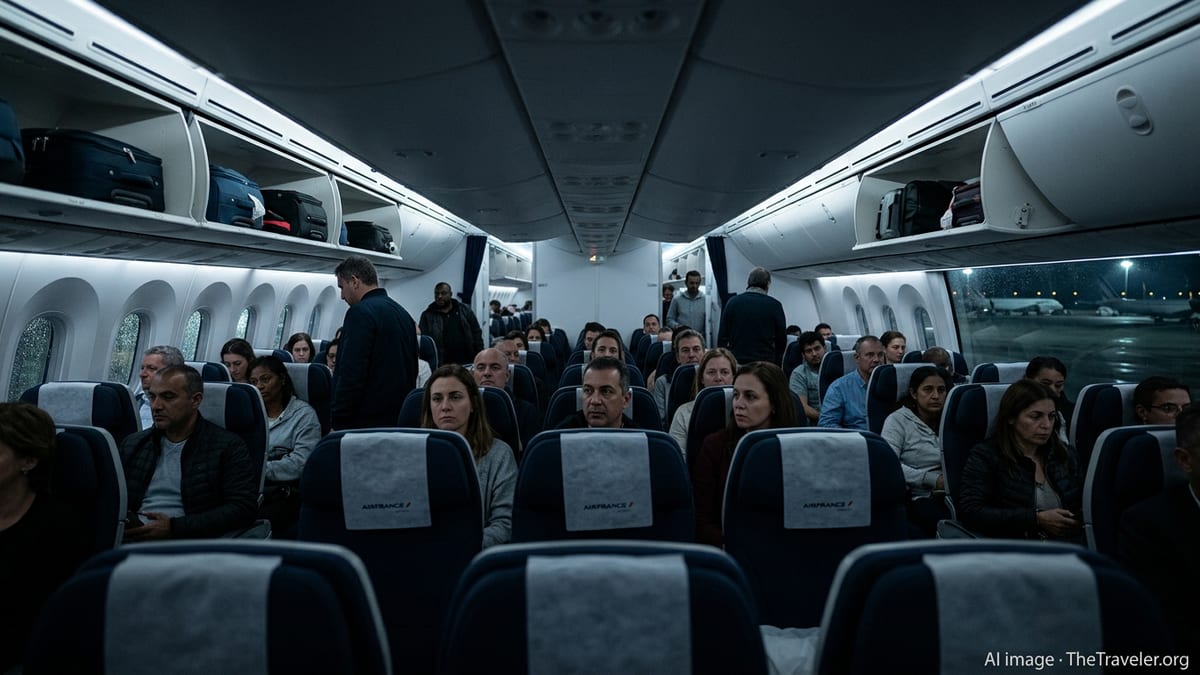
Travellers on board AF12 experienced what has become a familiar pattern in modern long haul disruptions. According to accounts shared through public channels, the flight initially appeared routine, with normal climb and cruise, before the change in heading over the Atlantic gradually became apparent on inflight maps and tracking apps.
The mid ocean U turn effectively converted a planned overnight crossing into an extended circular journey that began and ended in Paris. Once back on the ground, the flight was listed as cancelled rather than delayed, and passengers were rebooked on later services or accommodated in hotels depending on their onward itineraries and available capacity on alternative flights.
Such disruptions can be particularly challenging on heavily booked transatlantic routes, where same day rebooking options are limited and premium cabins are often full. Some travellers faced missed connections in New York and onward destinations in North America, while others had to adjust ground transport and accommodation plans at short notice.
Consumer advocates note that European passenger protection rules may entitle affected travellers to care and assistance, and in some circumstances to compensation, though technical faults classified as extraordinary circumstances can complicate these assessments. For many passengers, however, the primary concern in the immediate aftermath is clarity about rebooking options and how long they will be delayed reaching their final destination.
Airbus A350 Reliability Under the Microscope
The AF12 turnback comes at a time when the Airbus A350 is central to the long haul strategies of several major airlines, including Air France. The type is generally regarded as a modern, fuel efficient and reliable widebody, and it has accumulated millions of flight hours on routes across the Atlantic, Pacific and other intercontinental corridors.
Previous incidents involving A350 aircraft at various carriers have ranged from bird strikes and minor structural damage to software anomalies and sensor issues, most of which have been resolved without injuries. Published safety investigations into individual cases, including events affecting Air France A350s, have led to targeted inspections, maintenance actions and occasional updates to manuals and procedures.
Aviation safety analysts emphasize that isolated technical events on a widely used aircraft type do not necessarily indicate a systemic problem. Instead, each occurrence is examined by airline engineering teams, the manufacturer and regulators, who compare fault codes, maintenance records and flight data to determine whether any broader safety implications exist.
At the same time, social media and real time flight tracking have made such events far more visible to the public. A diversion that might once have attracted limited attention now generates viral posts and speculation within minutes, increasing pressure on airlines and manufacturers to explain both the immediate cause and the wider context of an incident.
Operational and Reputational Implications for Air France
For Air France, the AF12 cancellation has both short term operational and longer term reputational dimensions. In the short term, the airline must reposition aircraft and crews, accommodate displaced passengers and absorb the costs of lost revenue on a transatlantic sector.
Operational research on airline networks points out that disruptions to a single long haul flight can ripple through an entire schedule, affecting aircraft rotations, crew duty limits and subsequent departures. Carriers increasingly rely on sophisticated planning tools to minimize knock on effects, but an unexpected mid Atlantic return creates a complex puzzle for schedulers and maintenance planners.
In the longer term, repeated high profile disruptions can influence public perception of an airline’s reliability, even when underlying safety metrics remain strong. Traveller discussions on forums and review platforms already reflect mixed views of Air France’s long haul performance, with some praising modern cabins and inflight service while others describe frustrations with delays, irregular operations and communication.
Industry observers suggest that transparent communication about incidents such as the AF12 turnback, combined with visible efforts to support affected passengers, can help mitigate reputational damage. As investigations into the technical aspects of the flight proceed, the outcome is likely to feed into ongoing refinements of maintenance programs and operational procedures for the Airbus A350 fleet, both at Air France and across other operators that rely on the type for their flagship long haul services.