


More news on this day
Airlines continue to attribute a large share of flight delays to forces outside their direct control, pointing most often to airport congestion, air traffic flow restrictions, and increasingly disruptive weather patterns that ripple through tightly scheduled networks.
Get the latest news straight to your inbox!
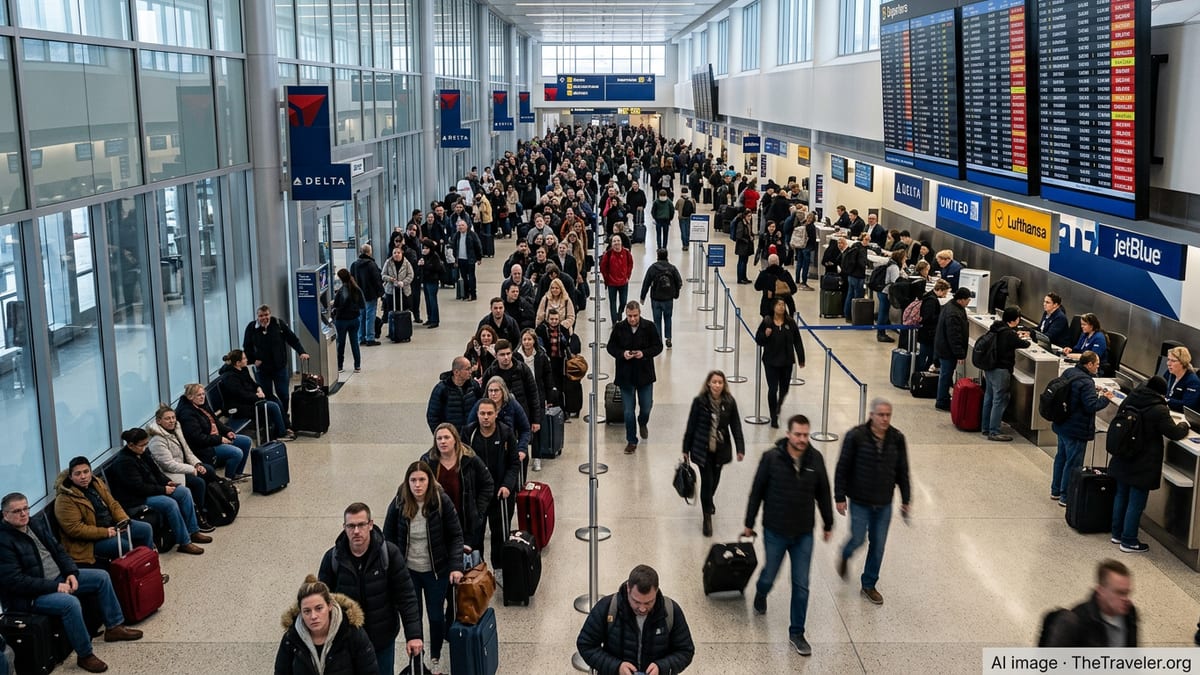
Congestion is becoming a daily operating constraint
Across the busiest hubs, airlines and airports are operating closer to maximum capacity, leaving less slack when thunderstorms, runway closures, or air traffic flow programs reduce arrival rates. Publicly available FAA materials show the agency has recently leaned on schedule-management tools at high-volume airports where demand can exceed what runways and local airspace can reliably handle during peak periods.
One of the highest-profile examples is Chicago O’Hare (ORD), where the FAA announced a “scheduling reduction” for summer 2026 that limited daily operations to 2,708 flights after peak-day schedules climbed above 3,000 flights. The same announcement pointed to the reliability impact of overscheduling, and framed the move as an attempt to prevent widespread delays and cancellations during the peak travel season.
The congestion problem is not confined to one airport. The FAA has also highlighted a mix of runway work, staffing gaps, and heavy demand in the New York and Newark area, where even minor disruptions can trigger cascading delays along the East Coast. When aircraft and crews are displaced by late arrivals, airlines have fewer recovery options later in the day, amplifying passenger impacts even on routes far from the original bottleneck.
Weather remains the most visible trigger for travelers
Airlines can schedule additional aircraft time and build operational buffers, but they cannot prevent convective storms, winter systems, or sustained low ceilings that reduce airport arrival rates. When weather forces traffic management initiatives, delays typically spread as aircraft wait for departure slots, are rerouted around storms, or hold on arrival.
Operational reporting in Europe underscores how weather can dominate delay patterns even when air traffic volumes grow. EUROCONTROL’s June 2026 “all-causes delay” brief reported more than 1.047 million flights in the ECAC area and measured average departure delay per flight at 16.4 minutes, with arrival delays averaging 14.4 minutes. The same reporting framework tracks how weather interacts with capacity limits in a network where flights frequently cross multiple airspaces.
Weather also compounds congestion because it reduces the effective capacity of airports and airspace sectors. When a hub’s arrival rate is cut in half due to storms, the queue of inbound flights can extend far beyond the immediate region, creating long ground delays at departure airports that may be hundreds of miles away.
Air traffic control staffing and technology are part of the delay debate
Airlines often argue that delays blamed on “air traffic control” are not simply a single issue, but a combination of staffing availability, equipment limitations, and the difficulty of coordinating demand and capacity across the national network. FAA publications in 2026 have acknowledged longstanding staffing constraints while emphasizing multi-year efforts to rebuild the controller workforce.
In May 2026, the FAA released an air traffic controller workforce plan and described the scale of the current system: roughly 11,000 certified professional controllers deployed across more than 300 facilities, with about 4,000 controllers in the training pipeline. The FAA also noted that fully certifying a new hire can take more than two years depending on facility complexity, a timeline that affects how quickly staffing levels can respond to rising demand.
Technology upgrades are being presented as another lever to reduce congestion-driven delays. In June 2026, the FAA announced a modernization initiative centered on Flow Management Data and Services (FMDS), described as a technological backbone for the Air Traffic Control System Command Center. The FAA said an associated capability, SMART, is designed to analyze schedules, weather, and airport capacity to anticipate conflicts before departures and help reduce systemwide congestion.
Performance data shows uneven results across airlines
While airlines frequently point to congestion and weather, federal consumer reporting still captures meaningful differences in on-time performance among carriers operating in the same environment. The U.S. Department of Transportation’s Air Travel Consumer Report provides monthly snapshots that travelers and industry analysts use to compare reliability.
In the June 2026 Air Travel Consumer Report (covering April 2026 operational data), the DOT reported an overall on-time arrival rate of 78.9% across reporting carriers. In that month’s table, Delta Air Lines posted 84.1% on-time arrivals, Alaska Airlines 83.7%, United Airlines 81.9%, Southwest Airlines 77.3%, and American Airlines 76.8%, with Spirit Airlines listed at 63.0%. Those figures do not isolate the cause of each late arrival, but they show how operational planning, network design, and recovery capability can influence outcomes even when external constraints are widespread.
Industry-wide, reliability metrics can also be affected by airport-specific initiatives. When flight volumes are reduced by schedule caps or when airlines adjust timetables to reflect realistic turnaround times, the goal is often fewer extreme disruptions, even if it means fewer available peak-time slots. For travelers, the tradeoff can show up as higher schedule predictability but less choice in departure times.
Recent disruptions show how quickly delays can cascade
Beyond routine congestion and weather, large-scale disruptions can also come from air traffic system failures, which airlines sometimes cite as evidence that network resilience remains fragile. In early September 2026, published coverage described a major disruption in the United Kingdom after technical problems in the air traffic control system led to more than 2,000 flight cancellations, with delays continuing as airlines worked to reposition aircraft and rebook passengers.
Events like these are extreme, but they illustrate the same basic vulnerability that affects day-to-day operations: when demand is high and schedules are tight, the system has limited room to absorb shocks. Even when the original trigger is resolved, backlogs can persist for days as aircraft, crews, and gates are out of place.
For passengers, the practical implication is that the stated reason for a delay on a boarding announcement may only describe the first link in a longer chain. A thunderstorm in one region can create missed connections elsewhere, while a constrained airport can generate ground stops that affect routes nationwide. As airlines, airports, and regulators pursue staffing and technology fixes, the near-term reality remains that congestion and weather will continue to drive a significant share of the delays travelers experience.