


More news on this day
Air travelers moving through Dubai and Abu Dhabi are facing rolling delays and selective cancellations this month, as Emirates, Etihad Airways and flydubai adjust operations in response to ongoing regional tension and shifting airspace risk assessments that are lengthening some flight times and disrupting connections.
Get the latest news straight to your inbox!
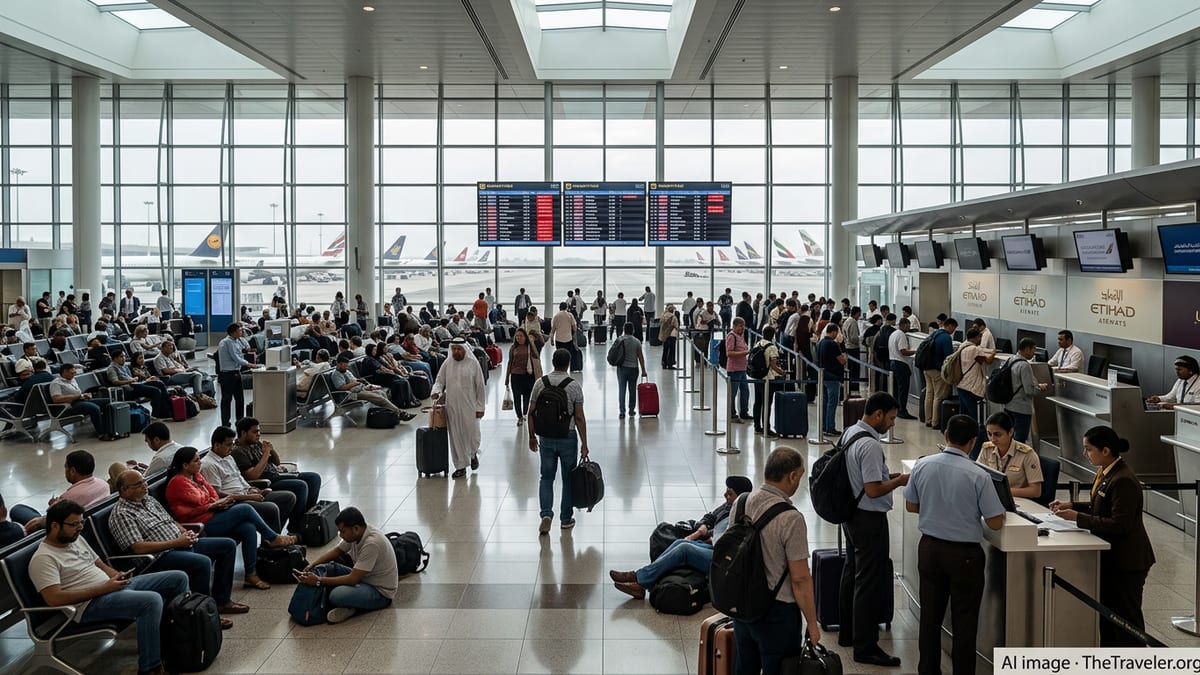
What’s driving the disruption in Dubai and Abu Dhabi
Published coverage over the first half of September has linked the latest wave of disruption to a combination of factors: heightened regional security concerns affecting preferred routings, plus knock-on operational issues that can ripple quickly through tightly scheduled hub networks. The result has been uneven impact across destinations, with most services still operating but a noticeable increase in late arrivals, missed connections, and last-minute aircraft and crew substitutions.
In Dubai, the effects have shown up as longer-than-usual routings for some flights and periodic congestion in the arrival and departure banks at Dubai International Airport. Flydubai has separately advised that flight durations and transit times in Dubai can run longer when flight paths are temporarily rerouted, a pattern that becomes most visible on shorter sectors where a detour adds proportionally more time to the overall trip.
In Abu Dhabi, Zayed International Airport has remained operational, but published reports have tracked delays across a spread of Etihad routes on peak disruption days, spanning Europe, South Asia, and parts of the Middle East. For travelers, that breadth matters because it increases the odds that a delay on one incoming flight can cascade into later departures on the same aircraft rotation.
How Emirates, Etihad and flydubai services have been affected
Across the UAE’s three major carriers, the most consistent pattern has been delays rather than broad network shutdowns. However, selective cancellations have been reported on specific city pairs, particularly where airlines are managing tighter operational buffers or where regional developments make routings less predictable.
In early September, published flight-disruption roundups listed Emirates arrivals with later-than-scheduled timings on multiple European routes on certain days, and also described temporary reductions on some Gulf routes. Separately, The National reported that on Sunday, September 13, more than 170 flights were delayed in Dubai and Abu Dhabi, with two flydubai flights between Dubai and Bahrain cancelled, a notable example given how heavily travelled the short Gulf sectors are for both business and leisure demand.
Etihad has been cited in published coverage as among the more affected operators on particular days, with delays reported across a wide mix of inbound flights. Even when flights continue to operate, irregular operations at a hub carrier can create a second-order effect: tighter onward connections, gate changes, and re-accommodation pressure on later departures.
Airspace, reroutes, and why some flights take longer than the schedule
When airlines detour around higher-risk areas or avoid certain corridors, the immediate traveler-facing outcome is simple: longer block times. Longer block times translate into later arrivals, increased likelihood of missed onward connections, and, in some cases, duty-time constraints that can force crew changes or require a flight to wait for a replacement crew.
Publicly available operational guidance from UAE aviation authorities has emphasized coordination mechanisms designed to manage traffic evolution and operational measures that can affect airspace and airport performance. While travelers do not see the underlying air traffic management processes, they experience the practical impacts in the form of extended taxi times, holding, re-sequencing, or revised departure slots.
In Dubai, flydubai’s operational updates have explicitly flagged that transit times may be longer than usual when flight paths are temporarily rerouted. For passengers connecting through Dubai International, those extra minutes can be the difference between making a short connection and being rebooked on a later departure.
What travelers should do now: status checks, connection planning, and rebooking basics
For travelers with upcoming itineraries through Dubai International (DXB) or Abu Dhabi’s Zayed International (AUH), the most useful step remains frequent flight-status monitoring directly with the operating airline, especially on the day of travel. Published guidance and airline help pages commonly point passengers to confirm status before heading to the airport and to watch for notifications about schedule changes.
Connection strategy matters more during disruption periods. Travelers with self-made connections (separate tickets) should plan for larger buffers than usual, since even modest inbound delays can erase the protection normally provided by a published minimum connection time. Where possible, itineraries on a single ticket can provide more straightforward re-accommodation options if the first leg arrives late.
For rebooking and disruption support, airline policies vary by fare type and the reason for disruption, but publicly available Emirates customer guidance indicates it typically attempts to rebook disrupted passengers on the first available connection, and may offer options to change plans depending on the circumstances. Travelers should keep their contact details current in their booking so alerts are not missed, particularly if changes occur after online check-in.
Where the ripple effects are showing up: regional short-haul and long-haul networks
Dubai and Abu Dhabi are structured as connecting hubs, so disruption is rarely isolated to a single market. Even when a geopolitical issue is regional, the operational knock-on can reach long-haul schedules because widebody aircraft and crews are tightly planned across multi-day rotations. A late-arriving aircraft from Europe can affect an onward departure to Asia, and a delayed inbound from South Asia can affect an evening departure wave to Europe.
At the same time, short-haul Gulf routes can be disproportionately sensitive to airspace changes because they have less slack built into the schedule. A detour or revised slot can push a short flight into a different arrival bank, creating congestion and complicating same-day connections.
As of mid-September, published coverage has continued to emphasize that most flights are still operating, but that passengers should expect a higher likelihood of delays and occasional cancellations on specific routes as airlines keep adjusting to evolving conditions. For travelers, that means building flexibility into itineraries, watching connection times closely, and checking flight status repeatedly as departure time approaches.