

More news on this day
An Alaska Airlines flight from Portland to Anchorage was diverted for an emergency landing in Anchorage after a passenger allegedly sexually assaulted his seatmate midair, leading to the man’s arrest on federal felony charges and renewed concern over in-flight passenger safety.
Late-Night Flight Cut Short by Alleged In-Flight Assault
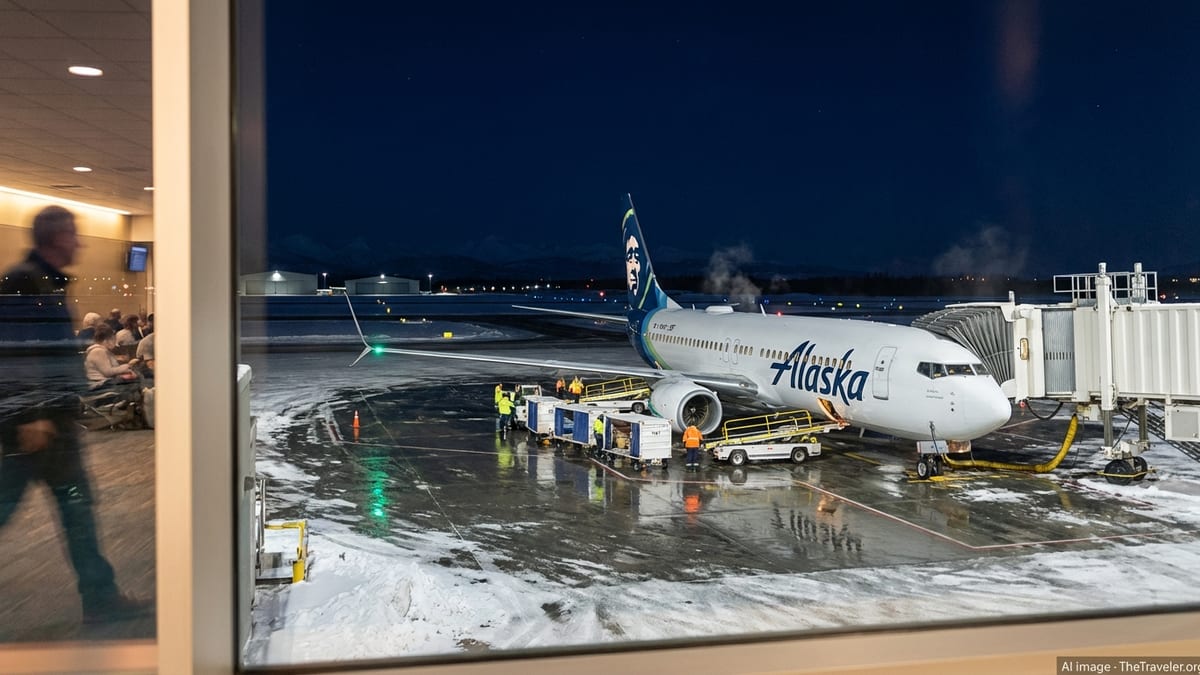
The incident occurred on February 22, 2026, aboard Alaska Airlines Flight 733, operating a late-night service from Portland International Airport to Ted Stevens Anchorage International Airport. According to federal charging documents, the flight was forced to divert to Anchorage after the crew reported an alleged sexual assault in the passenger cabin.
Investigators say the suspect, identified as 44-year-old Timothy Hobson, was seated next to a woman traveling alone when his behavior allegedly escalated from unsettling staring to unwanted physical contact. The criminal complaint describes a series of actions that left the victim feeling trapped and fearful during the flight.
Federal authorities state that once notified of the allegation, the cockpit crew coordinated with air traffic control and law enforcement on the ground, prioritizing an expedited arrival in Anchorage so that officers could meet the aircraft at the gate.
Details of the Alleged Midair Attack
Court filings say the encounter began even before departure, when Hobson allegedly stared intensely at the woman and smiled without speaking. After takeoff, he is accused of using a dropped item as a pretext to reach into her personal space, repeatedly brushing against her leg and encroaching into her seat area.
The complaint further alleges that Hobson later placed his head on the woman’s shoulder despite her attempts to move away. The victim eventually alerted cabin crew, who then took steps to separate the two and document what had occurred. Other passengers and crew members have provided statements as part of the ongoing investigation.
Upon landing in Anchorage, law enforcement officers boarded the aircraft and took Hobson into custody. A breath test administered after his arrest reportedly showed a blood alcohol level above the legal driving limit, which investigators say may factor into their assessment of his behavior but does not diminish the seriousness of the alleged crime.
Federal Felony Charge and Ongoing Legal Case
Hobson has been charged with abusive sexual contact under the special aircraft jurisdiction of the United States, a federal felony that applies to crimes committed aboard U.S.-registered commercial flights. He is being held at the Anchorage Correctional Complex pending further court proceedings.
If convicted, he faces the possibility of a significant prison sentence as well as mandatory registration as a sex offender. Prosecutors have emphasized that the case is being treated as a serious violation of passenger safety and federal aviation law.
The initial court appearance, scheduled in Anchorage federal court, is expected to address detention status and set a timetable for further hearings. Public defenders or privately retained counsel are likely to review surveillance records, crew reports and passenger statements as they prepare a defense.
Airline Response and Safety Protocols in Focus
Alaska Airlines has confirmed that the crew reported the incident and coordinated closely with authorities in Anchorage. The airline has reiterated that flight attendants are trained to respond swiftly to allegations of harassment or assault, including moving passengers, documenting complaints and contacting law enforcement as soon as possible.
Industry guidelines call for crews to prioritize deescalation and victim safety while maintaining control of the cabin. In many cases, that means continuing to the nearest suitable airport where police can meet the flight. Aviation safety specialists note that cooperation between airlines, federal agencies and local airport police has become increasingly structured in recent years as reports of in-flight misconduct have risen.
While authorities stress that such incidents remain rare compared with the volume of daily flights nationwide, they also acknowledge that the confined environment of an aircraft cabin can amplify the impact of any assault and leave victims feeling particularly vulnerable.
Broader Concerns Over In-Flight Misconduct
The Alaska Airlines case comes amid heightened scrutiny of unruly and criminal behavior on commercial flights across the United States. Federal officials have pursued a growing number of cases involving sexual contact, interference with crew and alcohol-fueled disruptions, arguing that strong prosecution is essential to deterrence.
Advocates for survivors say incidents like the one alleged on Flight 733 underscore the importance of passengers speaking up quickly if they feel unsafe, and of airlines reinforcing clear reporting channels on board. They also call for continued training so that crews recognize the signs of predatory behavior early.
For travelers, the diversion of a routine late-night flight into a criminal investigation is a reminder that the protections of federal law extend from the airport gate to cruising altitude, and that serious misconduct in the skies can carry lasting legal consequences on the ground.