

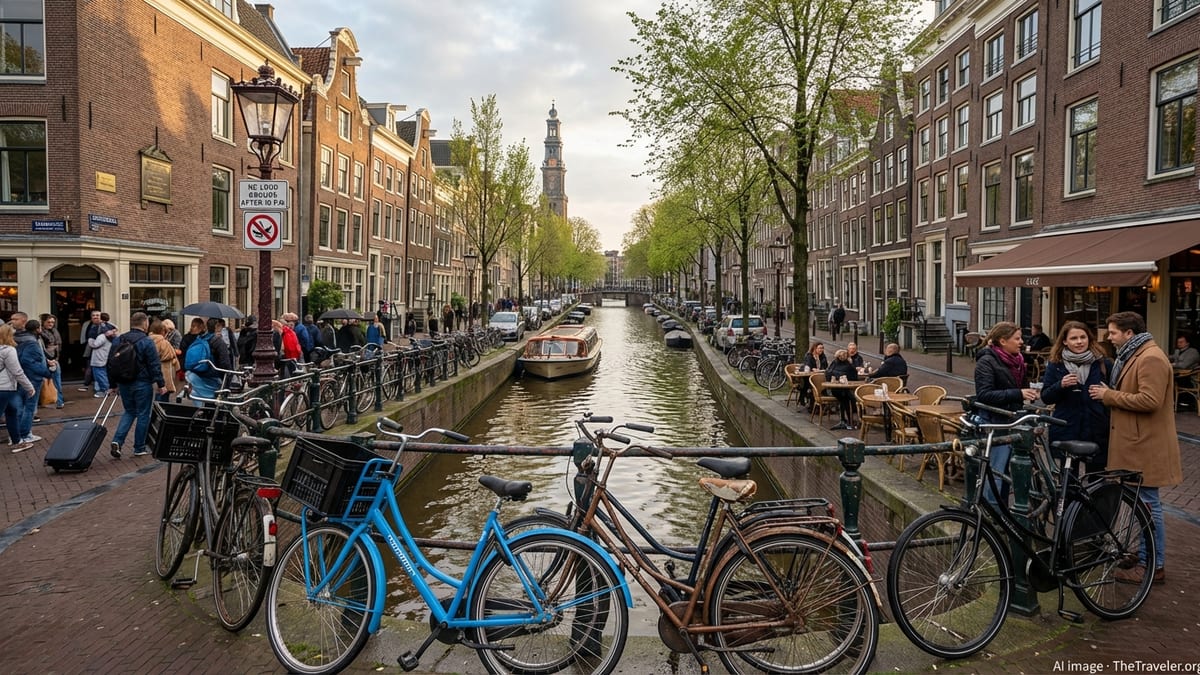
Amsterdam is one of those rare cities whose name alone conjures a whole world of images: glittering canals, gabled houses, Rembrandt and Van Gogh, bicycles, coffee shops, and the red light district. Yet behind the postcard clichés lies a dense story about trade and tolerance, colonial wealth and injustice, artistic genius and everyday pragmatism.
Today, as the Dutch capital wrestles with overtourism, a housing crunch, and the climate crisis, Amsterdam has become a laboratory for how historic cities can protect their soul while staying open to the world. To understand why Amsterdam matters now, it helps to know how it became what it is.
From Swamp Village to Golden Age Metropolis
Amsterdam began in the 13th century as a modest fishing settlement at a dam on the River Amstel, a practical piece of infrastructure that gave the city its name. Its rise was never guaranteed. The surrounding land was marshy and flood-prone, demanding constant engineering just to stay habitable. That struggle with water shaped the city’s character: pragmatic, cooperative, and relentlessly focused on managing collective risks. Over time, merchants and shipbuilders joined the fishermen, and by the late Middle Ages Amsterdam was a middling but promising trading town within the low-lying, commercially ambitious Dutch provinces.
The breakthrough came in the late 16th and early 17th centuries, when Amsterdam became the beating heart of what historians call the Dutch Golden Age. Ships sailed from its harbor to the Baltic, the Mediterranean, Africa, Asia, and the Americas, carrying timber, grain, spices, sugar, textiles, and enslaved people. Amsterdam emerged as Europe’s key entrepôt and financial center, home to the Amsterdam Stock Exchange, often called the world’s first modern securities market, and to the Bank of Amsterdam, which stabilized currency and credit for traders across the continent.
At the same time, the city was the headquarters and principal shareholder base of the Dutch East India Company and a major node of the Dutch West India Company. These companies drove colonial expansion and the Atlantic slave trade, generating enormous profits that financed the city’s canal ring, merchant houses, and art patronage. The elegant streets tourists admire today were funded in no small part by coerced labor and extractive trade overseas, a legacy the city is now confronting more openly in public debate and museum exhibitions.
Culturally, the Golden Age turned Amsterdam into a magnet for talent. Rembrandt, Vermeer’s patrons, and scores of lesser-known painters flourished in a market where prosperous burghers invested in portraits, landscapes, and still lifes. Booksellers and printers made the city a haven for relatively free expression by European standards, with banned texts often printed or traded there. This intertwining of commerce, art, and ideas set the template for Amsterdam’s later image as both a business hub and a place of intellectual and cultural experimentation.
Canals, Trade, and the Making of a World City
The physical Amsterdam that visitors explore today is largely a 17th-century urban project. Starting in 1613, city planners embarked on a massive expansion, building the iconic concentric ring of canals and the narrow, gabled houses that line them. These canals are central to the main things to do in Amsterdam. They were not just decorative; they functioned as transport corridors, drainage infrastructure, and a tool for controlling land values. Merchant families could dock their barges directly at their warehouses and homes, while the water grid helped regulate traffic and goods flows through the booming port city.
The canal system plays a big role when evaluating if Amsterdam is worth visiting. These same canals now form the UNESCO-listed historic center, anchoring Amsterdam’s global brand. Tour boats glide past façades that once housed spice traders and bankers. Museums such as the Amsterdam Museum and the city archives interpret how this built landscape encoded social hierarchies, with wealth concentrated on the grand canals and artisans and workers packed into smaller side streets and courtyards. The tulip mania of the 1630s, still a fixture of economic textbooks as an early speculative bubble, also rooted itself in this world of merchant optimism and financial innovation.
As global trade patterns shifted and other powers rose, Amsterdam’s absolute dominance waned in the 18th and 19th centuries, but the city remained a crucial commercial and logistics node. Industrialization brought new docks, rail connections, and working-class districts, while the old center aged rather than being demolished and rebuilt. That continuity is one reason the historic core feels unusually intact compared to many other European cities that saw more radical 19th- and 20th-century remodelling.
In the postwar era, as container shipping and air travel reshaped global flows, Amsterdam reinvented itself again as a transport, services, and cultural capital. Schiphol Airport became one of Europe’s most important aviation hubs, and the Port of Amsterdam stayed a major gateway for fuel, food, and bulk goods. Corporate headquarters, creative industries, and international institutions followed, bringing wealth and jobs but also housing pressure in a compact city where land remains physically scarce.
Culture, Creativity, and Everyday Life
Amsterdam’s cultural ecosystem is outsize for a city of around 900,000 residents in the municipality and a little over 2.5 million in the metropolitan region. The Rijksmuseum, home to masterpieces by Rembrandt and Vermeer, has become almost a civic shrine to the Golden Age, while the Van Gogh Museum draws visitors into the intense, short life of one of Europe’s most celebrated painters. Nearby, the Stedelijk Museum champions modern and contemporary art and design, while the Moco Museum has carved out space for more populist, street-influenced contemporary art aimed at younger audiences.
Beyond this museum triangle, culture spills into almost every neighborhood. Historic churches reinvented as concert halls, fringe theaters in former industrial sheds, and artist-run spaces in side streets keep the creative scene broad and experimental. Electronic music clubs, jazz bars, and live music venues continue the tradition of Amsterdam as a place where countercultures are visible, from 1960s hippies and 1980s squatters to today’s queer, migrant, and digital communities.
For residents, the city’s culture is as much about everyday rhythms as about blockbuster art. Cycling is not a lifestyle statement but the default mode of getting to work, school, or the supermarket. Children bike independently from a young age, and the streetscape is organized around their safety rather than around private cars. Sidewalk cafés and brown cafés, the traditional wood-paneled bars, create dense social networks at street level, with locals mixing with tourists over strong coffee, beer, or genever.
The city’s culinary landscape has shifted dramatically over the past two decades. Once stereotyped as a place of bland fast food and simple Dutch fare, Amsterdam now supports a dense constellation of Indonesian, Surinamese, Turkish, Moroccan, and other migrant cuisines alongside ambitious fine dining and plant-forward kitchens. That diversity reflects centuries of global connections layered onto more recent migration and positions the city as a tasting table for the postcolonial Netherlands.
Tolerance, Protest, and the Politics of Freedom
Amsterdam’s self-image as a liberal, tolerant city has deep historical roots, though they are more complex than the marketing slogans suggest. In the 17th century, the city was known for relative religious and intellectual openness, attracting Sephardic Jews fleeing Iberian persecution and dissenting Protestants from across Europe. Yet that tolerance was often pragmatic and conditional, focused on people who contributed to the economy, and it coexisted with brutal colonial practices overseas.
In the 20th century, Amsterdam’s Jewish community was almost entirely destroyed under Nazi occupation, a trauma now inscribed in the city’s memory through sites such as the Anne Frank House and the National Holocaust Names Memorial. Postwar, the city became a hub for protest and counterculture, from student movements and anti-nuclear campaigns to the punk and squatters’ scenes that fought urban decay and speculative vacancy in the 1970s and 1980s. Those movements left a legacy of activist urbanism and a suspicion of unchecked market forces that still shape local politics.
The more recent association of Amsterdam with legalized sex work and cannabis emerged out of this mix of pragmatism and dissent. Rather than criminalizing certain activities, Dutch policymakers sought to regulate and contain them, reasoning that visibility and oversight offered better outcomes than underground economies. The red light district, with its window brothels, and the coffee shops that sell cannabis under strict rules became symbols of that approach.
However, as these policies drew waves of tourists seeking easy thrills, the balance between tolerance and livability has come under intense strain. Residents of the historic center complain about noise, litter, and aggressive behavior, while sex workers and coffee shop owners have warned that blanket crackdowns risk driving their industries back into unsafe, illegal spaces. The debates unfolding in Amsterdam about what kind of freedom a city should promote echo far beyond its compact canal belt.
Tourism, Overtourism, and a City at its Limits
Tourism has become both a pillar of Amsterdam’s economy and one of its greatest challenges. Before the pandemic, the city was receiving well over 20 million overnight stays per year, a figure far out of proportion to its small resident population. After a brief lull during global travel restrictions, visitor numbers rebounded and then exceeded the cap of 20 million overnight stays that the city council had written into a bylaw. Estimates for recent years put overnight stays well above that threshold, sparking anger among residents who accuse the municipality of failing to enforce its own rules.
In response, Amsterdam has become a high-profile case study in how a European city can attempt to manage overtourism. Authorities have raised tourist taxes, restricted large cruise ships, and limited the number of hotel rooms that can exist in the city. New hotel construction is essentially barred unless an older hotel closes and the total number of beds does not increase. The city has also capped the number of bed and breakfasts by district and sharply constrained short-term holiday rentals, with stricter limits on how many days per year homes can be rented to visitors.
The measures extend into the social fabric of nightlife. In and around the red light district, the municipality has introduced earlier closing times for some bars, sex establishments, and terraces, banned smoking cannabis on certain streets, and considered relocating sex work to a proposed erotic center in another part of town. A much-discussed digital campaign urged nuisance tourists, especially young men seeking stag parties, to stay away. Supporters argue that these steps are essential to preserve quality of life for residents and to protect the historic center from becoming a theme park.
Critics, including some business owners and civil liberties advocates, counter that the policies risk stigmatizing certain groups and undermining Amsterdam’s long-standing reputation as an open, welcoming city. A residents’ initiative has gone so far as to take legal action, arguing that the city is not adequately applying the tools it already has to reduce visitor numbers and that the gap between policy and enforcement undermines trust. The resulting litigation and media scrutiny have turned the city into a global reference point in the debate over who large tourist destinations ultimately serve.
Housing, Equity, and the Everyday City
The tourism debate in Amsterdam cannot be separated from the broader question of housing. The city’s relatively small land area, extensive historic protection zones, and desirability as a place to live and invest have pushed rents and purchase prices sharply upward in the past decade. Short-term rentals, second homes, and speculative investment have intensified competition for apartments, leaving students, young families, key workers, and lower-income residents squeezed out of the center and even out of the city entirely.
To counter this, Amsterdam has introduced a raft of measures aimed at protecting housing from being hollowed out by tourist use or pure speculation. New rules limit the number of private holiday rentals, reduce the permitted number of days per year that residents can rent out their home, and cap the number of licensed bed and breakfasts by neighborhood. The city has moved to prioritize certain groups such as young people who have lived in Amsterdam for several years, alongside students and trainee teachers or police officers, in allocations of more affordable housing.
Authorities have also experimented with restrictions on buying properties for pure investment and with conditions that require new developments to include significant portions of mid-range and social housing. While these policies are hotly debated and not always perfectly enforced, they reflect a broader attempt to view housing as a social good first and a commodity second. The outcome is closely watched by other cities dealing with similar pressures from tourism, global capital, and constrained housing supply.
For visitors, these dynamics are less visible than the picturesque canals, but they shape the experience of the city. Neighborhoods that once teetered on the edge of decline have become highly desirable, while former working-class districts face waves of gentrification. Cafés, shops, and community centers that survive often do so by balancing local needs with tourist demand. Understanding this background helps explain why some residents react strongly to what might seem to outsiders like minor nuisances and why the municipality’s fine-grained rules about rentals and hospitality matter so much.
Sustainability, Mobility, and Amsterdam’s Global Role
Amsterdam has long marketed itself as a cycling paradise, but the city’s sustainability ambitions extend well beyond bike lanes. Local authorities have set targets for reducing emissions, improving air quality, and shrinking the environmental footprint of both residents and visitors. Initiatives include expanding car-free and low-traffic zones, promoting electric mobility, and gradually phasing out high-polluting vehicles from the inner city. The aim is not just to protect the historic center’s fragile buildings from exhaust and vibrations, but also to create healthier public space.
In recent years, Amsterdam has climbed the rankings in international sustainability indices, reflecting progress on ecological measures and destination management. City planners have introduced mobility hubs that integrate bikes, trams, and shared vehicles, making it easier for visitors to navigate without a private car. Pedestrianization projects in select areas, especially around shopping streets and cultural quarters, have increased safety and comfort while supporting local businesses that benefit from foot traffic rather than drive-through trade.
Tourism policy is increasingly intertwined with these sustainability goals. Limits on river and sea cruises reduce not only the number of day visitors pouring into the city at once but also emissions and air pollution linked to large ships. Experiments with congestion pricing and real-time monitoring of crowds aim to distribute visitors more evenly across districts and seasons, encouraging exploration beyond the heavily trafficked canal belt. Cultural institutions and event organizers are under growing pressure to adopt greener practices, from waste reduction to renewable energy use.
Amsterdam’s status as a hub for tech startups and social enterprises reinforces this image of a forward-looking, sustainability-minded city. International conferences on climate policy, circular economy, and digital innovation frequently meet there, drawn by the combination of strong infrastructure and a sense that the city is an early laboratory for policies others may later adopt. The very tensions over tourism and housing that trouble residents are, paradoxically, also part of what makes Amsterdam such an important case study in urban futures.
Why Amsterdam Matters Beyond Itself
Amsterdam’s significance today goes far beyond its compact footprint. As a historic port that became a financial powerhouse, an artistic center, and a laboratory for social policy, it reflects many of the forces that shaped modern Europe. Its Golden Age wealth was built on global trade, colonialism, and the exploitation of enslaved people, a history that complicates any simple nostalgia for its 17th-century splendor. Contemporary debates in the city about apologies for slavery, restitution of colonial-era artifacts, and the representation of this past in museums speak to how societies worldwide are grappling with uncomfortable legacies.
The city is also a barometer of how liberal societies negotiate the boundaries of personal freedom. Amsterdam’s approach to drugs, sex work, and counterculture has influenced global discussions of decriminalization and harm reduction. Now, as local leaders recalibrate those policies in response to overtourism and changing social norms, they raise questions that resonate in other places wrestling with nightlife regulation, public space, and moral politics. How much should a city tolerate in the name of openness, and who gets to define what counts as nuisance or expression?
In urban planning circles, Amsterdam’s integration of cycling, public transport, and dense housing is often held up as a model of human-scale design. Yet the city’s struggles with affordability, congestion, and visitor pressure highlight the limits of good infrastructure when a place becomes globally desirable. The policies Amsterdam is experimenting with, from caps on tourist beds to priority housing rules and crowd management technologies, are therefore followed closely by mayors, planners, and activists from Barcelona to Kyoto.
For travelers, understanding why Amsterdam matters adds depth to a visit. Strolling along the canals or visiting the museums becomes not just a pleasant pastime but an encounter with a city that has repeatedly reinvented itself in response to global shifts. Experiencing Amsterdam today is to see a living debate about how history, culture, and commerce can coexist in a space that is at once highly local and profoundly international.
The Takeaway
Amsterdam is much more than a pretty city of canals and bicycles. It is a place forged by water management and trade, by artistic ambition and pragmatic tolerance, by colonial exploitation and postwar reinvention. Its current battles over tourism, housing, and sustainability are the latest chapter in a centuries-long story about how a small city can have outsized influence on the world.
As authorities experiment with caps on visitors, restrictions on holiday rentals, and new rules for nightlife, Amsterdam is trying to answer questions that almost every major destination will soon face. How can a city remain open yet livable, historic yet forward-looking, free-spirited yet fair to those who call it home year-round? There are no easy answers, but few places are grappling with them as visibly as Amsterdam.
For visitors willing to look beyond the clichés, engaging with this complexity is part of the reward. By exploring neighborhoods outside the busiest zones, supporting local businesses that serve residents as well as tourists, and taking time to understand the city’s layered past, travelers can help ensure that the Amsterdam they came to experience will still feel authentic in the decades to come.
FAQ
Q1. Why did Amsterdam become so important during the Dutch Golden Age?
Amsterdam sat at the crossroads of crucial sea routes and built a powerful fleet, which allowed it to dominate European trade in the 17th century. The city developed sophisticated financial institutions, such as an early stock exchange and a central bank, and served as the main base for Dutch trading companies active from Asia to the Americas.
Q2. How is Amsterdam dealing with overtourism today?
The city has capped the number of tourist overnight stays allowed per year, restricted new hotel construction, tightened rules on holiday rentals and bed and breakfasts, and raised tourist taxes. It has also introduced measures in the historic center to reduce noise and nuisance, including earlier closing times for some venues and limits on street cannabis use.
Q3. Is Amsterdam still as tolerant as its reputation suggests?
Amsterdam remains relatively liberal on issues like LGBTQ+ rights, personal lifestyle, and cultural expression, but that tolerance is not without limits or debate. Policies on sex work, cannabis, and nightlife are being tightened in response to resident concerns, and public discussion is ongoing about how to balance individual freedoms with community well-being.
Q4. What role did colonialism and slavery play in Amsterdam’s history?
Profits from colonial trade and the Atlantic slave economy helped finance Amsterdam’s Golden Age wealth, including its canals, merchant houses, and art patronage. The city was a major shareholder base and operating hub for Dutch trading companies involved in both spices and enslaved people. Today, Amsterdam’s institutions increasingly acknowledge and examine this history through research, exhibitions, and public debate.
Q5. Why is cycling so central to life in Amsterdam?
Cycling became dominant in Amsterdam after mid-20th-century protests against car-centric planning successfully pushed for safer, people-focused streets. The city invested heavily in bike lanes, traffic calming, and parking infrastructure. As a result, cycling is now the most convenient and efficient way for many residents to get around, and visitors quickly adopt it while in the city.
Q6. How affordable is it to live in Amsterdam today?
Amsterdam faces serious housing affordability challenges. High demand, limited space, and strong investor interest have pushed up prices, making it hard for students, young families, and key workers to find housing. The municipality has responded with tighter rules on short-term rentals, caps on tourist accommodation, and policies to prioritize certain local groups in the housing market, but the pressure remains intense.
Q7. What are the must-visit cultural institutions for first-time visitors?
Most first-time visitors head to the Rijksmuseum to see Dutch Golden Age art, the Van Gogh Museum for a deep dive into the painter’s life and work, and the Anne Frank House to confront the city’s wartime history. Many also include the Stedelijk or Moco Museum for modern and contemporary art, along with smaller neighborhood museums that explore Amsterdam’s social and urban history.
Q8. How is Amsterdam working to become more sustainable?
The city is expanding car-free zones, investing in public transport and cycling, and phasing out high-polluting vehicles from the center. It is also limiting certain kinds of high-impact tourism, such as large cruise ships, and encouraging more sustainable events and business practices. These efforts are reflected in improved rankings in international sustainability indices.
Q9. Is it still possible to experience a quieter, more local side of Amsterdam?
Yes. While the central canal belt and red light district can be crowded, many outer neighborhoods retain a more local feel, with markets, parks, and cafés that serve residents first. Visiting early in the day or outside peak season, exploring beyond the most famous streets, and using bikes or trams can all help travelers find a calmer, more everyday version of the city.
Q10. Why does Amsterdam matter so much in discussions about the future of cities?
Amsterdam encapsulates many global urban challenges in a compact, visible way: historic preservation, mass tourism, housing crises, climate adaptation, and debates over freedom and regulation. Its experiments with managing visitor numbers, protecting housing, and greening mobility are closely watched worldwide, making the city a reference point in thinking about how urban centers can remain livable, equitable, and open in the 21st century.