


Angkor Wat is one of those places that travelers build up in their minds long before their plane lands in Siem Reap. The images are iconic: lotus ponds reflecting the temple at sunrise, tree roots swallowing crumbling stones, quiet corridors lined with apsaras. The reality on the ground in 2026 is more complex.
The temples are still astonishing, but they are also a heavily visited, regulated World Heritage site recovering from a tourism surge after the pandemic lull. Understanding what to expect in reality will help you experience Angkor’s magic without being blindsided by crowds, logistics or the physical demands of exploring such a vast complex.
Understanding the Angkor Archaeological Park Today
Angkor Wat is only one temple within the Angkor Archaeological Park, a protected area covering more than 400 square kilometers just north of Siem Reap. The park includes monumental complexes such as Angkor Thom with its many-faced Bayon, jungle-strangled Ta Prohm, the pink sandstone carvings of Banteay Srei, and numerous smaller, quieter shrines scattered across forest and rice fields. Visitors often arrive expecting a single, neatly contained site; in reality, Angkor functions more like a sprawling open-air museum connected by paved roads and village tracks.
The park is managed primarily by the APSARA National Authority and Angkor Enterprise, with oversight from the Cambodian government and international conservation partners. After international tourism collapsed during the pandemic years, visitor numbers have risen sharply again. Recent Angkor Enterprise reports show foreign ticket sales approaching one million annually, with particularly strong growth through 2024 and 2025. This rebound has brought welcome revenue for conservation, but it has also revived concerns about erosion, visitor behavior and crowd management at the most famous temples.
Most travelers base themselves in Siem Reap, which has transformed over the past decade into a busy tourism hub with cafés, boutique hotels and restaurants catering to every budget. That convenience can foster an illusion that Angkor is a routine day trip. In practice, visiting the temples requires early starts, time in traffic, patience at checkpoints and a realistic appraisal of your own stamina in tropical heat. The better you understand that context beforehand, the more enjoyable your visit will be.
Tickets, Passes and Practical Rules
Every foreign visitor to Angkor Archaeological Park needs an Angkor Pass, commonly known as the Angkor ticket. As of early 2026, prices remain stable: 37 US dollars for a one-day pass, 62 US dollars for a three-day pass (valid for any three days within a 10-day window), and 72 US dollars for a seven-day pass (valid for any seven days within one month of purchase. Children under 12 enter free but must show proof of age, usually a passport. Cambodian citizens do not pay an entry fee. These rules have been consistent across official and tourism industry updates through late 2025 and into 2026.
The official ticket is issued by Angkor Enterprise, and the main ticket office stands on Road 60, about four kilometers outside central Siem Reap. It opens in the early morning, typically around 4.30 or 5.00 a.m., and stays open until early evening. You must purchase your pass there or via the official online system; tickets bought from any other source are invalid. Staff take your photograph on site or require a digital photo for online purchases. Your image is printed on the pass, which makes it non-transferable and allows guards at checkpoints to verify that the user matches the ticket.
The Angkor Pass covers all major temples in the main park and several outlying sites such as Banteay Srei and the Roluos group. It does not include Phnom Kulen, Koh Ker, or a few other remote temples that maintain separate entrance fees. Some popular day trips marketed from Siem Reap include a mix of Angkor and non-Angkor sites, so you may find yourself paying both for the Angkor Pass and additional local tickets. Be sure to clarify inclusions before booking tours, and carry enough cash for standalone sites that may not accept cards.
Park regulations are more actively enforced than many visitors expect. Tickets are checked at the entrance to major temples such as Angkor Wat, Bayon and Ta Prohm, and spot checks can happen on access roads. Dress codes require shoulders and knees to be covered at sacred sites; in practice, security is strictest at the central sanctuary of Angkor Wat, where guards routinely stop visitors in shorts or sleeveless tops. Drone flying is prohibited without special permits, climbing on fragile structures is forbidden, and some upper levels now have timed access or capacity limits. Violations can result in ejection from specific areas or even the park for the day.
How Angkor Actually Looks and Feels
The romantic idea of wandering alone through deserted, vine-draped ruins rarely matches reality on the main circuits. Angkor Wat itself is a living religious site and one of Southeast Asia’s most visited landmarks. Expect crowds at its causeway, inner galleries and upper terraces for much of the day, particularly during the peak season from November through February. Similar scenes unfold at Ta Prohm’s famous tree roots and Bayon’s giant stone faces, where visitors queue for the classic photo spots and guides rotate groups swiftly through.
Physically, the temples are more rugged than many first-time visitors anticipate. Steep staircases, uneven stone blocks, narrow corridors and low lintels are the norm. Conservation agencies have installed wooden staircases and railings at some of the most precarious climbs, especially to the upper levels of Angkor Wat and other towers, but many areas remain challenging. Surfaces are often polished smooth by centuries of wear, and moss, sand and dust can make them slippery. Good footwear is essential, and those with mobility issues will find some upper galleries effectively off-limits.
The broader landscape retains a surprising amount of greenery. Reservoirs and moats create mirror-like reflections at dawn and dusk, laterite causeways cross still ponds, and forest edges press close to many temple walls. However, visitors coming with purely jungle-in-ruins expectations may be surprised by paved approach roads, parked tuk tuks, food stalls and souvenir vendors near entrances. Angkor is not a remote ruin hidden from the world; it is an accessible, heavily managed site that must balance tourism infrastructure with heritage protection.
Weather shapes the feel of Angkor as much as crowds. From roughly November to February, cooler, drier air and clearer skies create more comfortable sightseeing conditions and often more vivid sunrises. The shoulder months around March and October can be hot and hazy, while April and May bring intense heat. The rainy season, typically from June to October, turns moats and ponds lushly full and intensifies the greens of the forest but comes with slippery paths, sudden downpours and high humidity. Each season delivers a different visual reality from the glossy marketing images.
Sunrise, Sunset and Crowd Realities
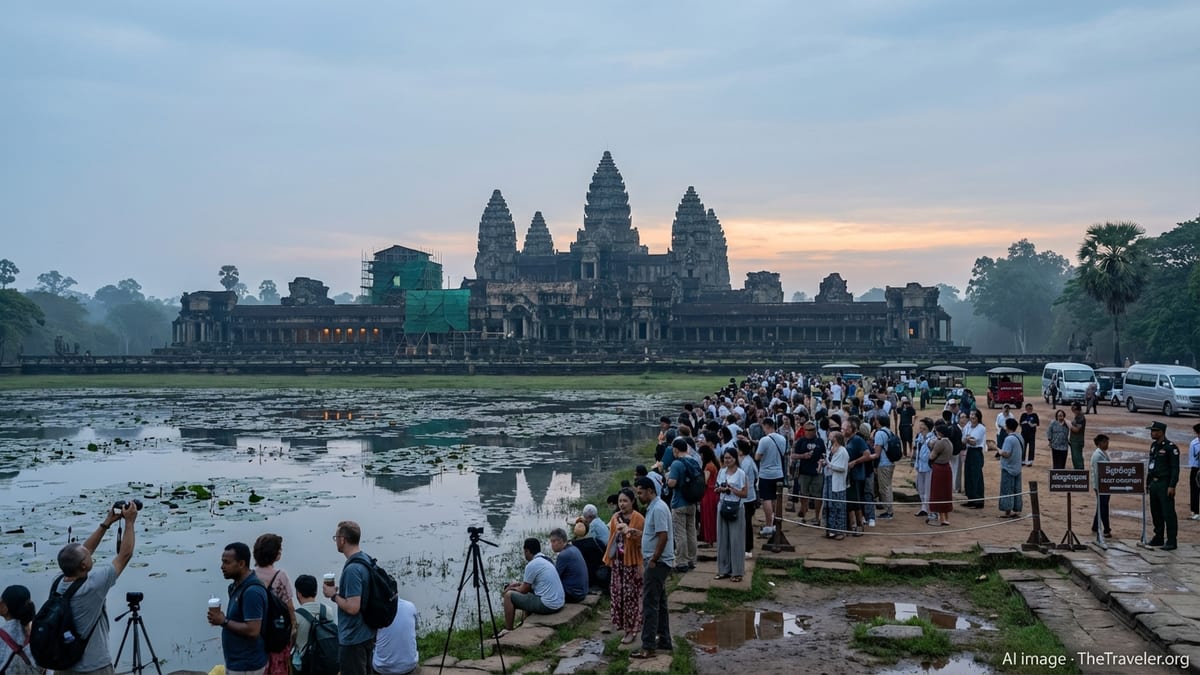
Sunrise at Angkor Wat has become something of a pilgrimage. The classic photograph shows dark temple spires mirrored in still lotus ponds as the sky flames pink and orange. In reality, by 5.00 a.m. in high season you may already find several rows of visitors lined shoulder to shoulder along the water’s edge. Tripods compete for space, tour guides marshal groups, and vendors sell coffee to sleepy travelers. It can feel more festival than meditative, especially on clear mornings when everyone is chasing the same shot.
That said, the experience retains genuine drama. As silhouettes sharpen and the chorus of cicadas and birds rises, the sheer scale of Angkor Wat becomes clear. Many visitors consider the early wake-up worthwhile, but it is important to calibrate expectations. The sky does not always blaze with color; some mornings are grey or clouded. Photographers sometimes discover that their cherished Instagram images were taken with long exposures during rare atmospheric conditions or special celestial alignments. What you see on an average day may be gentler and subtler than the iconic posters suggest.
Crowd patterns follow a predictable rhythm. Sunrise sees the largest concentration at Angkor Wat. After the main event, many tour groups hurry inside the temple, then move on to breakfast and the next sites on the small circuit around 7.30 to 8.00 a.m. That creates a short window when the immediate area around Angkor Wat’s outer galleries can feel noticeably calmer. By mid-morning, attention shifts to Bayon and Ta Prohm. Those temples can be packed between 9.00 a.m. and midday, especially during Christmas, New Year and major Asian holidays, then thin out somewhat in early afternoon when the sun is at its most punishing.
Sunset options are more dispersed. Phnom Bakheng, perched on a hill west of Angkor Wat, remains one of the classic sunset spots. It has a controlled capacity, and during busy seasons visitors are admitted in rotation, which can lead to queues on the path. Pre Rup, another elevated temple, also draws sunset watchers with its warm stone glowing in late light. Alternatively, some travelers simply return to the moat around Angkor Wat for reflections in the opposite direction. Realistically, you should expect company wherever you go at golden hour, but with flexibility and patience you can still find quiet vantage points a little removed from the densest clusters.
Planning Your Route: Circuits, Timing and Energy
Most visitors experience Angkor through two standard driving loops commonly referred to as the small circuit and the grand circuit. The small circuit focuses on the headline sites closest to Siem Reap: Angkor Wat, Angkor Thom and Bayon, Ta Prohm and a handful of other temples. The grand circuit extends further east and north to include places like Preah Khan, Neak Pean and Ta Som. A one-day visit that tries to cover both circuits usually results in rushed photo stops and exhaustion. In reality, each circuit can comfortably occupy a full day if you allow time to linger, rest and absorb the atmosphere.
Tuk tuks, private cars and bicycles are the primary ways to move between sites. Tuk tuks are the most common choice: affordable, open to the breeze, and easy to book through hotels or local drivers. Expect to pay a modest day rate that rises if you include early morning sunrise runs or more distant temples like Banteay Srei or Beng Mealea. Private cars offer air conditioning and faster transfers, but they can feel less connected to the landscape. Cycling is feasible for reasonably fit travelers during cooler months, but traffic on some roads has increased along with tourism, and the midday heat is formidable.
In terms of daily rhythm, the most sustainable strategy usually involves an early start, an extended mid-day break, and optional late afternoon or sunset exploration. Many travelers find that beginning their temple day too late leads to trudging through the hottest hours when crowds are also dense. By contrast, starting around sunrise allows you to see one or two major sites in pleasing early light, retreat to your hotel for lunch, rest and perhaps a swim, then return around 3.30 p.m. for softer light and lower temperatures. With multi-day passes valid across flexible windows, you can also intersperse non-temple days to avoid burnout.
Energy management matters more than on-paper distances might suggest. Even if you are transported between temples, each site demands walking, climbing and standing. It is common for visitors to underestimate how draining the combination of heat, humidity and stone staircases can be. Build short rest stops into your route: sipping a coconut in the shade outside Ta Prohm, pausing by the moat of Angkor Thom, or simply sitting quietly in a shaded gallery for ten minutes. These pauses not only protect your stamina but also allow time for reflection beyond the camera lens.
The Temples Themselves: What You Actually See
Within the park, each of the main temples delivers a different kind of reality that may or may not resemble expectations. Angkor Wat, oriented west and enclosed by a vast moat, reveals itself in layers: first the iconic facade, then long bas relief galleries depicting epic battles and myths, and finally the steep central tower whose upper level offers panoramic views. The interior is more austere than some travelers imagine, but the scale and precision of its architecture are overwhelming. Some areas are cordoned off to protect fragile bas reliefs and sandstone floors, yet there remains ample space to roam.
Angkor Thom and Bayon present a more labyrinthine experience. Entering through one of Angkor Thom’s monumental gates, crowned by four serene faces, you travel along roads through scattered ruins, terraces and pools to reach the central Bayon. Inside, towers sprout above narrow corridors, each tower carved with the enigmatic smiling faces that have become Angkor’s unofficial mascot. The space can feel crowded, but there are also upper and side galleries where fewer visitors linger. Much of the stonework is weathered and darkened, adding to the sensation that you are navigating through a dreamlike, layered monument.
Ta Prohm, made famous by a Hollywood film, leans into the romance of nature reclaiming architecture. Giant silk-cotton and strangler fig trees have grown from collapsed roofs and walls, their roots pouring over stone in sculptural cascades. Conservation teams have stabilized many structures and created a fixed one-way loop through the site to ease congestion. As a result, Ta Prohm is less wild than it once was, but the interplay between massive trees and weathered carvings remains compelling. The loop design does, however, mean you are almost always moving with a flow of other visitors during busy hours.
Further out, temples such as Banteay Srei, with its intricate pink sandstone reliefs, and Beng Mealea, a more heavily ruined complex partly swallowed by vegetation, offer contrasting realities again. At these sites, the sense of remoteness is stronger, though infrastructure has grown here as well with ticket checks, walkways and local vendors. Visiting at quieter times of day can recapture some of the solitude many travelers crave, especially if you are willing to pay for the extra transport time beyond the main circuits.
Culture, Etiquette and the Human Dimension
Angkor is not just an archaeological site; it is a living spiritual and cultural landscape. Cambodian Buddhists still visit Angkor Wat and other temples to light incense, pray or make offerings, and local communities live in and around the park boundaries. Recognizing this human dimension is crucial to understanding what you are seeing and how to behave. The temples were not built as backdrops for travel photography. They were royal and religious centers at the heart of a sophisticated empire that shaped regional history for centuries.
Respectful behavior starts with dress. Lightweight, breathable clothing that covers shoulders and knees is the minimum standard, particularly for entering the inner sanctuaries. Scarves used as improvised shoulder coverings are sometimes accepted, but not always; bringing a proper sleeved top is wiser. Inside shrines still in active use, you may see monks or lay worshippers engaged in quiet rituals. Keeping your voice low, avoiding intrusive close-up photography of people at prayer, and not stepping onto platforms or altars meant for offerings are all part of basic temple etiquette.
Photography etiquette at Angkor is increasingly discussed among guides and conservation staff. While taking photos is allowed almost everywhere, certain practices cause friction: blocking narrow walkways for long shoots, touching or leaning on carved surfaces, climbing into forbidden zones to get a unique angle, or staging elaborate costume sessions that disturb other visitors. Guides will sometimes intervene when they see behavior that threatens the stonework or disrupts the flow of people. A simple rule of thumb is to treat the temples as you would a historic cathedral or museum rather than an open studio.
Local livelihoods are intertwined with tourism throughout the park. Tuk tuk drivers, licensed guides, snack vendors and souvenir sellers all depend on visitors. Many travelers report that the majority are polite and not overly pushy, but you should nonetheless be prepared for solicitations at parking areas and temple entrances. Bargaining remains common for non-ticketed services and goods, yet doing so respectfully and with an awareness of local incomes goes a long way. Tipping guides and drivers is customary when service has been good, and buying water or snacks at family-run stalls can spread benefits more widely.
Common Myths and Misconceptions
Online images and secondhand stories have fostered several persistent myths about Angkor that are worth correcting. One is that the temples are perpetually empty if you arrive early enough. While it is true that you can find quieter corners and times, Angkor Wat, Bayon and Ta Prohm draw significant numbers of visitors throughout most of the year. Even in the so-called low season, there are usually tour buses, regional visitors and independent travelers circulating through the major sites. Solitude is more realistically found at lesser-known temples or by seeking side galleries and back entrances rather than expecting the main viewpoints to be deserted.
Another misconception is that visiting Angkor is a quick tick-box exercise that can be fully appreciated in a single day. In reality, the sheer scale and historical depth of the site argue for a slower approach. A one-day pass can give you headline impressions, but it rarely allows for deeper exploration of bas reliefs, lesser-known temples or repeated visits at different times of day. Multi-day passes, with their flexible validity windows, are designed precisely to encourage a more measured experience and reduce pressure on both visitors and the monuments.
A third myth involves comfort and accessibility. Some travelers assume that because Angkor is a flagship attraction with large tourist flows, it must be fully accessible and easy to navigate. While infrastructure has improved dramatically, particularly with paved roads, signage and basic facilities, many inner temple areas remain physically demanding. Wheelchair users and those with limited mobility can enjoy certain ground-level sections and viewpoints, especially around Angkor Wat’s outer galleries, but upper levels and some inner courtyards are not realistically accessible. Planning with a candid understanding of these limitations prevents disappointment and frustration on arrival.
Finally, there is a tendency to imagine Angkor as frozen in a particular era, either in ancient glory or in the romantic overgrowth of early photographs. The truth is that the site is continuously evolving. Restoration scaffolding moves from one temple section to another, visitor flows increase or shift with new tour patterns, and conservation strategies change in response to scientific research and climate realities. Accepting Angkor as a living, changing place in 2026 rather than an untouched relic helps reconcile expectations with on-the-ground reality.
The Takeaway
In the end, Angkor Wat and its sister temples are neither the empty, mystical ruins of a travel fantasy nor the overcrowded disappointment some fear after reading pessimistic accounts. They are a complex, layered heritage landscape balancing mass tourism, conservation needs and the spiritual life of a modern nation. The reality includes sunrise crowds jostling for space at the lotus ponds, but it also includes quiet corners where bas reliefs glow in slanting light and birds call from trees rooted in ancient stone.
What you can realistically expect in 2026 is a well-organized but busy site with clear ticket rules, active security and a mix of polished infrastructure and rugged terrain. You should be prepared for early mornings, heat, uneven steps and the need to share viewpoints with many others. At the same time, you can expect to be moved by the ambition of the Khmer builders, the delicacy of the carvings, and the sight of towers rising from moats and forests that have outlived empires.
The travelers who come away most satisfied tend to be those who give Angkor time, treat it with respect and arrive with balanced expectations. They plan around the heat, choose multi-day passes, seek both the famous temples and the quieter ones, and remain flexible about crowds and weather. By doing so, they find that the reality of Angkor, with all its imperfections and modern intrusions, offers something deeper than a perfect photograph: a tangible connection to one of humanity’s great architectural and spiritual achievements.
FAQ
Q1. How many days do I really need to see Angkor properly?
Most visitors find that two to three days provide a satisfying balance between the main highlights and a few quieter temples. One day can cover Angkor Wat, Angkor Thom and Ta Prohm in broad strokes, but it often feels rushed. With a three-day pass, you can split the small and grand circuits, revisit favorite sites at different times of day, and still allow for rest during the hottest hours.
Q2. Is the one-day Angkor Pass worth it, or should I choose a multi-day ticket?
The one-day pass is worth it if you are very short on time, but the per-day value of multi-day passes is significantly better. The three-day pass, valid over ten days, is a popular choice because it lets you spread temple visits out and avoid burnout. The seven-day pass suits travelers who want to explore extensively, take rest days and add outlying temples without feeling rushed.
Q3. How crowded is sunrise at Angkor Wat in reality?
Sunrise at Angkor Wat is usually busy, especially between November and February. You should expect several rows of people around the reflecting ponds well before dawn, with more arriving as the sky lightens. The atmosphere is still impressive, but it is not a solitary experience. Arriving early improves your chances of a good viewing spot, and staying after the main crowd leaves can offer quieter moments inside the temple.
Q4. What should I wear to visit the temples?
Lightweight, breathable clothing that covers shoulders and knees is both respectful and practical. Short-sleeved shirts or blouses and loose trousers or long skirts work well. Solid, comfortable footwear with good grip is important because many surfaces are uneven and sometimes slippery. A hat, sunglasses and a light scarf can also help with sun protection and modesty in active shrines.
Q5. Do I really need a guide, or can I visit on my own?
You can visit on your own using maps and background reading, and many independent travelers do so. However, a knowledgeable, licensed guide can greatly enrich your understanding of the history, symbolism and layout of the temples, particularly on your first day. Some visitors choose a guide for one or two days to gain context, then explore additional sites independently once they have a better feel for the complex.
Q6. How physically demanding is a typical Angkor temple day?
Even with vehicle transport between sites, a temple day can be quite demanding. You will likely walk several kilometers over uneven ground, climb steep staircases without handrails, and spend hours in heat and humidity. Most reasonably fit travelers cope well with sensible pacing, hydration and rest stops, but those with mobility challenges or heart and joint issues should plan carefully, consider shorter days and focus on more accessible areas.
Q7. Can I buy my ticket online, or do I have to go to the ticket office?
Angkor Enterprise now offers official online ticket purchases, allowing visitors to buy passes in advance and present digital or printed tickets at checkpoints. Many travelers still purchase at the ticket office on Road 60 upon arrival in Siem Reap, where staff take your photo and issue the pass within minutes. Both methods are valid; online purchase mainly saves queue time during peak periods.
Q8. Are there still quiet temples where I can escape the crowds?
Yes, despite rising visitor numbers, there are many less-visited temples where you can find relative calm, especially outside the peak hours of mid-morning and late afternoon. Sites on the grand circuit and smaller ruins off the main loops often see far fewer tour buses. Going early, staying late, or visiting during the wet season further increases your chances of peaceful exploration.
Q9. How safe is Angkor for solo travelers?
Angkor and Siem Reap are generally considered safe for solo travelers, including solo women, provided you take normal precautions. Petty theft can occur, so keep an eye on bags and valuables, especially at busy viewpoints. Use licensed tuk tuk drivers or reputable tour operators, carry water and sun protection, and inform your hotel of your plans for longer day trips. Most solo travelers report feeling welcomed and at ease.
Q10. What is the best time of year to visit Angkor, realistically?
The cooler, drier months from November to February are the most comfortable and therefore the busiest. You can expect better conditions for sunrise and long days of exploration, but also heavier crowds and higher demand for accommodation. The shoulder seasons around March and October offer a compromise between weather and visitor numbers. The rainy season from June to September brings lush landscapes and fewer tourists, at the cost of frequent showers and higher humidity.