

More news on this day
Thousands of passengers have been stranded across Europe in April 2026 as a succession of severe storms, staffing shortfalls and wider geopolitical pressures combine to disrupt flight schedules at the continent’s busiest airports.
Get the latest news straight to your inbox!
Wave of Disruptions Hits Multiple Countries in Early April
Publicly available data from aviation trackers and travel-industry analysts shows that Europe’s flight network has entered April under acute strain, with several days of exceptional disruption in the first week alone. On April 1, reports indicate that more than 1,600 flights were delayed and over 100 cancelled across England, France, Germany, Greece, Spain and the Netherlands, overwhelming hubs such as Amsterdam Schiphol, Barcelona, Madrid, London Heathrow, Manchester, Paris Charles de Gaulle and Frankfurt.
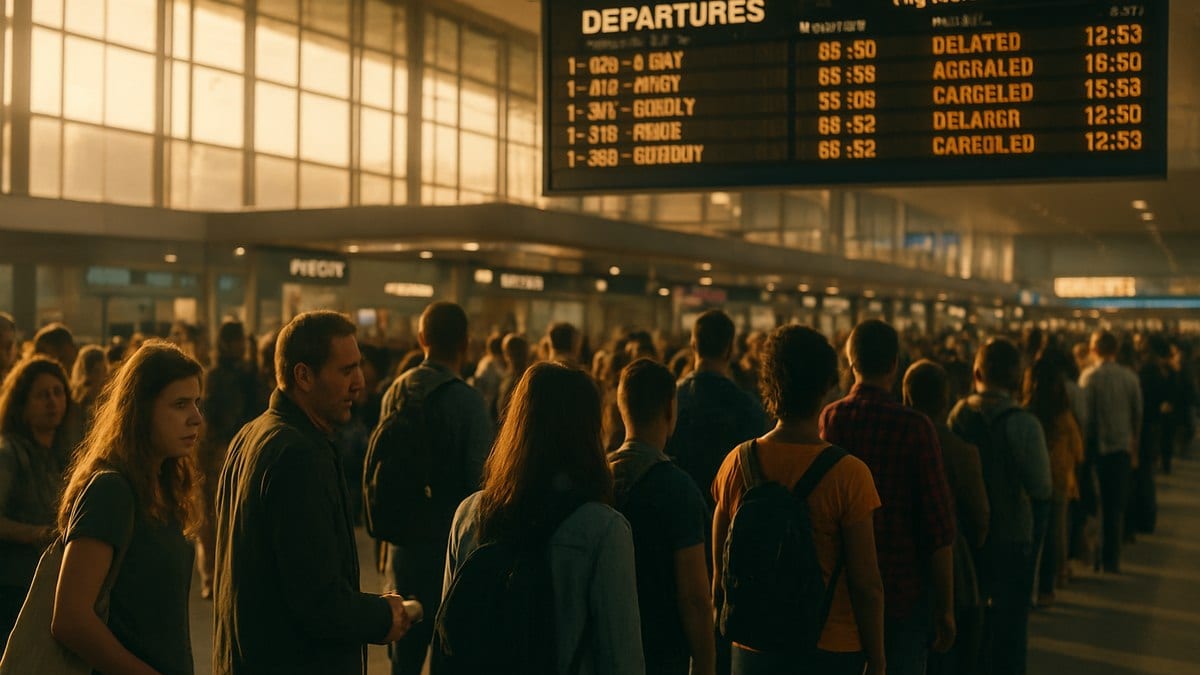
The pattern worsened heading into the first weekend of April. On April 6, coverage from European news outlets described around 1,475 flights delayed and 172 cancelled across the continent, leaving departure boards flooded with rolling changes and forcing many passengers into overnight airport stays. Crowded terminals and long queues were reported from major hubs serving both leisure and business markets.
By April 7, a fresh wave of disruption added to the backlog. Industry summaries for that day point to roughly 1,691 delayed flights and more than 150 cancellations across Germany, the United Kingdom, Denmark, Spain, France and several other states. Airports in London, Paris, Oslo, Amsterdam and major German cities struggled to clear the accumulated congestion, with knock-on delays affecting connecting traffic across Europe and on long-haul routes.
These repeated shocks come on top of an already fragile operating environment carried over from March, when nearly 2,000 delays and dozens of cancellations on some days left thousands stuck at airports in Frankfurt, London, Paris, Barcelona and Amsterdam. The result is a system that entered April with little spare capacity to absorb further weather or staffing problems.
Storm Systems and Severe Weather Batter Key Hubs
Severe early-spring weather is playing a central role in the current chaos. A powerful windstorm identified in meteorological reporting as Storm Goretti swept across northwestern Europe around April 2, bringing snow to northern Germany and strong winds and heavy rain to France, Britain and the Netherlands. Weather advisories and airport notices show that Goretti prompted the cancellation of dozens of flights at affected airports, particularly in northern Germany, and disrupted ground transport to and from major cities.
Independent flight-compensation platforms have also flagged widespread weather-related delays and cancellations at the turn of March and April. One analysis published this week highlighted 471 disrupted flights tied to severe conditions across Western and Northern Europe, citing significant operational pressure at hubs including Frankfurt, Munich, Madrid, London Heathrow and Oslo. These issues often cascade as aircraft and crews arrive late, forcing airlines to push back subsequent departures across their networks.
Weather remained a dominant factor on April 7, when a pan-European mix of thunderstorms and low cloud contributed to 1,445 delays and at least 20 cancellations, according to data collated by travel advisory services. Italy’s main gateways in Rome Fiumicino and Milan Malpensa were among the worst hit, collectively accounting for hundreds of delayed movements as storms rolled across the central Mediterranean.
Because Europe’s largest airports operate close to capacity in normal conditions, even short-lived storms can cause hours of disruption. When these events arrive in quick succession, as they have in late March and early April, there is little opportunity for airlines to reposition aircraft or for airports to clear the backlog before the next weather system arrives.
Strikes, Staffing Gaps and Fuel Constraints Deepen the Crisis
Operational issues inside the aviation system are amplifying the impact of adverse weather. Reports from industry-focused publications describe labour disputes and staffing shortages at ground-handling companies and air traffic control providers in several countries, adding delays at check-in, baggage handling and on the ramp.
Coverage from early April points to nationwide air-transport strike action in Italy and walkouts by ground staff in parts of Spain, which have intensified delays at major hubs such as Milan Malpensa, Rome Fiumicino and Madrid. These actions have forced airlines to consolidate or cancel services and have slowed turnaround times even when weather conditions have been favourable.
Separately, travel and mobility briefings have noted ongoing jet-fuel rationing at some northern Italian airports, a factor that further complicates scheduling and aircraft rotation during peak periods. While airlines continue to refuel at alternative airports or adjust payloads where necessary, any additional constraint on operations reduces flexibility in a system already struggling to recover from repeated shocks.
Staffing shortfalls, particularly among air traffic controllers, continue to limit available capacity in parts of European airspace. Combined with stricter safety margins during periods of poor visibility or high winds, these constraints translate into flow restrictions, holding patterns and ultimately into delays and missed connections for passengers across the network.
Global Tensions and Network Knock-On Effects
The flight chaos unfolding at Europe’s hubs in April is also linked to broader geopolitical tensions that are reshaping long-haul traffic flows. Since late February 2026, the conflict involving Iran has led to partial airspace closures and reroutings across parts of the Middle East, according to publicly accessible aviation and security briefings. These changes have extended flight times on some Asia–Europe and Europe–Gulf routes and have complicated aircraft and crew scheduling.
When long-haul services into Europe run late or are diverted, the disruption quickly spills into short-haul rotations. Aircraft scheduled to operate intra-European services later in the day can miss their slots, feeding additional delays into already congested banks of departures at hubs such as Frankfurt, Amsterdam and London.
Analysts drawing comparisons with earlier crises, such as the large-scale airspace closures during the 2010 volcanic ash event, point out that while April 2026 has not seen a complete shutdown of European skies, the cumulative effect of weather, strikes, staffing shortages and geopolitical pressures is creating similar levels of uncertainty for travellers. Passengers face a higher risk of last-minute changes, longer journeys and unplanned overnight stays, even when their own departure airport appears to be operating normally.
These pressures are particularly acute during the spring shoulder season, when airlines ramp up capacity ahead of the summer schedule and load factors begin to climb. With aircraft and crews already heavily utilized, there is limited slack to recover when a storm or an airspace restriction suddenly removes a block of flights from the network.
Airlines and Airports Struggle to Protect Passengers
Publicly available information from passenger-rights organisations highlights that many affected travellers in Europe are turning to EU261 regulations to understand their entitlements in the current wave of disruption. Under this framework, airlines must provide rebooking or refunds when flights are cancelled, and in some circumstances compensation, although weather-related cancellations are often classified as extraordinary events that limit eligibility for cash payments.
Reports from travel advisory platforms suggest that airlines across the region are offering a mix of free rebooking, vouchers and, where required, hotel accommodation and meal vouchers to stranded customers. However, limited seat availability on alternative services, especially on popular leisure routes, means some travellers are waiting many hours or even days for a viable replacement itinerary.
Airports are meanwhile dealing with surges in unplanned dwell time as passengers wait out delays. Images shared in media coverage depict crowded seating areas, long queues at customer-service desks and families sleeping on terminal floors after late-night cancellations. While operators have deployed additional staff and opened contingency spaces where possible, the sheer scale of the disruption has tested facilities at several major hubs.
Travel experts advise that, with conditions expected to remain changeable through April, passengers flying via Europe’s primary hubs should build in additional time for connections, monitor flight information closely and consider flexible booking options where available. Until weather patterns stabilise and labour disputes ease, Europe’s air travel network is likely to remain vulnerable to further episodes of large-scale disruption.