

More news on this day
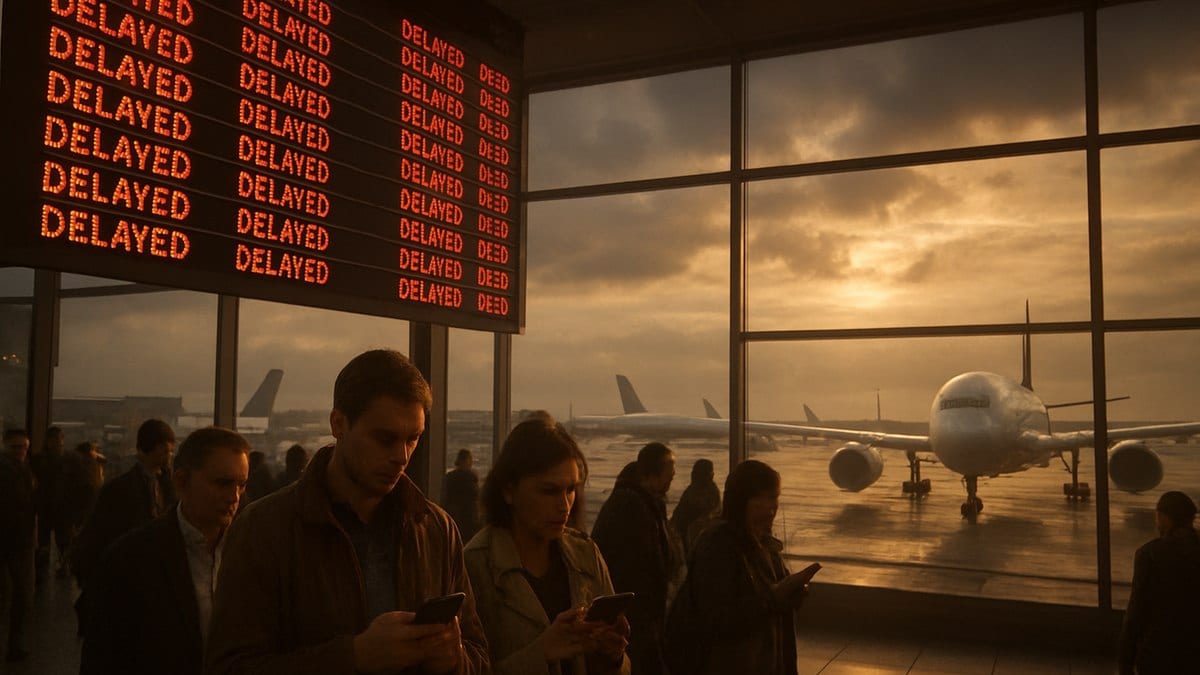
Flight operations in early April 2026 are coming under renewed strain, with publicly available tracking data indicating at least 311 delayed departures recorded across seven countries as a new wave of disruption sweeps key air corridors.
Get the latest news straight to your inbox!
Fresh April Turbulence Across Multiple Regions
The latest round of disruption appears to span North America, Europe, the Middle East and Asia, intersecting with already fragile aviation networks still recalibrating after March’s severe shocks. Industry dashboards and open flight-tracking datasets show a cluster of delays and schedule changes concentrated over a handful of major hubs, with 311 delays tied to services touching seven different national markets so far in April.
Recent coverage of global air travel trends in April highlights a sharp uptick in operational stress, particularly at large connecting airports and along long-haul routes that skirt conflict zones. While thousands of flights continue to operate to schedule, these 311 delays illustrate how quickly bottlenecks can form when weather, congestion and rerouting requirements align.
Analysts reviewing these figures note that the raw number of delayed flights understates the passenger impact. A single disruption at a major hub can cascade through networks, forcing missed connections, aircraft rotations out of place and stretched crew rosters across several countries at once.
Europe and North America Feel the Strain
In Europe, early April has already produced several widely reported episodes of disruption, with delay statistics climbing at airports in the United Kingdom, France and the Netherlands as spring demand ramps up. Coverage of recent events describes more than a thousand delayed flights across the continent on peak days, driven by a mix of unsettled weather, air traffic control constraints and knock-on effects from longer routings around closed airspace.
North American hubs are facing parallel pressures. Reports from aviation data aggregators and travel outlets point to days in April when several thousand flights across the United States alone registered delays, particularly at large connecting hubs such as Atlanta, Chicago, Dallas and New York. In that context, the 311 delayed flights linked to seven nations form part of a much larger pattern of rolling schedule instability.
Publicly available operational data indicates that many of the affected services are short and medium haul, which often bear the brunt of congestion because they rely on tight turnarounds and dense slot schedules. Once departure banks slip by even 30 to 60 minutes, crews and aircraft can fall out of position for later rotations, amplifying the disruption into the evening peak.
Middle East Tensions Ripple Through Global Networks
The seven-nation tally is also being shaped by continuing instability in and around the Gulf region. Since late February, a series of airspace closures, emergency restrictions and security-driven reroutings have forced airlines to redraw flight paths and adjust schedules, with ripple effects that reach far beyond the Middle East itself.
Published briefings from risk consultancies and aviation-focused outlets describe sustained congestion at alternative hubs and longer flight times on routes that previously transited airspace now subject to restrictions. Some carriers have extended suspensions on particular city pairs into late April, and in some cases into the summer season, reallocating capacity to other markets or holding aircraft in reserve.
For passengers, these geopolitical pressures translate directly into delay risk. Flights that remain scheduled must often take longer, more circuitous tracks, consuming additional fuel and narrowing the margin for on-time arrivals. When these aircraft are scheduled to continue onward to a second or third destination, any delay on the initial leg can propagate to new regions and add to the growing April count.
Asia-Pacific Weather and Capacity Constraints
Asia-Pacific networks are contending with their own challenges as seasonal weather systems and infrastructure constraints collide with strong travel demand. In late March and early April, several regional monitoring services documented hundreds of delays and cancellations across key hubs such as Tokyo, Shanghai, Jakarta and Delhi, with thunderstorm activity and heavy rain repeatedly disrupting runway operations.
Travel-industry reporting notes that some Asian airports are operating at or near capacity, leaving little room to absorb irregular operations. When a storm cell closes a runway or an air traffic control system encounters technical issues, airlines may quickly run out of spare gates, parking stands and rested crew, multiplying the impact on scheduled services.
The 311 April delays identified across seven nations include a share of Asia-Pacific routes that connect into Europe and North America. These long-haul flights are particularly sensitive to upstream disruptions; a delay on a short domestic sector feeding a major hub can easily spill into an overnight intercontinental departure, affecting passengers in multiple countries at once.
What Travelers Can Expect for the Remainder of April
With Easter and school holiday travel overlapping in many markets, aviation planners are warning that capacity will remain tight for the rest of April. Publicly available commentary from airline executives and industry bodies suggests that staffing levels and aircraft availability are improving compared with previous years, but not yet sufficient to fully buffer the system from multi-region shocks.
For individual travelers, the pattern of 311 documented delays across seven nations serves as a reminder that even a relatively small share of disrupted flights can have an outsized impact on trip plans. Missed connections, rebookings onto later departures and overnight stays near hub airports remain a realistic possibility, particularly for itineraries involving multiple carriers or tight transfer windows.
Travel specialists advise that passengers booking for the coming weeks build in longer connection times, favor morning departures where possible and monitor flight status closely through official airline and airport channels. Travel insurance policies with disruption coverage and flexible ticket options may also prove valuable in an environment where localized events can quickly translate into cross-border delays.
As April progresses, observers will be watching whether these 311 delays mark the upper edge of a temporary spike or an early signal that global aviation is entering another prolonged period of strained reliability. For now, the data suggests that while most flights continue to operate, the margin for error across interconnected networks remains thin.