

More news on this day
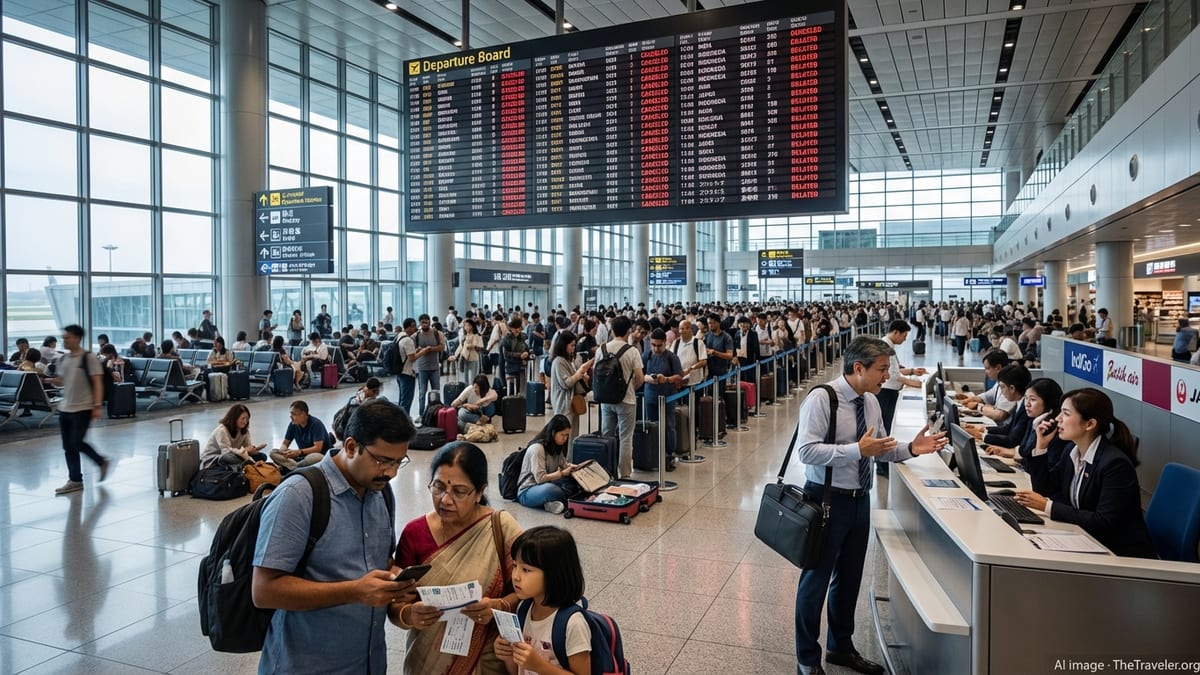
Asia’s aviation network is experiencing one of its most turbulent periods in years, as a wave of delays and cancellations strands thousands of passengers and pulls major carriers including Singapore Airlines into a widening web of disruption.
Get the latest news straight to your inbox!
Singapore Airlines Pulled Into Region-Wide Turbulence
The latest disruption data situates Singapore Airlines among a growing roster of major carriers wrestling with operational headwinds across Asia. Recent schedule adjustments and targeted route cancellations, particularly on services touching the Middle East, place the airline squarely inside a regional pattern of instability that now stretches from Southeast Asia to the Gulf.
Publicly available advisories and passenger reports indicate that Singapore Airlines has been trimming capacity and cancelling selected flights through April, especially on routes exposed to the volatile Middle East airspace. These targeted cancellations, while affecting a fraction of the carrier’s total network, have still contributed to queues at transfer counters and longer-than-usual rebooking times at the airline’s Changi hub.
Network reductions published in recent weeks highlight a strategy focused on consolidating frequencies rather than shuttering entire city pairs. Yet even modest schedule cuts can cascade quickly when load factors are high and alternative seats are scarce, leaving travelers with limited options and extended waits for onward connections.
At Singapore Changi Airport, one of Asia’s key transfer hubs, disrupted Middle East services and higher traffic on Europe and Australia routes have created pressure points at peak times. While most Singapore Airlines flights continue operating, the carrier’s inclusion in a broader wave of regional disruption underscores how little buffer remains in tightly scheduled Asian networks.
Emirates, Qatar Airways and Etihad Struggle With Middle East Bottlenecks
Major Gulf carriers are simultaneously grappling with constraints that are reverberating back into Asia. After the closure and subsequent restriction of airspace over parts of the Middle East, operations at Dubai, Doha and Abu Dhabi have been repeatedly scaled back or reshaped, forcing airlines including Emirates, Qatar Airways and Etihad to thin out frequencies and re-time services.
Recent coverage of airport operations in the United Arab Emirates describes sharply reduced flight movements per hour at Dubai International, resulting in a formal cap on foreign airline services into the city through late May. That cap has hit Indian carriers particularly hard and has complicated the ability of Asian airlines, including IndiGo and others, to maintain normal schedules to the Gulf, feeding further disruption across the region’s transfer flows.
Qatar Airways and Etihad have moved to operate limited but gradually expanding schedules as conditions allow, yet backlogs remain. Passengers transiting through Doha or Abu Dhabi have reported tight connections, missed onward flights and difficulty securing same-day alternatives, particularly on popular Europe–Asia corridors that once relied heavily on plentiful Gulf hub capacity.
For travelers, the practical consequence is that itineraries involving Gulf stopovers are more fragile than usual. A delay on a feeder leg from Asia can now translate more readily into missed long-haul connections, with rebooking options constrained by aircraft and crew availability as well as ongoing airspace and slot restrictions.
Cathay Pacific, China Eastern, IndiGo and Batik Air Face Operational Strain
Beyond the Middle East, mainland Asian and regional carriers are seeing their own operations fray under pressure. Data collated from multiple aviation trackers and industry reports over the past week show China, Japan, India, Indonesia, South Korea and Qatar collectively cancelling hundreds of flights and delaying many thousands more, with airlines such as China Eastern, IndiGo and Batik Air among those most exposed.
One recent regional snapshot described 485 cancellations and more than 6,000 delays in a single day across major hubs including Tokyo, Shanghai, New Delhi, Jakarta and Doha, with China Eastern, Batik Air, IndiGo and Etihad all listed among the significantly impacted airlines. Another report from April highlighted additional waves of disruption across China, Indonesia, Japan, South Korea and the United Arab Emirates, again naming IndiGo alongside Korean and Japanese carriers as facing substantial scheduling challenges.
Low-cost and hybrid carriers such as IndiGo and Batik Air are particularly vulnerable when operations tighten, because their high aircraft utilization and lean spare-capacity models leave little room for error. A single weather closure, technical issue or airspace restriction can ripple across daily rotations, producing rolling delays and a cluster of same-day cancellations that strand passengers far from home or onward connections.
For travelers across South and Southeast Asia, that has translated into crowded customer-service lines, rapidly shifting departure boards and a scramble for remaining seats on unaffected flights. With multiple carriers trimming or rescheduling services simultaneously, switching airlines at short notice has become more difficult and often more expensive.
Knock-On Effects at Key Asian Hubs
The scale of disruption at individual airports further illustrates how widely the turbulence is spread. Recent tallies from aviation data providers and travel-industry publications point to thousands of delayed and cancelled flights across Asia’s busiest hubs in just a few days, affecting cities such as Bangkok, Beijing, Jakarta, Shenzhen, Kuala Lumpur, Hong Kong and Singapore.
One analysis released on April 12 noted nearly 2,700 delays and close to 200 cancellations across Thailand, Hong Kong, Singapore, Malaysia, Indonesia and China in a single reporting window, disrupting carriers such as Singapore Airlines, Cathay Pacific, Air China and leading low-cost operators. A separate breakdown of conditions at key Chinese and Southeast Asian hubs earlier this month logged hundreds more delays and dozens of cancellations concentrated at airports in Shenzhen, Jakarta and Beijing, leaving travelers stuck in terminals for hours.
These localized logjams are interacting with broader network stresses. When Beijing or Bangkok experiences a surge in delays, for example, aircraft and crews arrive late into secondary cities, compressing turnaround times and increasing the likelihood of further knock-on delays. For connecting passengers, what appears at first to be an isolated delay can quickly cascade into missed flights on a different carrier at a different hub.
Moreover, as airlines attempt to protect their most profitable long-haul services, they may opt to cut or consolidate shorter regional sectors instead. That strategy can stabilize flagship routes linking Asia with Europe, North America and Australia, but it does so at the expense of regional connectivity, particularly for smaller cities that rely on a handful of daily departures.
What Travelers Are Experiencing and How Airlines Are Responding
On the ground, passengers are reporting a familiar pattern: long queues at rebooking desks, extended waits for luggage on misconnected journeys and uncertainty over compensation and accommodation when disruptions stretch overnight. Social media posts and traveler forums describe cases of families stranded mid-journey, business travelers missing critical meetings and tourists forced to cut short or re-route itineraries when replacement flights are unavailable for days.
In response, airlines across the region, from full-service players such as Singapore Airlines, Emirates, Qatar Airways and Cathay Pacific to low-cost operators like IndiGo and Batik Air, have issued rolling advisories and schedule updates. Publicly available notices outline temporary suspensions on certain Middle East routes, relaxed rebooking policies on affected services and, in some cases, additional flights or upgauged aircraft where operationally feasible to clear backlogs.
Industry commentary suggests carriers are also leaning more heavily on interline and codeshare partners to move stranded customers, particularly on Europe–Asia flows now bypassing congested Middle East hubs. However, the same network constraints that limit each airline individually also restrict the scope for large-scale recovery through partnership, especially when multiple carriers in an alliance are simultaneously affected by the same bottlenecks.
With high travel demand persisting into the northern summer season, analysts note that Asia’s aviation system is operating with slim margins for disruption. Unless airspace restrictions ease materially and airlines can rebuild buffer capacity, further waves of delays and cancellations remain possible, keeping travelers on alert even as they return to the skies in growing numbers.