

More news on this day
Air travel across Asia is facing fresh turbulence as Singapore Airlines introduces new capacity cuts, joining Emirates, Qatar Airways, Cathay Pacific, China Eastern, IndiGo, Batik Air and Etihad in a widening web of delays, cancellations and stranded passengers from the Middle East to major Asian hubs.
Get the latest news straight to your inbox!
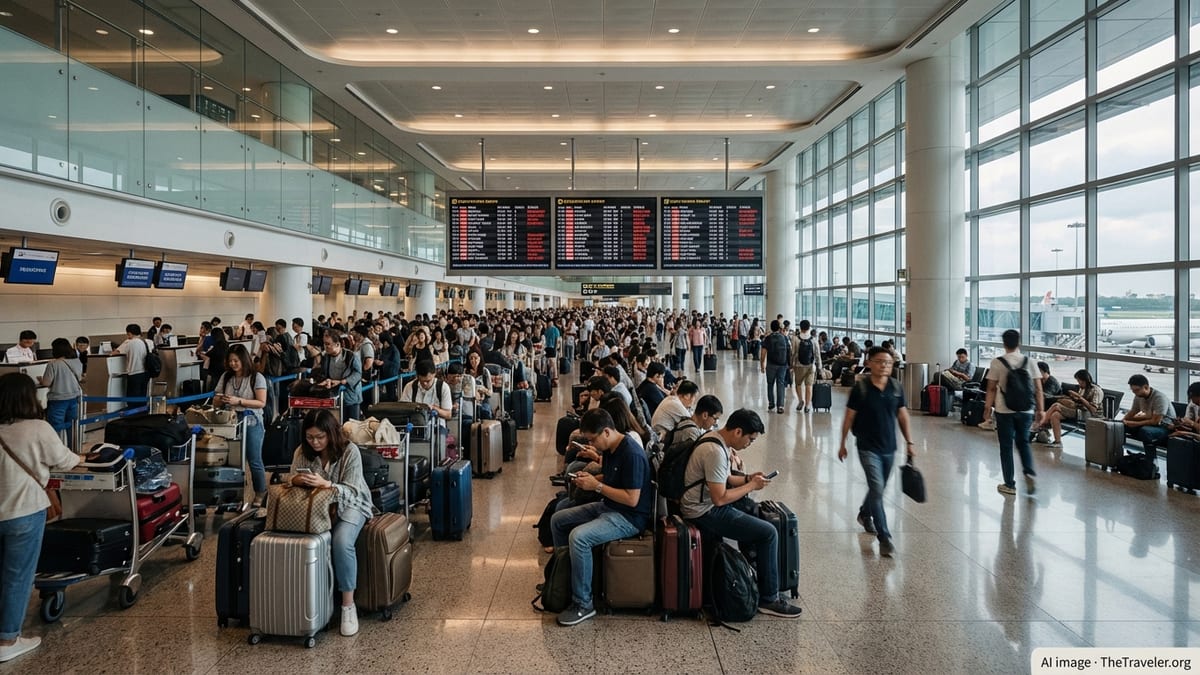
Network Cuts Spread From Gulf Hubs to Asian Gateways
Publicly available schedules and disruption trackers show that airlines linking Asia with the Middle East and Europe are under sustained pressure, with multiple carriers trimming or suspending services on key corridors. Emirates, Qatar Airways and Etihad have been operating on constrained schedules in recent weeks as airspace closures and operational challenges ripple through one of the world’s busiest transit regions.
The knock-on effects are being felt widely across Asia. Updated airline data and regional media coverage indicate that carriers such as Cathay Pacific, China Eastern, IndiGo and Batik Air are all experiencing elevated levels of disruption, particularly on routes connecting to major hubs in the Gulf, East Asia and Southeast Asia. Passengers report longer journey times, unexpected diversions and rolling last-minute schedule changes.
In this context, Singapore Airlines has begun scaling back selected services, placing additional strain on already limited capacity between Southeast Asia, the Middle East and Europe. While many flights continue to operate, reductions on specific days and routes are adding another layer of complexity for travelers trying to navigate the region.
With several of Asia’s largest full-service and low-cost carriers simultaneously adjusting their networks, aviation analysts note that the region’s usual redundancy is diminished, leaving fewer options for swift rebooking when flights are disrupted.
Singapore Airlines Announces Fresh Capacity Reductions
Recent operational bulletins and schedule notices from Singapore Airlines outline a targeted reduction in flight capacity, including the cancellation of selected services over the coming weeks. These adjustments follow a series of earlier schedule fine-tunings and are framed as necessary responses to evolving operational and airspace constraints.
The latest cancellation lists show specific dates where flights are being removed rather than a blanket suspension of entire routes. However, even selective cancellations create significant disruption for passengers with tightly timed long-haul itineraries, especially when connecting from or to other affected carriers such as Emirates, Qatar Airways or Cathay Pacific.
Travel forums and passenger reports describe crowded service desks and heavily loaded call centers as customers seek alternative routings via other Asian gateways. Some travelers have reported being rebooked on partner or competitor airlines days after their original departure date, while others face extended stopovers at regional hubs where hotel capacity and transit services are already stretched.
Singapore’s Changi Airport, normally known for its smooth connections, has seen intermittent surges of stranded travelers when multiple long-haul departures are delayed or cancelled in close succession. Although most airport operations remain stable, the episodic spikes underline how tightly coupled airline schedules are across the region.
Middle East Airspace Constraints Ripple Across the Region
According to published coverage on current airspace restrictions, the Middle East remains a central pressure point, with closures and reroutings disrupting the traditional corridors that link Asian cities with Europe and Africa. Major Gulf carriers, including Emirates, Qatar Airways and Etihad, have all faced substantial operational constraints, at times suspending or limiting services on specific routes.
International airlines such as Cathay Pacific, China Eastern, IndiGo and Singapore Airlines have also adjusted their schedules to and through the region, with some flights cancelled outright and others taking longer, more northerly routings to avoid restricted areas. These changes increase block times, complicate crew scheduling and narrow the margin for maintaining on-time operations.
Reports on Middle East airspace shutdowns highlight that thousands of flights have been affected over recent weeks, with disruptions spilling well beyond the immediate conflict zone. Asia–Europe itineraries that previously relied on smooth connections at Doha, Dubai or Abu Dhabi are now more vulnerable to missed links, missed curfews and sudden schedule resets.
As a result, route-planning tools show a pronounced shift toward alternative hubs in East and Southeast Asia, including Singapore and Hong Kong. Yet as those hubs absorb displaced traffic from the Gulf, carriers like Singapore Airlines and Cathay Pacific are forced to balance increased demand with the operational realities of longer routings and tighter fleet utilization.
Operational Strain for China Eastern, IndiGo and Batik Air
While the spotlight often falls on the largest global brands, regional operators are facing intense pressure of their own. Flight-statistics compilations published this week show China Eastern among the airlines with some of the highest absolute numbers of cancellations and delays across Asia, reflecting the scale of its domestic and international network.
IndiGo, already recovering from a high-profile scheduling crisis in late 2025 that led to thousands of cancellations, continues to face elevated disruption levels on routes to the Gulf and other Middle Eastern destinations. Recent reports note that India-based airlines have intermittently suspended or reduced flights to the United Arab Emirates, Qatar and Saudi Arabia, compounding the difficulty of maintaining reliable schedules in and out of South Asia.
Batik Air, operating across Indonesia and to select regional destinations, has also recorded notable numbers of cancellations and delays at key airports such as Jakarta’s Soekarno-Hatta. With many passengers using Batik Air and other low-cost carriers to connect into long-haul services on Emirates, Qatar Airways, Etihad or Singapore Airlines, disruption on short-haul feeder legs can cascade into missed intercontinental flights.
These operational strains reinforce how interdependent Asia’s aviation network has become. A single day of severe delays at a hub like Shanghai, Jakarta or Delhi can quickly result in stranded travelers as far away as Dubai, Singapore or Hong Kong.
Passengers Face Long Queues, Limited Alternatives and Rising Costs
For travelers, the converging disruptions translate into long queues, uncertain itineraries and, in many cases, higher costs. Reports from airports and online travel communities describe passengers waiting hours to speak with airline staff, only to discover that alternative flights on Emirates, Qatar Airways, Cathay Pacific, Singapore Airlines or their competitors are fully booked for days.
Where replacement flights are available, they often involve complicated routings through multiple hubs, extended layovers or overnight stays at intermediate airports. Some travelers with flexible tickets have opted to delay or reroute their trips entirely, while others remain stranded as they wait for seats to open on already constrained services.
Published analyses of current fare trends suggest that limited capacity, particularly on Asia–Europe and Asia–Middle East routes, is pushing prices higher. With Emirates, Qatar Airways, Etihad, Singapore Airlines and other key players all operating under some degree of constraint, competition is no longer enough to dampen fares on many popular city pairs.
Consumer advocates and travel commentators are encouraging passengers to closely monitor flight-status pages, keep contact details updated with their airlines and build extra time into any itinerary that relies on tight connections through the Middle East or major Asian hubs. As the situation continues to evolve, industry observers note that even well-planned journeys can be upended with little warning when airspace restrictions or operational snags appear.