

More news on this day
From crowded immigration halls to climate-disrupted flight schedules, global travel is undergoing a live stress test. Across Asia, governments, airports and tourism hubs are treating that pressure as a catalyst, racing to redesign how visitors move, spend and behave in ways that can withstand surging demand and mounting environmental and social strain.
Get the latest news straight to your inbox!
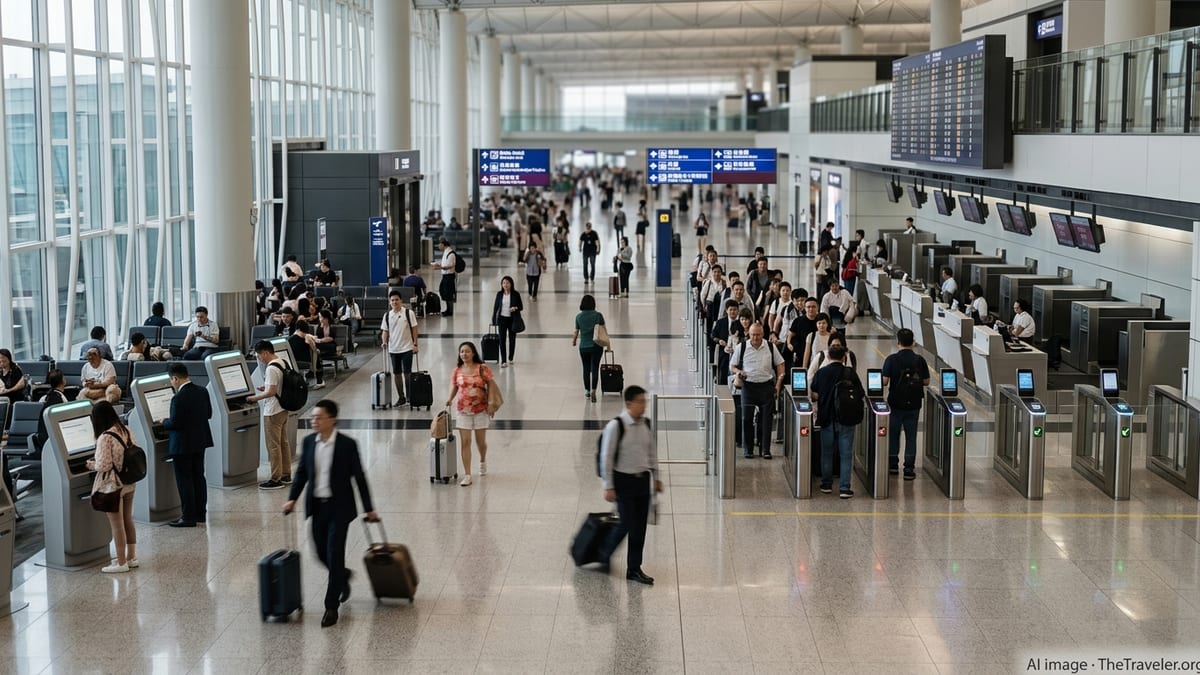
Biometric Borders Turn Asia into a Live Laboratory
Asia’s major gateways are accelerating a shift toward automated, document-light travel, pushing biometric systems from pilot projects into everyday infrastructure. In Singapore, the Immigration and Checkpoints Authority has reported that nearly all passengers at Changi Airport now clear immigration via automated lanes, with facial and fingerprint biometrics replacing manual checks at traditional counters. Authorities have been expanding these systems beyond air terminals to land crossings and cruise facilities, supported by new legislation that enables passport-free departures for many travelers.
Publicly available material from Changi Airport Group shows that this rollout is part of a broader “fast and seamless travel” strategy that pairs self-service bag drops and automated boarding gates with back-end analytics to manage surges. Singapore’s long-term planning assumes traveler volumes climbing toward hundreds of millions of movements a year, a trajectory that has forced airports to lean on automation rather than simply add staff or build more conventional counters.
The trend is regional rather than isolated. Surveys of airport technology deployments across Asia Pacific indicate that biometric boarding, automated security checks and digital bag-tracking are advancing rapidly in hubs such as Hong Kong, Seoul and Tokyo. These systems are not just about speed; they are being framed as resilience tools, intended to keep passenger flows moving during staffing shortages, health checks or sudden shifts in demand that strain traditional operations.
While privacy and data protection concerns remain part of the public debate, the region’s travel infrastructure is effectively being hardened through software. The same biometric corridors that shorten queues in normal times are being designed to give authorities more levers to prioritize vulnerable passengers, redirect flows between terminals and maintain throughput when travel patterns change abruptly.
Japan Uses Data and Rules to Tackle Overtourism
Nowhere in Asia is the stress on destinations more visible than in Japan, where inbound tourism has surged to record highs since borders fully reopened. Government white papers and economic reports describe foreign visitor spending hitting new peaks, even as local communities complain about congestion, noise and strains on transport and housing in hotspots such as Kyoto, Hakone and parts of Hokkaido. Overtourism has shifted from a niche policy concern to a national political issue.
Recent planning documents from Japan’s tourism authorities outline a multi-year effort to disperse visitors and manage behavior rather than simply market more arrivals. Budgets have been allocated to what officials describe as “emergency measures” against overtourism, including capacity management at sightseeing sites, support for local councils designing their own congestion plans, and investment in digital tools that monitor crowd density around stations and popular viewpoints.
Local initiatives are multiplying. Municipalities have begun experimenting with higher accommodation taxes, restrictions on day-tripper numbers at certain onsen towns and new rules around access to photogenic streets or viewpoints that have gone viral on social media. Reports from international outlets highlight barriers installed near iconic Mount Fuji photo spots and booking systems for traditional districts in Kyoto as emblematic of a new willingness to trade unfettered access for predictability and community relief.
Japan’s experiment points to a broader regional pivot: the realization that tourism growth targets have to be balanced by social license. The tools being tested range from dynamic pricing and time-slot tickets to visitor education campaigns and stricter enforcement of traffic or parking rules. The goal is not to deter travel altogether, but to convert the stress test of record crowds into a template for more sustainable visitor flows.
Airport Expansions Aim for Flexible Capacity, Not Just Size
Alongside digital upgrades, Asia’s physical airport networks are being reconfigured to cope with sudden shifts in demand. In Bangkok, Suvarnabhumi Airport has opened a satellite concourse connected by an automated people mover, part of a staged expansion designed to relieve pressure on gates and baggage systems while allowing operations to be adjusted as traffic ebbs and flows. Official reporting by the airport operator describes the project as a key step in handling tens of millions more passengers without overwhelming the original terminal.
In Hong Kong, Seoul and major Indian and Southeast Asian hubs, recent industry briefings and airport rankings point to similar strategies: modular terminals, flexible gate areas and multi-level transfer corridors that can be switched between domestic and international use as schedules change. Rather than a single monolithic terminal, airports are increasingly conceived as clusters of interoperable spaces stitched together by automated transport, centralized security and shared baggage infrastructure.
These expansions are being tested not only by volume but by volatility. Episodes of extreme weather, regional smog, and shifting airline route networks have exposed the fragility of tightly packed schedules and limited runway capacity. The response has included both concrete and code: new taxiways and stands, but also air-traffic optimization projects that use predictive models to sequence landings and reduce holding times around congested hubs.
Industry analysis suggests that Asia’s airports are adopting a layered resilience mindset. Additional piers and satellites create physical slack in the system, while integrated control centers, data dashboards and collaborative decision-making platforms give operators more options to reshuffle flights or reassign resources when disruptions cascade. The stress test is reshaping how airports are planned decades into the future.
Visa, Tax and Policy Tweaks Rewire Travel Demand
Beyond hardware and software, Asian governments are quietly using policy levers to shape who travels, when and where. A wave of new or adjusted visa schemes across the region has sought to attract higher-spending visitors, simplify entry for select markets and encourage longer stays that generate more stable economic benefits. At the same time, certain destinations are raising targeted fees or taxes to fund infrastructure upgrades and offset local impacts.
Japan’s recent tourism policy debates, for example, have featured proposals to increase some fees paid by foreign visitors, with the stated aim of channeling additional revenue into crowd-control measures, environmental protection and enforcement. Elsewhere in the region, popular beach and island destinations have introduced environmental levies or entry fees, signaling that unconstrained, underpriced access is no longer assumed.
Conversely, several Asian states have expanded visa-free entry or digital travel authorizations for key markets to stimulate recovery and compete for tourists who might otherwise look to Europe or the Americas. Public information from regional tourism boards shows a patchwork of trial waivers, seasonal schemes and multi-country promotions designed to nudge travelers toward off-peak periods or lesser-known destinations.
The cumulative effect is that travel demand in Asia is increasingly shaped by an evolving matrix of digital pre-clearance, differentiated fees and behavioral expectations. The region is using the current stress on its tourism systems as an opportunity to fine-tune the incentives that determine not just how many people arrive, but how they distribute themselves and what they contribute once on the ground.
Climate and Health Shocks Keep the Pressure On
Underlying all these adaptations is a recognition that the shocks battering travel are unlikely to fade. Recent seasons of haze in parts of Southeast Asia, heatwaves across major cities and more frequent extreme weather have periodically disrupted flights, closed attractions and reduced visibility at airports. Pandemic-era health checks and border controls, though largely dismantled, left behind public expectations that systems should be able to ramp back up quickly if needed.
Asian transport and tourism planners now talk in terms of “future-proofing” rather than short-term fixes. Airport sustainability reports and regional climate-risk assessments emphasize investments in more efficient cooling systems, resilient power supplies and flood safeguards, alongside operational playbooks for diverting flights or rescheduling events when air quality or storms cross critical thresholds.
On the health side, contactless processing, touch-free payment systems and digital health record infrastructure have been folded into mainstream travel technology. Even as entry requirements ease, the underlying platforms are being maintained and upgraded so they can be reactivated if a new outbreak or global emergency emerges. The stress test of the early 2020s has left an enduring expectation that high-volume hubs can flex in response to sudden health guidance.
For travelers, the changes are most visible in the proliferation of QR codes, biometric gates, time-slotted attractions and pre-trip registrations that now define many journeys across Asia. For the region’s tourism industry, those same systems are the scaffolding of a more adaptive model, one that treats disruption not as an anomaly but as a design constraint for the next era of global mobility.