


High on the Acropolis in Athens, travelers still find two quiet traces of a divine rivalry: a small saltwater well said to be Poseidon’s, and an olive tree that recalls Athena’s original gift. Together they preserve one of Greece’s most important foundation myths, the contest for Athens, when two powerful gods vied to become patron of the city and leave their mark on its rocky hill.
Get the latest updates straight to your inbox!
The divine contest for a city on a rock
According to Greek mythology, the land that would become Athens was once known as Kekropia, ruled by the serpent-tailed king Kekrops. When the Olympian gods noticed this thriving settlement atop a limestone hill, both Poseidon, god of the sea, and Athena, goddess of wisdom and warfare, wanted it as their own. The dispute reached such intensity that Zeus himself intervened and ordered a contest: each god would offer a gift, and the people, or their king, would choose which benefactor would become the city’s patron.
Ancient authors like Herodotus, Apollodorus and Pausanias describe versions of this myth, but they agree on its essentials: the contest took place on the Acropolis, the city’s sacred rock, with the people of Athens looking on. The Acropolis that travelers see today, with its marble temples and viewing platforms, still reflects that memory. Guides on modern walking tours regularly stop between the Parthenon and the Erechtheion to point out where the myth says each god struck the ground, inviting visitors to imagine the hill as a divine arena rather than just an archaeological site.
For Athenians of the classical period, this story was not just entertainment. It was a charter myth explaining why their city bore Athena’s name, why it prized olives and ships, and why its public art showed gods locked in dramatic rivalry. When you stand at the western end of the Parthenon and look up at the ruined pediment, you are looking at the remains of a sculpted scene that once showed this very contest, Athena and Poseidon frozen in the moment of striking the earth with spear and trident.
Poteidon’s salt spring and the promise of the sea
Pausanias and later writers tell us that Poseidon went first. Striding onto the bare rock of the Acropolis, he raised his trident and smashed it into the limestone. At that spot a saltwater spring burst from the ground, sometimes described as a small sea or well, its waters churning and murmuring with the sound of distant waves. The spring was called the “sea of Erechtheus,” and for Athenians it stood for Poseidon’s strength as Earth-shaker and lord of the oceans.
Today, travelers visiting the Erechtheion on the north side of the Acropolis can still peer through floor openings down to a cavity in the rock associated with that legendary spring. The chamber is dim and often echoing, and on guided tours you may hear the story of how ancient visitors listened for the splash of salt water or the rumble of subterranean waves. The north porch roof preserves a small opening that tradition links to the trident’s blow, a tangible architectural reminder of the god’s rejected gift.
Although the water was salty and undrinkable, the spring carried a practical symbolism. In some versions of the myth, Poseidon also offered the first horse, tying him to land power and chariot warfare. In others, the spring itself signaled naval might and sea trade. For a city that would later command the powerful fleet that defeated the Persians at Salamis and dominate Aegean commerce, the association with Poseidon’s sea gift made sense. When modern visitors stand on the Acropolis and look outward to the Saronic Gulf, they are seeing the maritime horizon that Poseidon’s gift implicitly promised to the city.
Athena’s olive tree: a quiet revolution in the soil
After Poseidon’s dramatic display, Athena stepped forward. Rather than thunder and surf, she offered something smaller and quieter. She struck the earth with her spear and produced an olive tree, the first of its kind in Attica according to the myth. Where Poseidon’s gift roared, hers simply took root. Yet that modest plant symbolized peace, stability and the long-term prosperity of the land.
The olive was a practical marvel. From its fruit, Athenians could press oil for cooking, lighting homes, and anointing athletes. The wood could be shaped into tools and carved cult statues; the leaves crowned Olympic victors. In a dry Mediterranean climate, the olive’s resilience and long lifespan turned it into a fitting emblem of a city that aspired to endurance rather than mere conquest. The myth compressed this agricultural reality into a single, decisive moment, but for farmers in Attica, the advantages of widespread olive cultivation played out over generations.
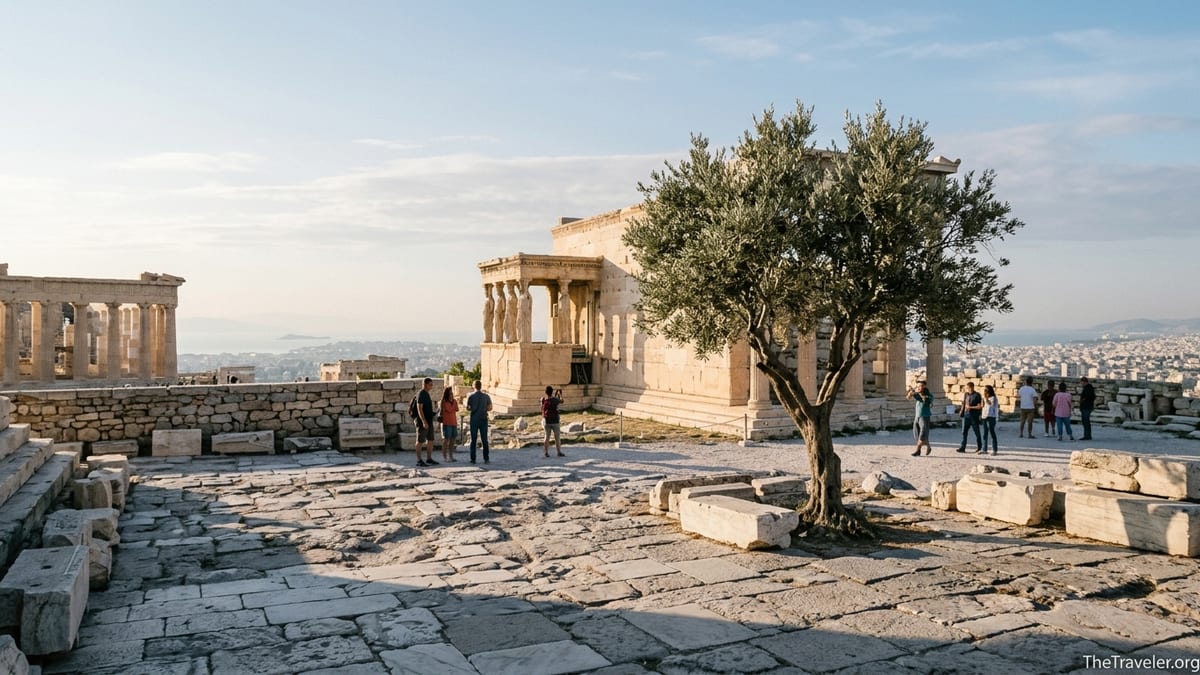
On the Acropolis today, just west of the Erechtheion, a lone olive tree grows in a small walled plot. It is not the original sacred tree, of course, but a modern descendant replanted to mark the legendary spot. Travelers will often see groups pause here for photos, the silver-green leaves framing the columns in the background. Local guides like to point out that while the marble around it has cracked and eroded in the summer heat and winter rains, the olive continues to thrive, re-sprouting even after damage. In 1917, when a fire damaged a previous tree, Athenians replanted a shoot taken from it, a living illustration of the myth’s theme of regeneration.
Why Athena won: utility, identity and a vote that echoed through time
Ancient versions differ on exactly who judged the contest, but a common story says that King Kekrops or the citizens themselves weighed the gifts. The olive tree, though less spectacular, was simply more useful. Salt water could not irrigate fields or quench thirst, and horses, powerful as they were, required significant resources to raise. The olive, by contrast, promised food security, trade goods, fuel and a commodity that could be stored and shipped. In effect, Athena offered a development strategy tailored to the rocky soil and dry climate of Attica.
Some later accounts add a political twist: the men of Athens supposedly voted for Poseidon, the women for Athena, and the women outnumbered the men by one vote. Poseidon, enraged at the result, flooded part of Attica. As a result, the story claims, women were barred from future assemblies and children ceased to bear their mothers’ names. Whether or not this was a serious explanation or a later folk elaboration, it shows how Athenians used the myth to explore issues of civic power and identity, projecting debates about gender, citizenship and divine favor back into mythical time.
In everyday terms, travelers can still sense Athena’s victory embedded in Athenian culture. Look at a modern one-euro Greek coin in your wallet and you may find the owl of Athena, another of her symbols, flanked by an olive sprig. Browse souvenir shops in Plaka and you will see endless variations of Athena’s helmeted profile accompanied by olive branches on ceramics, postcards and jewelry. In tavernas across the city, small bowls of olives and plates drizzled with olive oil arrive at the table as a matter of course, not luxury. Without quoting statistics, it is fair to say that Greece remains one of the world’s leading producers of olive oil, and Attica’s hills still support olive groves that connect the present economy to the ancient goddess’s mythic gift.
The myth written into stone: Acropolis sites travelers can still visit
The power of the Athena and Poseidon story is not only in texts, but in the Athenian landscape itself. For modern visitors, the Acropolis functions as an open-air map of the myth. On the west pediment of the Parthenon, sculptors once carved the contest between the two gods, with Athena and Poseidon at opposite corners and the olive tree likely placed between them. Though the figures are now fragmentary, museum displays in the Acropolis Museum arrange surviving blocks to help visitors visualize the original composition, and exhibit labels explain its connection to the city’s founding story.
The Erechtheion, built between roughly 421 and 406 BCE, embodies the compromise that followed Athena’s victory. The temple is unusual, with multiple levels and porches that accommodate the uneven bedrock and several cults. Inside, Athenians honored both Athena Polias, protector of the city, and Poseidon-Erechtheus, reflecting a fusion of the sea god with an early local hero. One chamber housed the sacred olive tree, another the saltwater well and trident marks. Travel writers often point out that the building’s asymmetry, which can seem puzzling compared to the Parthenon’s regularity, makes sense once you understand that it was constructed to enclose and display the physical traces of the myth.
Today’s travelers will recognize the Erechtheion most easily by its south porch, where the famous Caryatids support the roof. Just around the corner, on the north side, guides draw attention to the trapdoor in the floor associated with Poseidon’s well. Standing there on a busy summer morning, surrounded by tourists and cameras, it can be striking to realize that Athenians once climbed to this same spot not to take photographs but to witness the stones and water that proved their goddess’s claim on the city.
From myth to mindset: how the story shaped Athenian identity
Beyond physical landmarks, the contest myth influenced how Athenians understood themselves. By choosing Athena and the olive tree, they cast their community as one that valued skill, strategy and long-term planning over brute strength or sudden spectacle. Athena was a war goddess, but specifically of wise, tactical warfare; she also patronized craftspeople, from potters to weavers. Athenians could therefore imagine their democracy, navy, legal system and artistic output as extensions of her character.
This self-image appears in Athenian coinage and public art. The famous silver tetradrachms of the fifth century BCE show Athena’s head on one side, framed by an olive sprig, and her owl on the other, with an additional sprig and crescent. When you encounter these coins today in museum displays in Athens, London or Paris, their design reads like a miniature logo: the city presents itself to the world as clever, watchful and rooted in the olive. On painted vases, Athena’s armor often appears alongside curling olive branches, visually fusing military might with agricultural prosperity.
The Panathenaic festival, held every four years, further reinforced the connection. During this celebration, Athenians processed from the city walls up to the Acropolis, carrying a new embroidered robe for Athena’s ancient wooden statue and presenting offerings of olive oil stored in large ceramic amphorae. Modern visitors can see some of these prize amphorae, decorated with Athena and olive motifs, in the National Archaeological Museum. The festival’s focus on oil and the goddess’s image made the link between myth, daily life and civic pride impossible to miss.
Even the city’s political choices found reflection in the story. When Athens built its empire on the strength of its fleet, it could still claim to have chosen Athena’s path, since her wisdom guided naval strategy and diplomacy, and olive oil exports helped finance ships and rowers. Later philosophers, including Plato and Aristotle, operated in a cultural environment where Athena’s victory had long since been accepted as a kind of founding vote in favor of reason and measured development.
Reading deeper: historical echoes behind the legend
Modern scholars sometimes interpret the contest myth as preserving memories of older religious and social shifts. Before Athens became the city of Athena, some evidence suggests that Poseidon or a related sea or earth god may have held greater prominence in the region. The story of a rivalry resolved in favor of a new goddess could encode the way a local cult of Athena gradually displaced or absorbed an earlier Poseidon cult, especially at sites like the Erechtheion where the two deities share space.
From a more practical angle, the myth captures the economic logic of the region. Attica’s thin soils and limited freshwater supply made intensive grain agriculture difficult, while its long coastline and hills favored olives, vines and maritime trade. Athena’s tree represents an adaptation to these constraints: grow crops that can survive in dry, stony terrain and trade the surplus oil and wine abroad. Poseidon’s spring, attractive in principle, does little to solve the everyday problems of drinking water scarcity and soil management that ancient Athenians faced.
For travelers interested in this historical dimension, walking tours that combine the Acropolis with the ancient Agora and Kerameikos cemetery can be especially revealing. In the Agora museum, displays of olive presses, storage jars and commercial weights turn the myth’s abstract symbolism into artifacts you can view at arm’s length. In the surrounding countryside of Attica, visitors can book day trips to family-run olive groves, where producers explain traditional cultivation methods and tastings highlight the diversity of local oils. Hearing a modern farmer talk about drought-resistant trees and export markets provides a contemporary echo of the choices embedded in the ancient legend.
The Takeaway
The story of Athena, Poseidon and the olive tree is more than a charming tale attached to ruined temples. It is a narrative that helped Athenians explain their city’s name, justify their economic foundations and define what kind of people they aspired to be. Athena’s victory signaled a commitment to patient cultivation and strategic thinking, while Poseidon’s lingering presence in the Erechtheion and in Athenian festivals acknowledged that the sea and its unpredictable power still mattered.
For modern travelers, understanding this myth can transform a visit to Athens. The trident marks in the rock, the replanted olive tree, the carved figures on museum pediments and the olive oil on your lunch table all become part of the same story. As you stand on the Acropolis and look out over the dense, modern city to the glinting sea, you are seeing the landscape that made the contest’s gifts meaningful: a dry, stony peninsula that chose, at least in its imagination, the slow reward of a tree over the roar of a wave.
In that choice, Athens found a symbol that could outlast wars, political upheavals and the erosion of its own monuments. The olive tree’s deep roots and steady growth remain a fitting emblem for a city that has repeatedly reinvented itself while still claiming descent from a goddess’s single stroke of the spear on a rocky hill.
FAQ
Q1. Where on the Acropolis did the contest between Athena and Poseidon supposedly take place?
The contest is said to have taken place on the summit of the Acropolis, roughly where the Parthenon and Erechtheion stand today, with Poseidon’s spring and Athena’s olive tree preserved in and around the Erechtheion.
Q2. Can visitors still see traces of Poseidon’s gift in modern Athens?
Yes. Inside the Erechtheion, floor openings and a rock cavity are associated with the ancient saltwater spring and the marks of Poseidon’s trident, which guides often point out during Acropolis tours.
Q3. Is the olive tree on the Acropolis today really Athena’s original tree?
No. The current tree is a modern descendant planted on the traditional spot. Ancient sources describe a sacred olive there, but the present tree is a symbolic continuation rather than the original.
Q4. Why did the Athenians choose Athena’s olive tree over Poseidon’s salt spring?
The olive tree offered long-term practical benefits: food, oil, wood and trade goods suited to Attica’s climate and soil. The salt spring, by contrast, provided no fresh water and had limited everyday use.
Q5. How did this myth influence Athenian coins and art?
Athenian coins often show Athena’s head with an olive sprig and her owl, and temple sculptures, especially the Parthenon’s west pediment, depicted the contest, visually reinforcing the city’s connection to the goddess and the olive.
Q6. Did Athenians still honor Poseidon after Athena won the contest?
Yes. Poseidon continued to receive worship, especially in his merged form as Poseidon-Erechtheus within the Erechtheion, and in festivals linked to the sea and agriculture, reflecting his ongoing importance.
Q7. Are there guided tours that explain the Athena and Poseidon myth on site?
Many Acropolis and city walking tours include explanations of the contest, stopping by the Erechtheion and the modern olive tree to connect the myth with visible features on the hill.
Q8. How does the myth relate to Athens’ historical navy and sea power?
The myth balances Athena’s land-based olive economy with Poseidon’s sea gift. Historically, Athens became a major naval power, so the story allowed Athenians to see their maritime success as operating under both deities’ spheres.
Q9. What role did olive oil play in ancient Athenian life beyond the myth?
Olive oil was essential for cooking, lighting, religious offerings and athletics. Panathenaic prize amphorae filled with oil from sacred groves show how central olives were to the city’s economy and rituals.
Q10. How can travelers today best experience the legacy of Athena’s olive tree?
Visitors can combine an Acropolis visit, including the Erechtheion and its olive tree, with trips to nearby olive groves in Attica and meals featuring local olive oil to experience the myth’s legacy in landscape and cuisine.