


More news on this day
Rail passengers on several busy routes are facing timetable changes, diversions and reduced frequencies after a substation fire disrupted power supplies and forced operators to redraw schedules at short notice.
Get the latest news straight to your inbox!
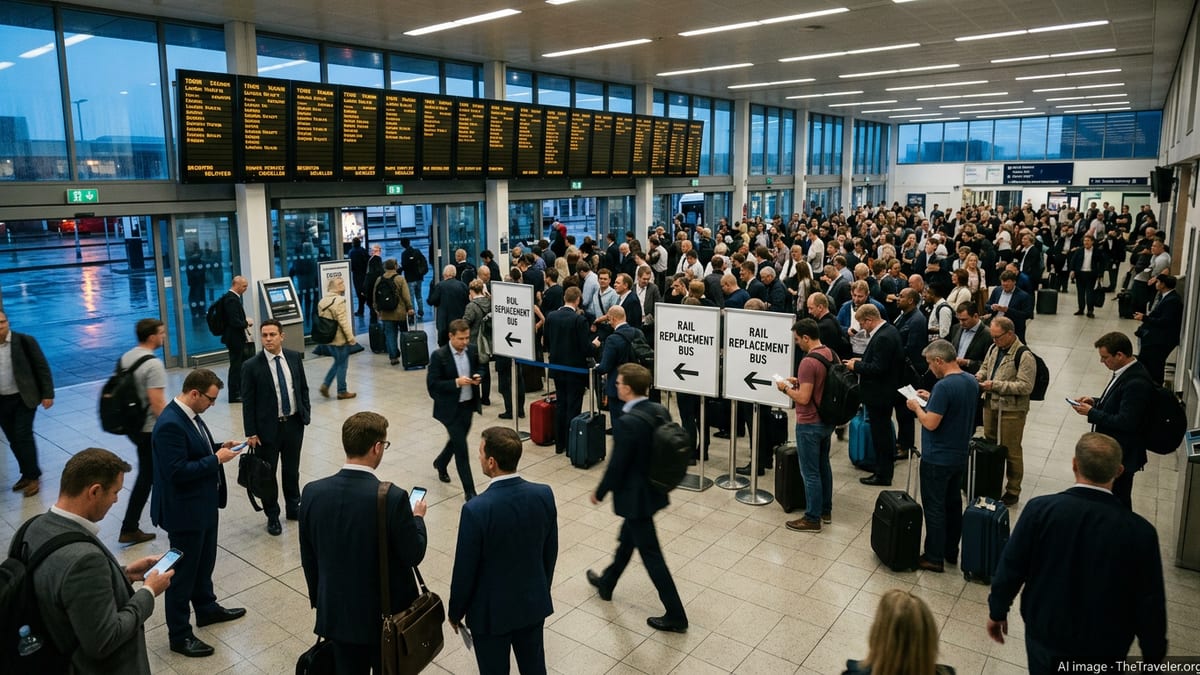
Power failure triggers wide‑ranging rail disruption
According to published coverage and operator updates, the fire in an electrical substation serving a key stretch of main line infrastructure led to an abrupt loss of traction power, signalling interruptions and the temporary isolation of several tracks. Initial reports indicate that trains were halted in the affected area while engineers assessed damage to cables and switchgear and implemented contingency power feeds where possible.
With sections of the network effectively without power, rail operators and infrastructure managers activated disruption plans that prioritize safety, controlled evacuations where necessary, and the orderly movement of stranded trains out of the impact zone. Publicly available information shows that control rooms rapidly imposed speed restrictions and blocked access to damaged sections, immediately cutting capacity on what is normally a high‑frequency corridor.
As it became clear that repairs would take more than a few hours, planners shifted from short‑term holding patterns to medium‑term timetable alterations. Instead of simply canceling services in real time, they began recasting the working timetable, removing some trains from the plan entirely, altering stopping patterns on others and arranging rail‑replacement buses around the worst bottlenecks.
Reports indicate that this staged response is designed to give passengers a predictable, if reduced, service while engineers continue inspections and equipment testing at the substation site. In similar past incidents, damaged transformers and feeder cables have taken days to return to full capacity, and rail planners appear to be working on the assumption of an extended, but finite, recovery period.
Temporary timetables, diversions and bus links
Publicly posted travel updates show that the most immediate impact for passengers is a temporary timetable on several commuter and regional routes. Early‑morning and late‑evening services are among the first to be withdrawn, freeing train paths for the busiest peak‑time services and giving maintenance teams larger overnight access windows to repair equipment.
On some lines, trains that would normally run through the affected power section are being turned back short at major hubs, with connecting services or buses bridging the gap. In other cases, operators are diverting selected intercity trains over slower, alternative routes that still have reliable power feeds, adding extra minutes to journey times but maintaining a basic through service.
Information published by infrastructure managers indicates that signaling and power redundancy limit the number of trains that can be safely run in the constrained area. This has prompted operators to thin out stopping services and prioritize longer‑distance or high‑capacity trains where possible, a strategy often used in response to severe infrastructure failures.
Replacement buses are being deployed around the worst‑affected stations, particularly where no practical rail diversion exists. These services are running at irregular intervals and are heavily influenced by local road traffic conditions, meaning journey times are variable and connections with rail services cannot always be guaranteed.
Passenger advice: check journeys, allow more time
Based on the latest public notices, travelers are being urged to check departures immediately before setting out, rather than relying on printed timetables or previously saved journey plans. Some operators have updated digital journey planners to reflect the reduced timetable, while others are publishing day‑by‑day summaries of cancellations, shortened trains and diversion patterns.
Rail planners caution that even the revised timetable remains sensitive to further disruption. With less operational flexibility and fewer spare train sets in circulation, minor delays can escalate quickly and cause knock‑on cancellations later in the day. Passengers making time‑critical trips, such as airport connections or onward long‑distance travel, are being advised by publicly available information to build in additional contingency time.
Season‑ticket holders and regular commuters are also being encouraged to consider shifting their journeys outside the busiest peaks where possible, helping to relieve pressure on the most crowded trains. Some operators are signposting alternative routes that may be slightly longer in distance but less exposed to the substation‑related constraints.
Published guidance notes that passengers whose trains are significantly delayed or canceled may be eligible for delay‑compensation schemes, depending on the operator and ticket type. Refund policies vary, but in previous large‑scale disruptions, rail companies have typically relaxed certain conditions to reflect the difficulty of completing journeys as originally planned.
Engineering recovery and the push for resilience
Technical documentation on rail power systems explains that a fire affecting a high‑voltage substation can damage transformers, switchgear, feeder cables and control systems that are critical for keeping electric trains moving. Even where damage is limited, inspection, testing and staged re‑energization are required before full power can be restored, which in turn keeps timetable restrictions in place for longer.
In the current case, infrastructure managers are reporting phased progress, with some tracks regaining normal power levels while others remain on restricted feeds. This patchwork recovery is reflected in the service pattern, where certain branches are returning closer to normal while the core corridor still operates on a slimmed‑down schedule.
Industry analysis of recent disruptions suggests that redundancy and alternative power routing can significantly reduce the duration of such incidents, but retrofitting older parts of the network is costly and complex. The latest substation fire is likely to intensify ongoing debates over how much additional resilience should be built into rail power systems as networks electrify further.
Published commentary from transport analysts notes that climate‑related risks, such as heatwaves and extreme weather, are placing additional stress on both rail infrastructure and the power grids that feed it. Substations are increasingly recognized as critical single points of failure whose protection and reinforcement may warrant targeted investment.
Longer‑term implications for timetables and planning
Once full power is restored, operators are expected to review performance data from the reduced timetable to understand how demand shifted, which services remained essential and where crowding was most acute. In previous large‑scale disruptions, such reviews have informed later timetable changes, including the permanent strengthening of certain peak services and the simplification of lightly used off‑peak patterns.
Scheduling experts point out that unplanned events such as substation fires effectively act as stress tests for the rail network, revealing where junctions are over‑saturated and where additional turn‑back points or crossovers might improve flexibility. Lessons from the current disruption may feed into future track and signaling upgrades aimed at containing the impact of any similar incident.
There is also likely to be renewed attention on coordination between rail operators and national or regional power utilities. Publicly available planning documents already highlight the need for joint contingency exercises, clearer communication channels and faster assessment of damage when rail‑related substations are affected by fire or other hazards.
For passengers, the immediate priority remains navigating altered timetables and extended journeys. Over the longer term, however, the incident is fueling a wider conversation about how rail networks can be made more resilient, both in their physical infrastructure and in the way timetables are designed to cope with sudden shocks to the system.