


Landing at Abeid Amani Karume International Airport in Zanzibar can feel hectic, especially after a long flight and in the tropical humidity that hits as soon as you step outside. Taxi drivers call out offers, hotel reps hold name boards, and everyone seems to want your attention. With no ride-hailing apps you can rely on and no metered taxis, understanding how airport taxis work is essential if you want to avoid overpaying and get safely to your hotel, whether you are staying in Stone Town, Nungwi, Paje or along the east coast.
Get the latest updates straight to your inbox!
How Zanzibar Airport Taxis Work Today
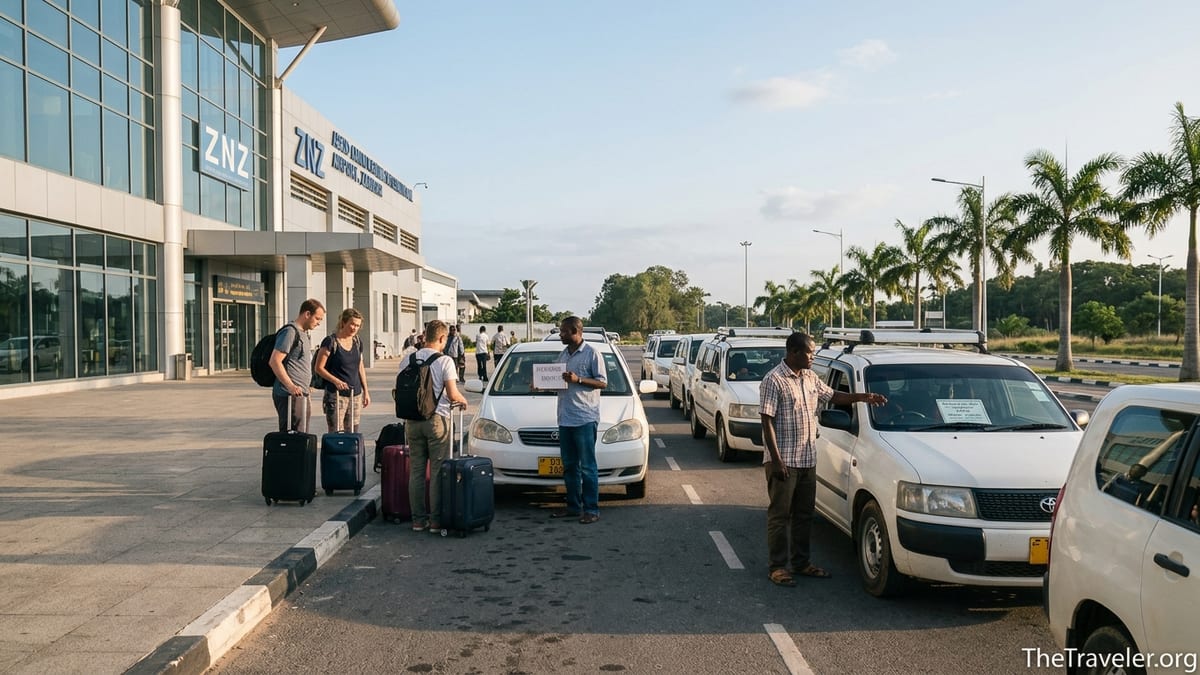
Zanzibar’s main gateway, Abeid Amani Karume International Airport (ZNZ), sits just a short drive from Stone Town but up to two hours from the northern and eastern beaches. There is no fully functioning Uber or Bolt scene and taxis are not metered, so airport rides are based on fixed or negotiated prices. When you exit customs at Terminal 3 for international flights, you enter a compact arrivals hall where hotel and transfer drivers wait with name boards. Just beyond the sliding doors outside is an official-looking taxi rank and a crowd of independent drivers offering rides.
In practice, visitors have three main options. First, pre-booked private transfers arranged through hotels, guesthouses or specialist transfer companies that monitor flights and meet you with a sign. Second, airport taxis from the stand or drivers who approach you in arrivals and quote a price on the spot. Third, a small but growing number of shuttle or shared minibus services between the airport and popular resort areas like Nungwi and Paje. Local buses known as dala dalas are technically an option, but they require changes in Stone Town, can be very crowded and are not practical with luggage straight after a flight.
Most visitors either pre-book private transfers or negotiate directly with airport taxis. Prices are usually quoted per car, not per person, and for 1 to 4 passengers in a standard sedan or small SUV. For larger groups, drivers switch to minivans and apply a higher vehicle rate. Because there are no meters, the key to a fair deal is knowing the typical price range in advance and agreeing the amount clearly before you put your bags in the car.
Airport taxis are available 24 hours a day, but there are more cars and more competition in the evening arrival window when many international flights land from Europe, the Middle East and East Africa. Late at night or very early in the morning you may find fewer drivers and slightly higher asking prices, especially for long trips to the north and east coasts.
Typical Fares from Zanzibar Airport: What You Should Expect to Pay
While there is some variation between operators, recent price lists from reputable transfer companies and hotels in 2025 and 2026 give a reliable idea of what counts as a reasonable fare. For the short trip between the airport and Stone Town hotels such as Park Hyatt Zanzibar, Tembo House or Forodhani Park, most companies charge around 15 to 20 US dollars per car, with 15 dollars a common online rate and 20 dollars frequently quoted at the taxi stand.
For the longer drive to the popular northern beaches, fares rise significantly. Companies advertising private transfers from ZNZ to Nungwi or Kendwa typically show prices in the range of about 35 to 65 US dollars one way per car, depending on vehicle type and margins. Some hotel-linked services publish rates around 40 dollars for a standard car, while independent reports from travelers mention paying about 35 dollars when negotiating directly with a taxi, and up to 65 dollars when accepting the first price or traveling at peak times. For the east coast, expect similar ranges: airport to Paje, Jambiani or Bwejuu often falls between 30 and 50 dollars for a private car, depending on distance along the coast and how hard you negotiate.
Prices to other well-known beach areas such as Kiwengwa, Matemwe or Pongwe usually sit just below Nungwi rates because the distance is slightly shorter. As a rough guide, a fair private taxi price from the airport in 2026 is around 15 to 20 dollars to Stone Town, 25 to 35 dollars to closer east-coast spots like Paje, 30 to 45 dollars to mid-east coast areas such as Kiwengwa and Matemwe, and 35 to 50 dollars to the far north at Nungwi or Kendwa. Very high-end resorts may bundle transfers into package rates, and some publish significantly higher prices as part of a premium service with luxury vehicles and onboard water or Wi-Fi.
One useful detail for planning is that many professional transfer operators now publish their rate tables online in US dollars for validity through 2025 or 2026, noting that fares may be adjusted if fuel prices or taxes change. This means that even if you choose not to pre-book, checking two or three of these public rate tables before you fly gives you a solid benchmark. If a taxi driver at the airport demands double those figures, you know you are being overcharged and can either negotiate or walk away.
Negotiating Fair Taxi Fares Without Stress
Because there are no meters, negotiation is part of the culture at Zanzibar Airport, but it does not have to feel confrontational. Drivers routinely start higher and expect some bargaining. Having a price range in mind before you exit the terminal makes the process faster and more relaxed. For example, if you know that a pre-booked transfer to Nungwi typically costs around 40 dollars, you can aim for a similar figure with airport taxis instead of accepting a first quote of 70 dollars.
A simple strategy is to ask more than one driver for a price before committing. Step outside, walk past the initial cluster of touts, and approach the official taxi desk or a driver standing slightly back from the crowd. Politely state your destination, confirm how many people and how much luggage you have, then ask for the price. If the quote is much higher than your target, respond with a friendly counteroffer that is realistic. If the driver says 50 dollars for Nungwi, you might answer with 35 dollars, knowing that other travelers have paid around that amount, and then settle in the 35 to 40 dollar range.
Always confirm whether the price is per car or per person and whether it includes all passengers and luggage. For a family of four heading to Paje with two large suitcases and two cabin bags, clarify that the quoted 30 or 35 dollars covers everyone and everything. Once you agree, repeat the amount back clearly and, if possible, confirm the price again as you load your bags. This reduces the risk of last-minute attempts to increase the fare on arrival.
If a driver will not come close to a fair price, do not be afraid to decline politely and walk away. Competition is strong around the airport, especially during busy periods, and another driver will usually agree to a more reasonable rate. Keeping your negotiation brief and good-natured tends to work better than long arguments over a few dollars. Remember that English is widely spoken in the tourism sector, but simple phrases and clear numbers help avoid misunderstandings.
Cash, Currency and Paying Your Driver
Cash remains the default way to pay for airport taxis in Zanzibar. While a few higher-end transfer companies and hotels can process card payments, most independent drivers will expect cash in either US dollars or Tanzanian shillings. Euros are sometimes accepted, but exchange rates may be less favorable. Because of this, it is wise to arrive with at least some small US dollar bills in good condition or to withdraw Tanzanian shillings from an airport ATM before leaving the terminal.
ATMs are available at or near the airport and in Stone Town, but they can occasionally be out of service or have limits. Many travelers therefore bring a mix of US dollars and plan to take out shillings once in Stone Town. Keep in mind that large US dollar bills may be difficult to break with a taxi driver. If your ride from the airport to Stone Town is 20 dollars and you only have a 100 dollar note, you may struggle to get change. Bringing 5, 10 and 20 dollar notes makes life easier, and the same small bills are useful for tipping porters or buying water and snacks.
In 2026, local advice still emphasizes that cash is king once you leave international hotels and big resorts. Even where card machines exist, some hotels and tour operators add a surcharge of around 3 to 5 percent, so paying cash can be cheaper. Government and tourism bodies also encourage visitors to use Tanzanian shillings for everyday spending. Changing part of your budget into shillings in Stone Town or withdrawing from an ATM there will give you better flexibility for small taxis, dala dalas, markets and local restaurants.
When paying a taxi driver, hand over the agreed amount only at the end of the trip, once you have arrived at your hotel or guesthouse. Some pre-booked transfer companies may ask for partial payment upfront if arranged online, but most airport taxis are paid in full on arrival. If you have arranged a transfer by WhatsApp with an independent driver before landing, clarify in advance whether the fare is in US dollars or shillings and confirm again when you meet at the airport. This avoids confusion over exchange rates, which can differ from those you see online.
Late Arrivals, Night Transfers and Safety Considerations
Many long-haul flights to Zanzibar land late in the evening or after midnight, creating understandable concerns about finding a safe ride in the dark. The main roads between the airport, Stone Town and the major beach areas are generally paved and in reasonable condition, but street lighting can be patchy in rural stretches, and driving standards vary. For these reasons, pre-booking a transfer through your hotel or a known operator is often recommended for arrivals after about 22:00 or for very early departures that require a 02:00 or 03:00 start from the northern beaches.
A typical example is a traveler staying in Nungwi with a 07:00 departure from Zanzibar. Many hotels will suggest leaving around 03:30 to allow roughly 90 minutes on the road and a buffer for check-in. Guests often arrange a driver through the hotel reception the day before, agreeing on a price similar to daytime rates or slightly higher. Reports from travelers describe paying around 35 to 45 dollars for this kind of night transfer when booked via hotels, versus similar day rates but with greater peace of mind.
For late-night arrivals into Terminal 3, the arrivals area remains busy when flight banks come in, but the atmosphere can feel intense for first-timers. If you have pre-booked, look for your name on a sign instead of engaging with touts. If you have not, head to the official taxi desk or gravitate towards drivers who are not aggressively pushing for business. Avoid leaving the airport grounds with someone who refuses to state a clear price or insists on stopping elsewhere before reaching your hotel.
Standard safety advice applies: keep your valuables out of sight, avoid flashing large amounts of cash and use well-regarded drivers whenever possible. National travel advisories continue to recommend arranging taxis via accommodation or established operators, particularly at night. That said, most visits to Zanzibar pass without incident, and for many travelers the biggest nighttime concern is road safety rather than crime, so choose drivers who seem rested, sober and cautious behind the wheel.
Luggage, Vehicle Types and Hotel Locations
Most standard taxis meeting flights at Zanzibar Airport are compact sedans or small SUVs. They comfortably seat two to three adults with two large suitcases and small hand luggage. For families, groups of four with multiple large bags, or travelers with bulky dive gear or kite-surfing equipment, it is better to request a larger car or minivan in advance. Many transfer companies advertise a higher rate for vehicles that can handle more passengers and luggage, but this is safer and more comfortable than overloading a small sedan.
If you negotiate with a driver on arrival, describe your luggage honestly before agreeing on a price. Mention if you have surfboards, golf clubs or dive bags. Some drivers charge a small supplement for very large or numerous bags, while others include everything in their flat rate. Either way, clarifying upfront avoids disagreements once you reach your hotel. Porters inside the terminal may help you with trolleys and bags; tipping is customary, usually the equivalent of one or two US dollars in small bills.
Hotel location also affects the complexity of your transfer. Many Stone Town hotels sit in narrow alleyways where cars cannot drive directly to the door. In this case your taxi will usually drop you near a recognizable landmark such as Forodhani Gardens, the Old Fort or the main road behind the seafront, and a hotel porter or guide will meet you there and walk you the final few minutes. For this reason, drivers sometimes ask which specific hotel you are staying at rather than just “Stone Town” so they can choose the most convenient drop-off point.
On the coasts, some boutique lodges and guesthouses are reached via short dirt tracks off the main road. In the dry season these tracks are usually fine; in the rainy season they can be muddy and slow. Make sure your driver understands the exact hotel name and area, for example “Paje, near Kite Centre” or “Kendwa, just north of the main public beach,” and have the hotel phone number ready in case the driver needs directions. Many hotels are used to guiding taxis by phone when guests get close but not right to the door.
How to Avoid Overpaying or Being Scammed
Zanzibar’s airport taxi scene can be mildly chaotic, and while outright scams are not the norm, overcharging is common if you look lost or have no idea of fair rates. The simplest way to avoid overpaying is to pre-book your airport transfer with your hotel or a reputable company before you fly. You will usually receive a written confirmation with the agreed price in US dollars, the meeting point in the arrivals hall and the driver’s contact details. Even if this costs a few dollars more than the absolute lowest taxi price, many travelers consider it worth it for the reduced stress.
If you prefer to decide on arrival, treat the published online transfer rates as your benchmark and be wary of anyone who refuses to name a price before you get in the car. Avoid vague answers like “We will see” or “Pay what you want at the hotel.” Insist on a fixed number and currency. Do not hand over your luggage until you are comfortable with the driver and the agreed fare. If someone grabs your bag and walks toward a car without your consent, calmly but firmly take it back and choose a different driver.
Another common way to overpay is through confusion over currencies and exchange rates. A driver might quote 40 dollars and then later ask for the equivalent in shillings at a rate that favors him. To prevent this, decide in advance whether you will pay in dollars or shillings, stick to that choice and keep the mental arithmetic simple. If you agree to pay 80,000 shillings instead of 30 dollars for a Stone Town transfer, for example, make sure that feels reasonable based on the rough current exchange rate rather than just trusting the driver’s conversion.
Finally, remember that taxis at the airport are usually more expensive than those booked locally in Stone Town for the same route. That is normal worldwide, but in Zanzibar the difference can be significant. If you are returning to the airport at the end of your stay, ask your hotel or a driver you liked on an excursion to quote you a rate for the return journey. Many visitors find that drivers who have already worked with them during their stay offer fairer prices for airport runs, and you gain the benefit of a known contact for early-morning or late-night trips.
The Takeaway
Getting a taxi from Zanzibar Airport does not have to be stressful or expensive if you arrive with realistic expectations and a basic understanding of how the system works. There are no meters and little in the way of reliable ride-hailing, so prices are based on fixed or negotiated fares per car, with typical 2026 rates around 15 to 20 US dollars to Stone Town and 30 to 50 dollars to the major beach areas, depending on distance and negotiation.
Pre-booked transfers arranged through hotels or reputable operators remain the most straightforward option, particularly for late arrivals or very early departures. They lock in your price in advance, provide a named driver with a sign in the arrivals hall and reduce the risk of overpaying. If you choose to negotiate on the spot, checking current transfer rates before you land, confirming the fare and currency clearly before loading your bags, and being prepared to walk away from inflated offers will usually secure you a fair deal.
Cash is still king, with most drivers preferring payment in US dollars or Tanzanian shillings and small bills making it easier to pay exactly the agreed amount and tip porters or helpers. With a bit of preparation, a clear sense of what your journey should cost and a calm approach to bargaining, your first taxi ride in Zanzibar can be a smooth start to your island stay rather than a source of anxiety.
FAQ
Q1. How much should I expect to pay for a taxi from Zanzibar Airport to Stone Town?
The most common fare for a private taxi from Abeid Amani Karume International Airport to Stone Town hotels is around 15 to 20 US dollars per car, depending on whether you pre-book or negotiate on arrival.
Q2. What is a fair price from the airport to Nungwi or Kendwa?
In 2026, a reasonable one-way fare for a private car to Nungwi or Kendwa is typically in the range of 35 to 50 US dollars, with some hotel or premium services charging slightly more and hard bargaining sometimes bringing the price a little lower.
Q3. Do taxis at Zanzibar Airport accept credit cards?
Most independent airport taxis expect cash and do not accept cards. Some hotel-arranged transfers or larger operators can take card payments, often with a small surcharge, but you should not rely on this unless it is confirmed in advance.
Q4. Should I pay in US dollars or Tanzanian shillings?
Both are widely accepted, but many drivers quote in US dollars for airport transfers. Paying in Tanzanian shillings can sometimes work out slightly cheaper if you use a fair exchange rate. Choose one currency, agree it clearly and try to have exact or near-exact change.
Q5. Is it safe to take a taxi late at night from Zanzibar Airport?
Most visitors use taxis at night without problems, but for peace of mind, it is advisable to pre-book a transfer through your hotel or a reputable company for very late arrivals or early-morning departures, especially for long drives to the north or east coasts.
Q6. How do I avoid being overcharged by airport taxi drivers?
Check current transfer prices online before you fly, decide on a realistic target fare for your route, ask more than one driver for a quote, insist on a fixed price and currency before getting in, and be prepared to walk away from inflated offers.
Q7. Can I use public transport like dala dalas from the airport?
Dala dalas do not run directly from the terminal. You would need to walk or take a short local ride to a bus stop, then change in Stone Town. With luggage after a flight, this is inconvenient, so most travelers use taxis or pre-booked transfers.
Q8. Do I need to tip my taxi driver and airport porters?
Tipping is not strictly mandatory but is appreciated. Rounding up the fare or adding a few dollars for good service is common for drivers, while porters who help with luggage at the airport are typically tipped the equivalent of about one to two US dollars.
Q9. Will my driver know how to find my hotel?
Drivers are familiar with major hotels and resort areas, but small guesthouses or new properties may require directions. Have your hotel name, area, and a contact phone number ready, and be prepared for the driver to call the property for final instructions.
Q10. Is it better to arrange my return transfer to the airport in advance?
Yes. Booking your return transfer a day or two before departure, either through your hotel or a driver you trusted earlier in your trip, ensures you have a confirmed pickup time and agreed fare, which is especially important for early flights.