

More news on this day
Operations at Athens International Airport “Eleftherios Venizelos” were severely disrupted today as at least 45 flights were delayed and 21 canceled, snarling schedules for major international carriers and rippling across key routes linking Athens with London and Paris.
Knock-on Effects From Regional Airspace Crisis
The disruption in Athens comes amid a wider aviation crisis triggered by the ongoing closure and restriction of Middle Eastern airspace, which has forced airlines to reroute or suspend services and has strained capacity across Europe’s busiest hubs. In recent days, carriers including Emirates, Air France and British Airways have been adjusting timetables and operating longer routings, which has increased crew and aircraft time and limited flexibility when additional delays occur.
Athens has become a key diversion and connection point as airlines look for alternative corridors between Europe, the Gulf and Asia. That strategic role has left the airport particularly exposed to ripple effects when flights are rescheduled or grounded elsewhere. Airport operations teams reported that a significant share of today’s delayed and canceled flights were linked either to aircraft arriving late from affected regions or to precautionary schedule cuts by airlines as they recalibrated their networks.
According to Greek aviation officials, affected services at Athens included both intra-European routes and long-haul connections, with several departures held on the ground for crew rest constraints or to await new flight plans that avoid closed airspace. While some flights eventually departed after extended delays, others were scrubbed entirely when it became clear that aircraft or crews would not arrive in time to operate within regulated duty limits.
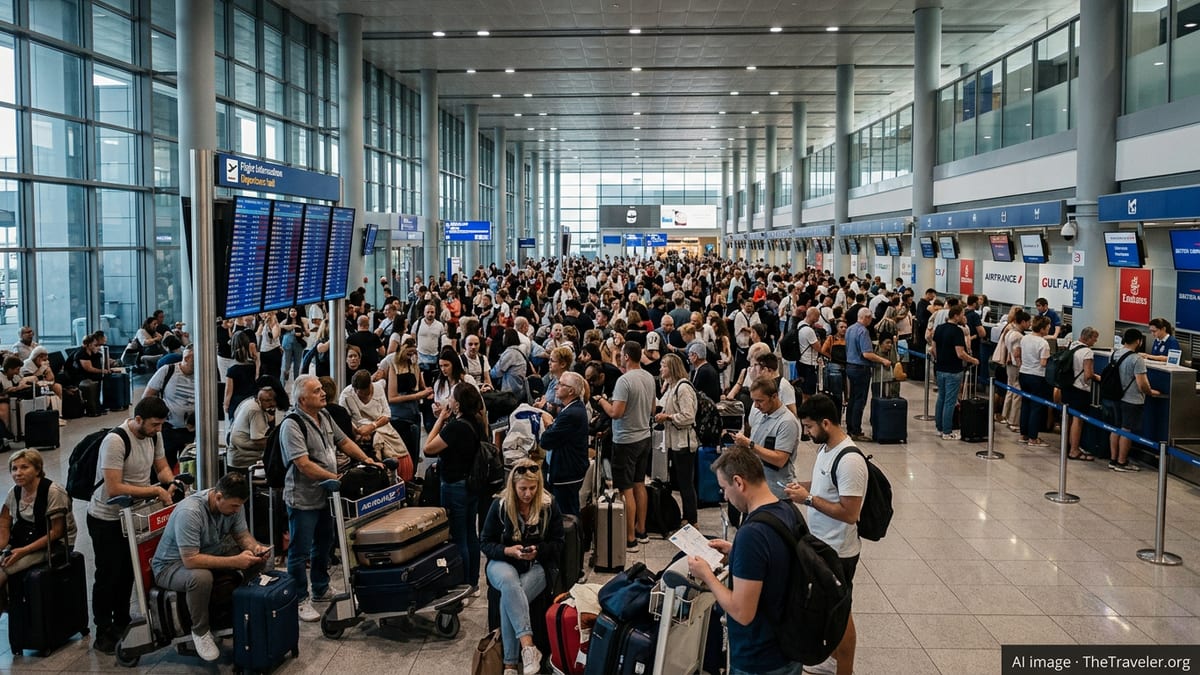
The result was a crowded departures hall and long lines at transfer desks as passengers sought new options to complete their journeys. Information screens at peak times showed clusters of delayed departures to major European cities alongside outright cancellations to Middle Eastern and beyond-Europe destinations.
Emirates, Air France and British Airways Among the Worst Affected
Major international carriers using Athens as a gateway to and from the eastern Mediterranean were among those most impacted by today’s disruption. Emirates services connecting Athens with Dubai and onward long-haul destinations experienced extended delays, with some flights held for hours as the airline adjusted routings and awaited updated clearances along longer, more northerly paths.
Air France and British Airways, which both rely on Athens feed to support their long-haul banks from Paris Charles de Gaulle and London Heathrow, also reported a series of delays and tactical cancellations. Disruptions on Athens to Paris and Athens to London services quickly cascaded into missed connections for passengers bound for North America, Africa and Asia, forcing rebookings onto later departures or entirely different routings via other European hubs.
Passengers described scenes of queues stretching across sections of the departure level as rebooking desks struggled to keep pace with demand. Many travelers reported being offered hotel accommodation in Athens or in London and Paris after missing onward legs, while others opted to postpone trips altogether in light of the uncertainty around departure times.
Operational planners at the affected airlines indicated that Athens was not an isolated case. Across Europe, carriers have been juggling aircraft rotations, juggling crews and consolidating flights where possible to minimize further disruption. However, the combination of constrained airspace, longer flight times and full late-winter schedules has left little slack in the system.
Wave of Disruptions Spreads Between Athens, London and Paris
Today’s problems in Athens were closely mirrored in London and Paris, where airport operators and airlines have already been contending with an elevated number of delays and cancellations linked to the same regional airspace issues. Heathrow and Charles de Gaulle both reported heavy pressure on departure and arrival banks serving the eastern Mediterranean and Gulf regions, with knock-on delays affecting flights from those hubs back to Athens.
In practical terms, this meant that passengers leaving Greece for London or Paris often encountered late incoming aircraft and last-minute gate changes. Some Athens departures to London were pushed back multiple times before finally boarding, as ground staff awaited connecting passengers from other delayed European flights or waited for crews nearing their maximum duty hours to be replaced.
For travelers attempting to connect through London and Paris to long-haul routes, the timing proved particularly difficult. Travelers who had built in what is normally considered a safe connection window at Heathrow or Charles de Gaulle found themselves stranded when their Athens legs departed late, arriving after long-haul services had closed or taken off.
Industry analysts noted that the highly interconnected nature of European aviation means that a shock in one region can quickly translate into operational strain hundreds or even thousands of kilometers away. With Athens now playing a larger role as an alternative routing point toward the eastern Mediterranean, disruptions there inevitably reverberate through London, Paris and other major hubs on the continent.
Passengers Face Long Queues, Hotel Nights and Changed Plans
For travelers caught in today’s disruption, the human impact was immediate. Families on school-break trips, business travelers and tourists all reported spending hours in queues at check-in counters, security lanes and airline service desks. Many passengers said that while frontline staff at Athens were doing their best, communication was at times patchy, with conflicting estimates for new departure times and limited proactive updates via email or mobile apps.
Hotels near the airport and in central Athens saw a surge in demand as airlines arranged overnight accommodation for passengers whose flights had been canceled or who had missed onward connections. Similar scenes unfolded in London and Paris, where hotels near major airports reported high occupancy from stranded travelers seeking last-minute rooms while they waited for alternative flights.
Some passengers chose to reroute entirely, opting for rail connections within Europe where feasible or booking fresh itineraries through less congested hubs. Others decided to abandon nonessential travel plans, focusing instead on securing refunds from airlines or lodging compensation claims where regulations apply.
Beyond immediate frustration, travel advisors warned that the disruption could have lingering effects, as many flights in the coming days are already heavily booked. This means that even when operations stabilize, some passengers may face limited options and extended waits before they can be re-accommodated on suitable services.
What Impacted Travelers Should Do Next
Travel experts and consumer advocates urged passengers affected by today’s widespread disruption to document their experiences carefully and to make use of the protections available under European and UK passenger-rights rules. While compensation is not guaranteed in cases where airlines can demonstrate extraordinary circumstances, travelers are generally entitled to assistance such as meals, refreshments and hotel accommodation during long delays or unexpected overnight stays, depending on the length of delay and flight distance.
Impacted passengers were advised to keep boarding passes, booking confirmations and receipts for any out-of-pocket expenses such as food, local transport and additional accommodation, as these documents can be vital for later claims. They also recommended using official airline channels, including mobile apps and call centers, to confirm whether flights are operating before heading to the airport, since airport screens may lag behind real-time operational decisions.
For those still scheduled to depart from Athens in the coming days on Emirates, Air France, British Airways or any other carrier serving London and Paris, travel planners recommended building in extra buffer time for connections, considering flexible tickets where possible and monitoring airport and airline advisories closely. Although airlines are gradually recalibrating schedules, the scale of current rerouting activity means that residual delays and aircraft shortages may continue to affect operations for several days.
With the underlying regional airspace constraints still evolving, industry observers expect further adjustments to flight plans and timetables across Europe. For now, travelers through Athens, London and Paris are being urged to stay informed, remain flexible and prepare for the possibility of continued disruption as airlines work to restore more predictable operations.