

More news on this day
Hartsfield-Jackson Atlanta International Airport, the world’s busiest passenger hub, has logged 129 flight delays and more than 20 cancellations in mid-April 2026, straining airline operations and disrupting travel plans across the United States and beyond.
Get the latest news straight to your inbox!
Central Hub Hit by 129 Delays and 23 Cancellations
Publicly available tracking data and industry coverage indicate that Hartsfield-Jackson Atlanta International Airport recorded 129 delayed flights and 23 cancellations on April 12, 2026. The disruption concentrated across a single day at one of the world’s most critical connecting hubs created knock-on effects throughout airline networks serving the Southeast and major coastal markets.
Reports highlight that the delays and cancellations affected a mix of domestic and international services. Routes to leisure destinations such as Fort Lauderdale and Aspen, as well as services to Puerto Rico and Querétaro, were among those impacted. Connections to secondary markets including Lexington and other midsize cities also experienced schedule irregularities, complicating travel for passengers relying on Atlanta as a transfer point.
The figures are notable even for Atlanta, which regularly manages hundreds of departures and arrivals each day. Aviation data shows that the airport typically maintains relatively strong on time performance for its size, so a cluster of 129 delays within a short window stands out as a sign of unusual operational stress.
As the primary hub for one of the largest U.S. carriers and an important gateway for partners such as Air Canada and other international airlines, any disruption at Atlanta can swiftly propagate across North American and transborder networks. Travelers departing from or heading to other major hubs, including New York, Chicago and Houston, may feel the secondary effects in the form of missed connections or rolling delays.
Weather, Staffing and Network Complexity Intensify Strain
The April disruption comes at a time when Atlanta’s aviation system is already navigating a combination of challenging factors. Recent local coverage points to severe weather events in the region that have periodically triggered ground stops and temporary halts in departures, forcing airlines to compress large volumes of flights into shorter operating windows once conditions improve.
Separate reports across March and early April have highlighted fluctuating wait times at security checkpoints, with some days seeing screening queues stretch well beyond an hour. While security operations are distinct from airline scheduling, extended checkpoint waits can complicate boarding timelines and contribute to missed connections, especially when paired with weather or air traffic constraints.
Industry analyses of U.S. delay patterns underscore how complex hub operations can magnify relatively small disruptions. When aircraft and crews are held up by storms or congestion at one airport, their late arrival can cascade into subsequent flights, turning an isolated delay into a series of schedule changes across multiple cities. At a hub of Atlanta’s scale, that dynamic can quickly translate into dozens of impacted departures and arrivals.
Travel data reports tracking nationwide performance in early April 2026 describe elevated levels of delays across several major U.S. airports, including Atlanta. These broader conditions suggest that the 129 delays at Hartsfield-Jackson on April 12 did not occur in isolation, but rather within a stressed national system still recovering from earlier bouts of severe weather and operational challenges.
Ripple Effects Across Domestic and International Routes
As flight delay and cancellation figures mounted in Atlanta, the consequences spread beyond Georgia. Published coverage notes that affected services included flights to popular vacation markets in Florida and Colorado, as well as key links to the Caribbean and Mexico. Travelers connecting through Atlanta on their way to resort destinations or returning from holidays faced extended waits, missed onward flights and, in some cases, unexpected overnight stays.
Because Atlanta functions both as a domestic connector and an international gateway, disruption in its banks of departures can interrupt itineraries spanning multiple continents. Long haul passengers transiting through the airport may find that even modest delays on feeder flights from smaller cities are enough to jeopardize connections to Europe, Latin America or other regions when schedules are tightly timed.
Data from previous months shows that Atlanta consistently ranks among the busiest airports globally by passenger volume and aircraft movements. In such an environment, airlines operate tightly scheduled “banks” of arriving and departing flights designed to move large numbers of travelers through the hub in short bursts. When weather, congestion or ground operations slow part of that pattern, the entire sequence can be disrupted, contributing to the kind of elevated delay totals seen in April.
Travel analysts observe that the combination of heavy banked schedules and strong demand in the spring travel period can leave limited room to absorb irregular operations. Even when airlines are able to substitute aircraft or crews, available seat capacity on later flights may be constrained, limiting rebooking options for stranded travelers.
Passenger Experience Inside the World’s Busiest Hub
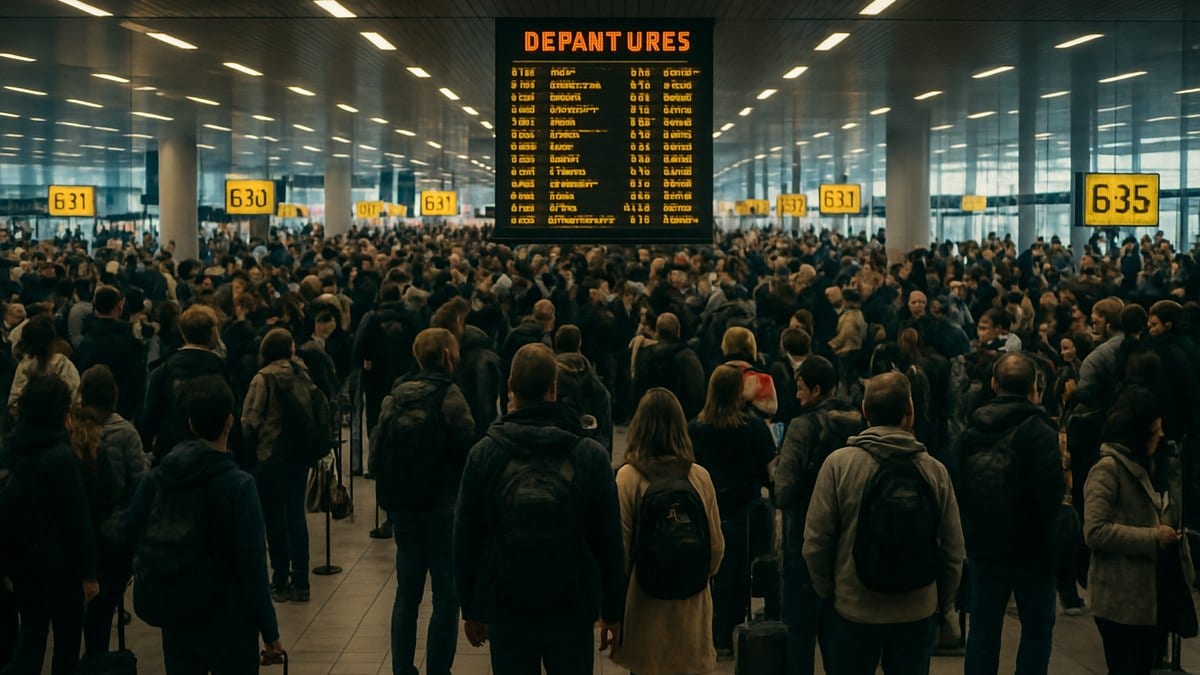
For passengers at Hartsfield-Jackson on the day of the disruption, the operational statistics translated into crowded concourses, busy gate areas and long lines at customer service counters. Observers on social media described departure boards showing waves of yellow and red status updates as delays accumulated throughout the afternoon and evening.
Atlanta’s terminal design, with multiple concourses connected by an underground people mover system, typically allows the airport to handle large crowds efficiently. However, any extended period of irregular operations increases the likelihood of congestion around key nodes such as central food courts, restrooms and tram stations, as travelers wait out delays or attempt to reroute.
Published advice from travel-industry sources emphasizes the importance of proactive planning when flying through major hubs during volatile periods. Recommendations commonly include monitoring flight status through airline apps, enabling notifications, and remaining alert to gate changes or rolling departure estimates that can shift multiple times within a short span.
Consumer travel advocates also note that passengers affected by significant delays may be entitled to rebooking assistance, meal vouchers or hotel accommodations, depending on airline policies and the cause of the disruption. However, in busy irregular-operation events, access to on-site support can be limited simply because of the volume of travelers seeking help at the same time.
What the April Disruptions Signal for Spring Travel
The mid-April disruption at Atlanta arrives just as the spring and early summer travel season begins to ramp up, offering an early indication of how sensitive U.S. aviation networks remain to concentrated stress at a few key hubs. With Hartsfield-Jackson continuing to rank among the busiest airports in the world by passenger traffic, operational hiccups there are likely to remain a barometer for broader system health.
Recent flight disruption reports for the United States highlight Atlanta’s central role in national connectivity, both as a departure point and as a nexus for connections between smaller regional airports and major coastal gateways. Any sustained pattern of delays at the airport would have implications not only for local travelers but also for business and leisure passengers whose journeys simply pass through the city.
Travel experts suggest that, heading into the peak summer period, passengers may wish to factor hub congestion risk into booking decisions. That can include selecting longer connection windows, avoiding the tightest bank periods when possible, and considering early morning departures, which are often less affected by the day’s accumulated delays.
While April’s figure of 129 delays and 23 cancellations represents a snapshot rather than a long term trend, it underscores how quickly conditions at the world’s busiest hub can shift. For travelers, staying informed and building flexibility into itineraries remain key strategies for navigating an increasingly complex air travel landscape.