

More news on this day
Persistent flight disruptions at Hartsfield-Jackson Atlanta International Airport are rippling across the United States, straining airline networks and leaving travelers nationwide facing rolling delays and cancellations.
Get the latest news straight to your inbox!
Atlanta Hub Turbulence Intensifies After Early April Disruptions
Publicly available flight-tracking data from the first week of April shows Atlanta repeatedly near the top of U.S. disruption tables, with significant clusters of delayed and canceled departures and arrivals. Travel industry coverage for April 6 and April 7 highlights Hartsfield-Jackson as one of the country’s most affected hubs, recording dozens of cancellations and several hundred delays in a single day as part of wider national totals that exceeded 3,000 delayed flights.
A travel-analytics snapshot for April 7 notes that Atlanta was associated with more than 60 cancellations and over 200 delayed flights, placing it among the worst performing airports alongside New York, Chicago, Orlando and Houston. Separate reporting on April 6 points to Atlanta again at or near the top of the list by total affected movements, underlining how frequently the airport has appeared as a focal point during recent operational strain.
Earlier in the month, consumer-rights data compiled for April 5 documented 285 delays and 76 cancellations on routes touching Atlanta, confirming a difficult end to the Easter peak travel period. These figures form part of a broader pattern in which the world’s busiest passenger airport experiences recurring surges of disruption as spring demand increases.
Compounding the pressure, weather systems moving across the Southeast in mid March triggered a temporary ground stop at Atlanta, with federal traffic management programs briefly halting or slowing arrivals. Reports from that event describe waits of several hours for some flights and extended queues at security checkpoints, foreshadowing the operational fragility now evident during the April travel surge.
Knock-On Effects Across Major U.S. Hubs
Aviation coverage indicates that the turbulence in Atlanta is feeding directly into a broader wave of schedule disruptions across the country. When Atlanta struggles to move aircraft and crews on time, the impact is quickly felt at other major hubs such as New York, Chicago, Boston, Los Angeles and Orlando, where banks of connecting flights rely on punctual arrivals from the Southeast.
National tallies for April 6 and April 7 describe a landscape of thousands of delayed flights and hundreds of cancellations, with Atlanta consistently listed among the core nodes in the network pattern. New York’s LaGuardia and John F. Kennedy airports, Chicago O’Hare, Houston, Seattle and Boston all appear alongside Atlanta in accounts of widespread delays, suggesting that congestion at one major hub is amplifying existing weather and staffing challenges throughout the U.S. system.
Travel reports frame these events as part of a familiar domino effect within hub-and-spoke airline networks. When an aircraft or crew begins the day behind schedule in Atlanta, subsequent legs through other cities risk missing their assigned slots, increasing taxi times, and crowding gate operations. Even airports not directly affected by storms or local incidents can see late-night arrival waves and missed connections as the disruption propagates outward.
Industry observers have noted that the recent issues are occurring at the same time that a powerful late-season storm track has swept across large portions of the Midwest and Northeast. That broader weather pattern has generated separate clusters of cancellations in cities like Chicago and Minneapolis, further tightening available capacity and making it harder for carriers to recover once Atlanta’s operations falter.
Strain on Airlines and Travelers During Peak Demand
The timing of Atlanta’s rough patch coincides with some of the heaviest passenger volumes of the year. Local forecasts for April indicate that Hartsfield-Jackson expects more than 8 million travelers this month, with some individual days projected to surpass previous records for security screenings. That level of demand leaves airlines and airport operators with little margin when storms or bottlenecks arise.
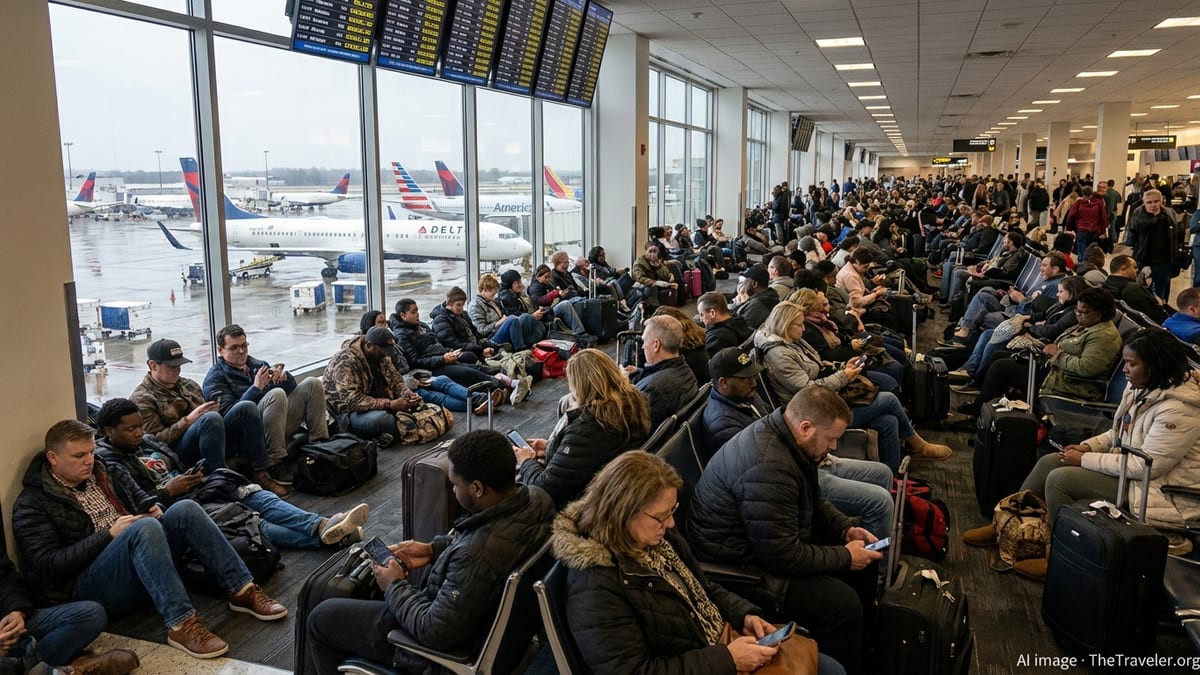
Coverage focused on specific carriers paints a picture of mounting strain. Delta Air Lines, which maintains its largest hub in Atlanta, has recently faced triple-digit cancellations and hourslong onboard delays during one of the worst days of disruption. Accounts from the terminal describe crowded gate areas and overnight stays on concourse floors as passengers waited for rebooked flights or rested between rolling delay notifications.
Other major U.S. airlines, including American, United, Southwest, Alaska and Spirit, have also reported sizable numbers of delayed flights during the same early April period, according to national disruption tallies. Many of these carriers operate multiple daily services through Atlanta, meaning a single missed slot or aircraft rotation there can displace planes and crews needed hours later in cities as far apart as Denver, Boston or Los Angeles.
For travelers, the effect has been a patchwork of missed connections, rebookings and extended queue times. At the height of recent events, passengers have faced reported waits approaching two hours at security checkpoints in Atlanta, along with long customer-service lines as airline agents work through backlogs of itinerary changes. Consumer advocates have reminded passengers that compensation rules differ widely depending on the cause of a delay and the operating carrier.
Weather, Network Complexity and Structural Vulnerabilities
Recent reporting on U.S. aviation performance places the Atlanta disruptions within a wider set of structural challenges. Analysts point to the growing complexity of airline networks, heavier reliance on tightly timed connections, and chronic staffing pressures at both carriers and federal agencies as forces that magnify even routine weather events.
During March, a major blizzard and associated severe weather in the Midwest and Plains states caused thousands of cancellations across the eastern half of the country. As that storm forced temporary ground stops and deicing backlogs at several hubs, federal traffic managers also implemented flow-control measures affecting inbound flights to Atlanta and Houston. These national slowdowns left aircraft and crews out of position for days, feeding into the operational strains that are now surfacing during April’s high-demand period.
Industry data released in February shows airlines adding new capacity and routes through Atlanta in 2026, reinforcing the city’s central role in domestic connectivity. While that growth supports broader access to air travel, it also means that any disruption in Atlanta has an outsized ability to disturb itineraries and strain recovery plans throughout the network.
Aviation commentators have repeatedly highlighted how storms in the Southeast can intersect with existing congestion at Northeastern and Midwestern airports, producing multi-day disruption cycles. In this environment, even brief outages or traffic restrictions at Atlanta can act as the tipping point that turns a challenging operating day into a nationwide cascade of missed flights and overnight delays.
What Travelers Can Expect in the Days Ahead
With spring break and early summer planning underway, publicly available forecasts suggest that high passenger volumes through Atlanta will continue through April and into May. Travel advisories from industry outlets emphasize that airlines are still working through residual schedule imbalances, particularly at large hubs where aircraft rotations remain tight after weeks of weather-related interruptions.
Consumer-facing reports consistently advise travelers routed through Atlanta to build extra time into their journeys, especially when relying on short connections. Same-day flight changes, proactive rebooking to earlier departures, and keeping a close eye on airline apps for rolling delay notices are all recommended strategies for reducing the risk of misconnection when operating through the hub.
Some carriers have periodically offered flexible travel policies during the most severe weather episodes this year, allowing passengers to adjust itineraries without change fees when storms threaten key hubs. While such waivers are not guaranteed for every disruption, past practice suggests they may reappear if the combination of storms and congestion at Atlanta again pushes cancellation counts higher.
For now, travel analysts expect that performance at Atlanta and other major hubs will hinge on how quickly airlines can rebuild schedule resilience and staffing buffers ahead of the busy summer season. The recent wave of disruptions has underscored how closely the rest of the country’s air traffic depends on a smooth day in Atlanta, and how quickly issues there can snarl routes across the United States.