

More news on this day
Australian travellers are being told to urgently reconsider or rework upcoming trips to Europe as the Middle East airspace crisis deepens, severing key transit hubs, leaving thousands of passengers stranded and prompting warnings that disruptions could drag on for at least five months.
Middle East Conflict Shuts a Vital Corridor
The rapid escalation of conflict involving Iran, the United States and Israel has triggered sweeping airspace closures across much of the Middle East, crippling one of the world’s most important aviation corridors between Australia and Europe. Authorities in Iran, Iraq, Israel, Syria, Kuwait and the United Arab Emirates have all imposed varying levels of restrictions, forcing airlines to ground services or execute lengthy detours.
For Australians, the fallout is particularly severe. Gulf hubs such as Dubai and Doha normally act as high-capacity bridges linking Australian cities with Europe, Africa and beyond. With these hubs now heavily constrained and many long-haul aircraft out of position, schedules have been shredded and spare seats on alternative routes are vanishing fast.
Aviation analysts warn that the disruption is no short, sharp shock. Industry experts advising Australian media expect instability across Middle Eastern airspace and hub operations to continue for months, with ripple effects feeding through to fares, capacity and reliability on Europe-bound routes well into the northern summer.
Warnings to Delay Europe Trips for Months
In the face of mounting uncertainty, aviation safety specialists are advising Australians with non-essential travel to Europe to consider postponing their plans for as long as five months. The concern is not only about overflying active conflict zones, but also about the operational fragility of hub airports that normally funnel huge volumes of traffic between Australasia and Europe.
Experts point out that even if some airspace lanes begin to reopen, the knock-on impact of grounded fleets, displaced aircraft and overstretched crews will take a long time to unwind. With schedules likely to be repeatedly revised, travellers could face rolling cancellations, missed connections and sudden last-minute reroutings throughout the coming peak season.
Australian authorities have stopped short of issuing a blanket ban on Europe travel, but officials and industry figures alike are urging citizens to think very carefully before embarking on discretionary trips over the coming months. Families planning once-in-a-lifetime holidays and retirees booking extended European journeys are being singled out as those most at risk of costly and stressful disruption.
Stranded Passengers Confront Airport Chaos
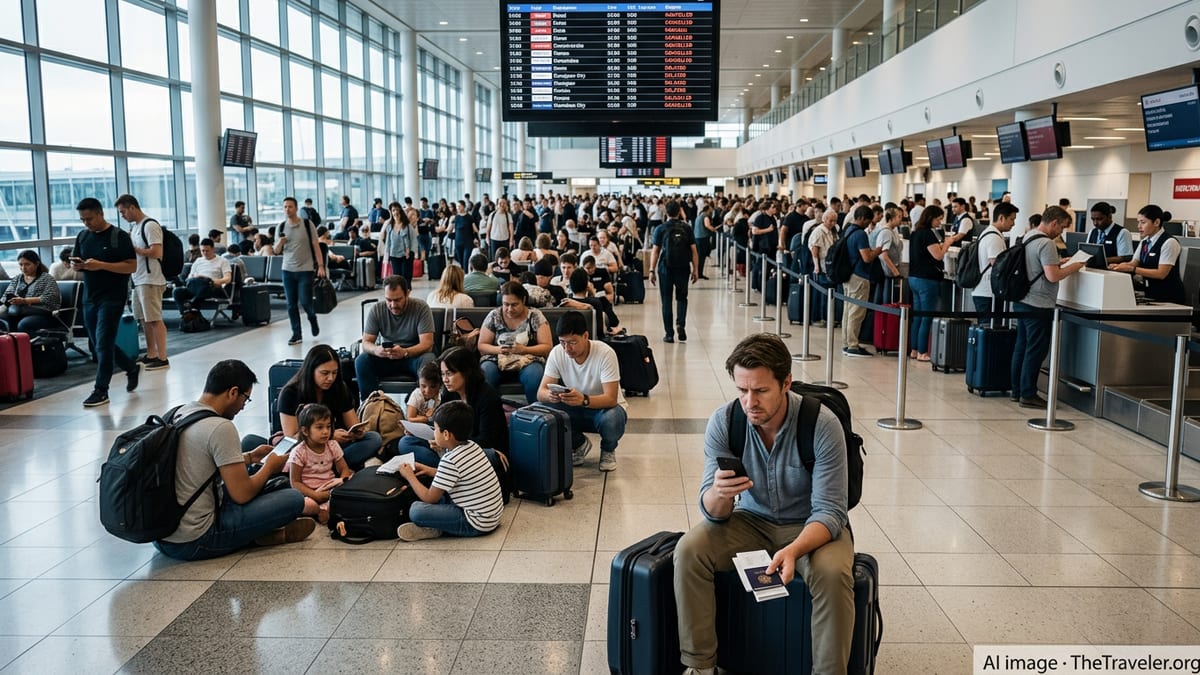
For many Australians, the crisis is no longer hypothetical. Thousands of passengers are already stranded at airports across the Middle East and Europe after abrupt airspace closures forced airlines to suspend or radically reroute flights. Long queues snake through terminals as travellers compete for scarce rebooking options, hotel rooms and accurate information.
Scenes from major hubs show exhausted families sleeping on terminal floors, departure boards dominated by cancellations and mounting frustration at customer service desks. Some Australians have described hiring private drivers to attempt complex overland journeys to alternative airports, while others have paid eye-watering last-minute fares for circuitous return routes home via Asia or North America.
The Australian government has deployed crisis response and consular teams to key locations, working with partner governments and airlines to support nationals caught in the disruption. Officials caution, however, that as long as large swathes of regional airspace remain effectively closed, options for assisted departures and mass repatriation flights will remain limited.
Rerouted Flights, Skyrocketing Fares and Insurance Traps
With traditional Gulf connections severely curtailed, airlines are scrambling to reconfigure networks. More services are being pushed through Asian hubs such as Singapore and Kuala Lumpur, but these routes were already busy before the crisis and are now under intense pressure. Longer flight paths around closed airspace add hours of travel time, burn more fuel and reduce the number of rotations each aircraft can complete.
The result is a sharp spike in fares on remaining Europe-bound seats. Travel agents report premium prices for even basic economy tickets, while some routes are selling out days in advance as displaced passengers snap up any available options. Travellers who try to rebuild complex itineraries at short notice are finding that the cost of new tickets can run into many thousands of dollars.
At the same time, consumer advocates and insurers are warning Australians not to rush into cancelling their trips without professional advice. Many policies contain exclusions for war, civil unrest and “disinclination to travel,” meaning that customers who voluntarily cancel outside airline or government directives may forfeit any chance of refunds or claims. Passengers are being urged to wait for airlines to officially cancel or significantly change flights, and to document all correspondence and out-of-pocket expenses.
What Travellers Should Do Now
For Australians currently overseas, the first recommendation from both airlines and authorities is to stay in close contact with carriers and avoid heading to the airport without confirmed, updated bookings. Many airlines are prioritising stranded passengers for rebooking and, where possible, offering fee-free changes or credit vouchers, but capacity constraints mean not everyone can be accommodated quickly.
Those still in Australia with imminent departures are being advised to speak to their airline or travel agent about alternative routings that avoid the Middle East entirely. Options via East and Southeast Asia, or in some cases via North America, may be available, albeit at higher cost and with fewer date and routing choices. Travellers with flexibility are being encouraged to shift travel to later in the year, when, it is hoped, airspace restrictions and hub operations will have stabilised.
Government agencies are also reminding citizens to register their travel plans and update contact details so they can receive real-time security and travel alerts. Given the highly fluid situation, conditions can change within hours, affecting everything from airport operating status to overflight permissions.
For now, the message from experts and industry alike is one of caution. While Europe itself remains open and welcoming to Australian visitors, the traditional pathways to get there are in turmoil. Until the Middle East airspace crisis eases and hub airports return to something resembling normality, Australians are being urged to think twice before locking in, or embarking on, Europe trips that could quickly turn into a costly, chaotic ordeal.