

More news on this day
Azamara’s newly unveiled 2028 World Cruise, a 175-night journey from Miami to Athens aboard Azamara Onward, is emerging as one of the most ambitious global voyages of the decade, with tourism leaders from the Caribbean to the Mediterranean eyeing its potential economic and promotional impact.
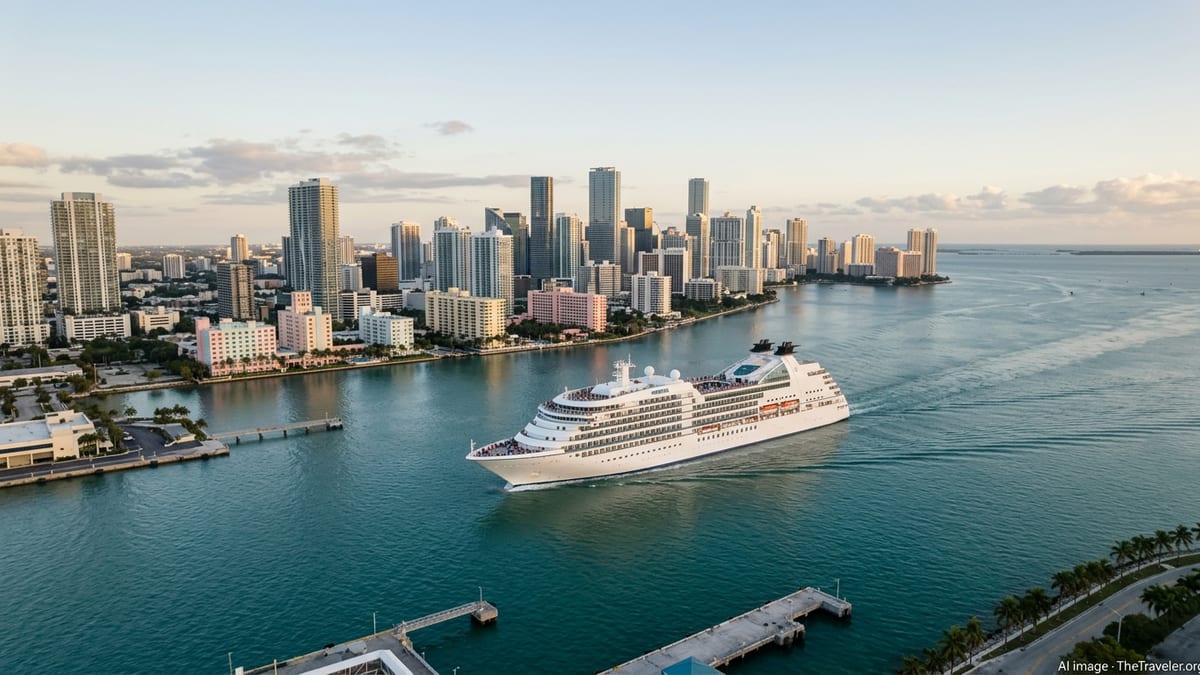
Mammoth 175-Night Voyage Connects Six Continents
Departing Miami on 5 January 2028 and concluding in Piraeus, the port of Athens, on 29 June 2028, Azamara’s latest world cruise will span 175 nights and trace a near-circumnavigation of the globe. The itinerary, already on sale, charts a course through 91 ports in 40 countries across six continents, positioning the sailing among the longest and most geographically diverse voyages currently on the market.
The cruise is scheduled to begin with a run through the Southern Caribbean and the northern coast of South America, calling in Aruba, Curaçao and Colombia before a Panama Canal transit and a pivot down the Pacific coast of Latin America toward Ecuador and Peru. From there, Azamara Onward is expected to cross into the South Pacific, linking remote island nations with heavyweight cruise markets in New Zealand and Australia.
Later segments will carry guests through Southeast Asia and the Indian Ocean, including calls in Indonesia, Malaysia, Sri Lanka, India and the Maldives, before swinging toward Southern Africa and the Atlantic. The final stretch will see the ship weave through West Africa, the Atlantic islands and Western Europe, then into the Adriatic and Eastern Mediterranean before disembarking guests in Athens.
Azamara has promoted the sailing as an immersion-led odyssey, emphasizing extended port calls and frequent overnights that allow passengers to linger in key destinations rather than simply ticking off ports at speed.
Global Tourism Stakeholders Anticipate Economic Ripple Effect
Tourism officials and port operators along the route are positioning the 2028 voyage as both an economic opportunity and a global showcase. With roughly six months of continuous travel and a largely international passenger mix, the cruise is expected to inject fresh spending into smaller ports that rarely feature on traditional world-cruise maps, from Pacific islands to coastal towns in Southern Africa.
Industry analysts note that Azamara’s focus on longer stays and niche ports could disperse visitor spending beyond the usual hotspots. Extended calls in destinations such as Cartagena, Manta, Colombo or lesser-known Mediterranean harbors are likely to benefit local tour operators, independent guides, restaurants and craft businesses that perform best when visitors have time to explore beyond the waterfront.
At the same time, the itinerary’s high-profile calls in gateway cities such as Miami, Lima, Sydney, Singapore, Cape Town and Athens strengthen air and hotel demand before and after the cruise. Travel advisers are already packaging pre- and post-cruise stays in Miami Beach and Athens, positioning the sailing as the centerpiece of a broader long-haul holiday for affluent travelers from North America, Europe and Asia.
The voyage also functions as a roaming advertisement for destinations still rebuilding long-haul markets. Port authorities and tourism boards are expected to leverage the arrival of Azamara Onward for media coverage, trade events and partnership announcements timed to coincide with the world cruise’s visits.
Premium Inclusions Aim at High-Spend, Long-Stay Travelers
Azamara is clearly targeting the upper end of the cruise market with its 2028 world voyage. The line is promoting a package of inclusions it values at more than 37,000 US dollars per stateroom for guests booking the full 175-night journey, bundling airfare credit, a pre-cruise hotel night in Miami, airport and pier transfers, and luggage-shipping reimbursement with onboard benefits.
At sea, guests will receive onboard credits, unlimited basic Wi-Fi, complimentary laundry, and access to exclusive world-cruise events and destination-focused experiences. These add-ons are designed to reduce friction for travelers committing half a year to life at sea, while also encouraging higher onboard spending on specialty dining, premium beverages and bespoke shore excursions.
Travel agents say such inclusions are intended to appeal to retirees, remote-working professionals and repeat cruisers accustomed to ultra-long itineraries. Many of these travelers are considered high-value visitors in port communities, often booking private guides, small-group culinary tours or overnight land programs that inject significantly more money into local economies than mass-market shore excursions.
The world cruise will also be supported by a dedicated World Cruise Desk, giving guests and trade partners a central point of contact for complex arrangements such as multi-country visas, medical planning and logistics for friends or family joining selected segments.
Segmented Itineraries Open Access to More Markets
While the full Miami-to-Athens journey is the headline, Azamara is also carving the cruise into shorter back-to-back segments, allowing guests to join for a few weeks or months at a time. Early promotional materials highlight distinct chapters, from the Caribbean and Pacific coast of South America to a South Pacific crossing, an Australia and New Zealand loop, an Asia and Indian Ocean exploration, and a final stretch linking Southern Africa to the Mediterranean.
This segmentation strategy opens the sailing to a wider demographic of travelers who may not have the time or budget for the entire 175 nights, while still feeding demand into each port of call. Local tourism players in cities such as Sydney, Singapore and Cape Town, where air connectivity is strong, are expected to benefit from fly-in guests embarking or disembarking for individual segments.
For Azamara, selling the cruise in sections provides revenue diversification and reduces reliance on a limited pool of full-world-cruise buyers. It also allows the line to market each regionally themed stretch to different audiences, from culture-focused travelers eyeing Asia and the Mediterranean to wildlife and nature enthusiasts drawn to the South Pacific and Southern Africa.
Travel advisers say they are seeing interest from multigenerational families planning to join relatives onboard for specific legs, as well as from first-time Azamara guests using a segment as a test of the brand’s small-ship style before committing to a full world cruise in future years.
Strategic Move in a Rapidly Expanding World-Cruise Market
The 2028 Miami–Athens itinerary underscores how quickly the world-cruise segment has grown more competitive. In recent years, several major and boutique cruise lines have unveiled longer and more elaborate around-the-world programs, seeking to lock in high-yield guests for months at a time and differentiate themselves in a crowded premium market.
For Azamara, which operates a small fleet of mid-sized ships, the 2028 voyage functions as both a brand statement and a capacity play. By showcasing its destination-immersion credentials on a route that touches remote islands, emerging cruise ports and established classics, the line is positioning itself squarely in the experiential, small-ship niche that has gained traction among seasoned travelers.
Industry observers say the cruise’s performance will be closely watched as a barometer of demand for ultra-long itineraries in the late 2020s. Early booking trends, fueled by strong interest around recent Black Friday and Cyber Monday promotions, suggest that appetite for extensive, slow-travel sea journeys remains robust among well-heeled travelers seeking stability, comfort and depth of experience.
As the 5 January 2028 departure date approaches, ports from Miami to Athens are expected to fine-tune infrastructure and visitor offerings for the arrival of Azamara Onward, with tourism boards leveraging the voyage to signal their own readiness for a new era of long-haul, high-value travel.