

More news on this day
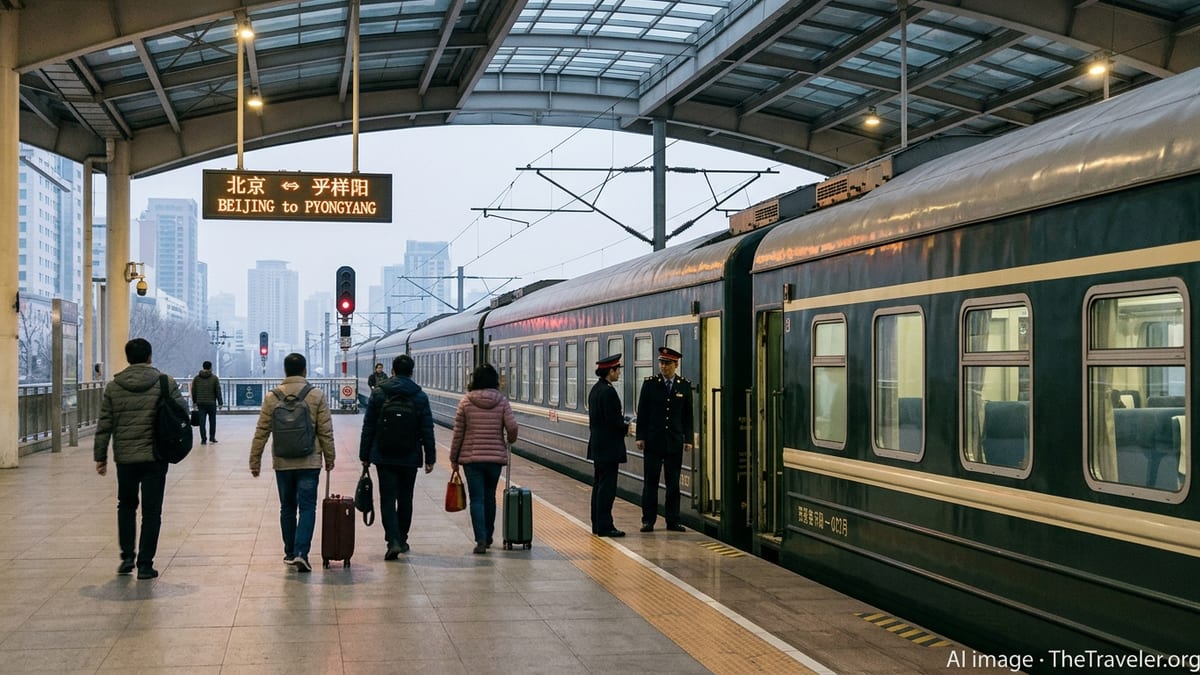
Regular passenger train services between Beijing and Pyongyang have resumed for the first time since the start of the Covid-19 pandemic, restoring an iconic overland route and raising fresh questions about how, and when, international tourists might once again experience one of the world’s most closed destinations by rail.
Get the latest news straight to your inbox!
A Historic Rail Link Comes Back to Life
After a six year suspension linked to pandemic border closures, international passenger trains are once again scheduled to run between the Chinese and North Korean capitals. Reports from Chinese state media and international coverage indicate that services restarted on March 12, 2026, reconnecting Beijing and Pyongyang via the long established K27 and K28 through trains that run via the border city of Dandong.
Publicly available information shows that the Beijing–Pyongyang service now operates four times a week, while a separate Dandong–Pyongyang train runs daily, restoring a pattern similar to pre‑pandemic operations. The journey remains a slow, overnight trip of close to 24 hours, crossing northeastern China before entering North Korea for the final leg to Pyongyang.
The resumption follows months of signals that rail links were gradually edging back to normal, including freight movements and the publication of draft schedules on tourism related websites. The confirmation that passenger services are again accepting travelers marks a new phase in the cautious reopening of North Korea’s borders.
For regional connectivity, the restored trains are more than symbolic. The Beijing–Pyongyang line has historically served officials, business travelers and tour groups, and its return suggests that cross border exchanges are once again being prioritized, even if full scale tourism remains tightly controlled.
What the New Schedule Means for Travelers
According to recent scheduling notices and media reports, trains now depart Beijing for Pyongyang four days a week, typically in the late afternoon or early evening, arriving in the North Korean capital the following day. The return service from Pyongyang mirrors this pattern, also operating on four weekly departures and connecting through Dandong on the Chinese side of the border.
While fine details may shift, the structure of the service resembles pre‑2020 operations, when K27 left Beijing in the early evening and reached Pyongyang the next day, and K28 provided the reverse connection. The bulk of the journey time is spent between Beijing and Dandong on Chinese tracks, with a significantly slower segment between Dandong and Pyongyang reflecting more modest infrastructure on the North Korean side.
Initial reports suggest that only part of each train is currently allocated to passengers, with the remaining cars used for cargo and official traffic. This arrangement allows both countries to rebuild capacity gradually while monitoring demand and managing border health protocols that have remained stringent long after other international routes reopened.
Travelers considering this route should expect limited flexibility compared with other international rail services. Seat and sleeper allocations are finite, changes can be difficult once tickets are issued, and operational decisions in either country can alter schedules at short notice. The line’s history of sudden suspensions underscores the need for contingency planning.
Tourism Access: Opportunities and Ongoing Limits
For many prospective visitors, the key question is whether the reinstated trains translate into broader tourism access to North Korea. Published coverage indicates that, while North Korea began cautiously reopening to foreign visitors in 2024, early steps focused primarily on travelers from Russia and on specific, tightly managed tour programs.
Specialist tour operators that previously organized group trips from Beijing by train are closely watching the developments but remain cautious in their messaging. Public information from several companies suggests they are evaluating when and how to relaunch itineraries using the Beijing–Pyongyang rail link, but offerings for general international tourists are not yet widespread.
Travel advisories from many governments still strongly warn against travel to North Korea, citing security, legal and consular risks. Some countries, including the United States, also maintain restrictions on their citizens visiting North Korea at all, which means the restored train service will likely cater mainly to Chinese nationals, other regional travelers and participants in officially sanctioned tours.
For those who are able and permitted to go, the resumption of the rail link may eventually reopen classic itineraries that combine Beijing city breaks with multi day guided programs in Pyongyang and regional centers such as Kaesong or Wonsan. However, any such trips will continue to operate under strict supervision, fixed schedules and mandatory local guides, as was the case before the pandemic.
Practical Considerations: Tickets, Visas and Onboard Life
Publicly available guidance from Chinese rail channels and past practice indicate that tickets for the Beijing–Pyongyang train are typically not sold through regular online booking platforms. Instead, they are usually arranged via authorized travel agencies or specialist rail offices in China, often bundled together with visas, accommodation and guided itineraries in North Korea.
Most travelers who previously used the route did so as part of an organized tour, with the operator handling paperwork, ticketing and required documentation. Early indications suggest this model is likely to continue. Independent ticket purchases remain difficult, and North Korea does not generally welcome unsupervised foreign visitors, which significantly limits spontaneous rail travel.
Onboard, passengers can expect a traditional overnight experience more akin to classic long distance trains than to modern high speed services elsewhere in China. Accounts from previous years describe standard soft sleeper compartments, samovars or hot water dispensers for instant meals and tea, and limited catering options, particularly on the North Korean segment. Travelers must also be prepared for lengthy border formalities, baggage inspections and restrictions on communications and photography once on North Korean territory.
Connectivity remains minimal along much of the route, especially after crossing the Yalu River. Travelers are generally advised in public guidance to expect no mobile data access in North Korea and to comply with local rules regarding devices, printed materials and recorded media.
How This Changes the Map for Overland Asia Travel
The reopening of passenger rail between Beijing and Pyongyang slots an important missing piece back into the overland map of Northeast Asia. Before 2020, a small but dedicated community of rail enthusiasts and long haul travelers incorporated the Beijing–Pyongyang service into epic trans Eurasian journeys that ran from Europe across Russia or Central Asia into China, then onward to the Korean Peninsula.
With Russia and North Korea also working to restore certain long distance rail links, including routes between Pyongyang and cities in the Russian Far East, the broader network of cross border trains in the region is again slowly expanding after years of contraction. For now, these services remain niche, bureaucratically complex and subject to sudden change, but their return indicates that rail is once again seen as a strategic connector.
From a tourism perspective, the revived Beijing–Pyongyang service is unlikely to produce mass travel in the short term. Instead, it will function as a specialized corridor for a narrow set of travelers willing to navigate significant restrictions and uncertainties in exchange for a rare experience.
For those monitoring the evolution of travel in and around North Korea, however, the resumption of this storied train is a clear signpost. It suggests that, after years of near total isolation, the country is cautiously re engaging with its closest neighbor, and that rail will remain at the heart of that limited reopening for the foreseeable future.